 English

Choosing a ball screwlinear module manufactureris not simply a matter of comparing catalog specifications or unit prices. A linear module is an integrated motion system in which the ball screw, linear guides, bearings, coupling, carriage, motor interface and supporting structure must work together. Even when two products list similar loads, strokes and positioning accuracy, their actual performance may differ significantly because of material quality, machining precision, assembly methods, inspection procedures and engineering support.
A reliable ball screw actuator manufacturer should be able to translate application requirements into a complete motion solution. This includes selecting the correct screw diameter and lead, calculating dynamic loads, verifying allowable moments, matching the motor, controlling backlash and confirming that the module can maintain its accuracy throughout its expected service life.
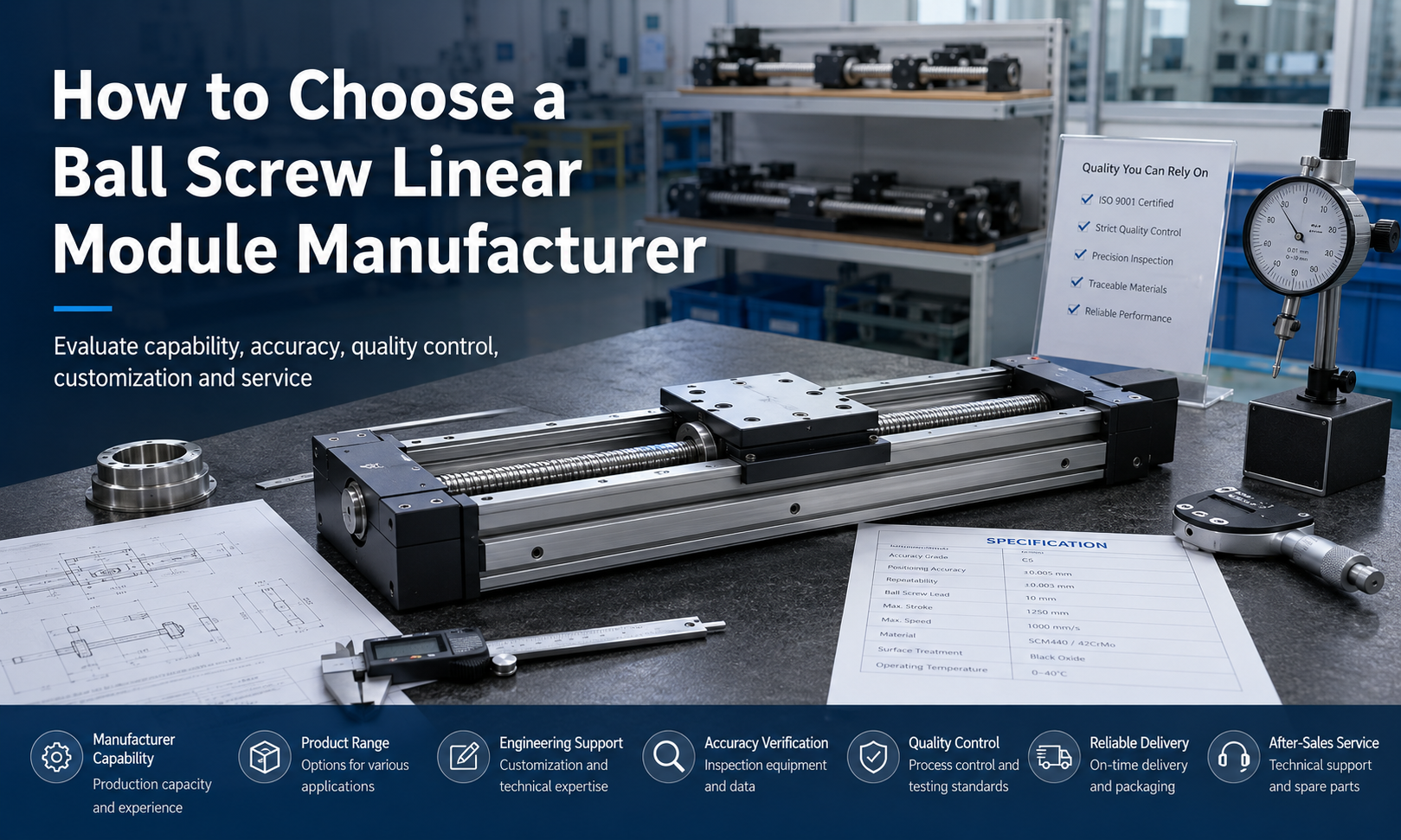
This guide explains how to evaluate a ball screw linear module manufacturer based on manufacturing capability, product range, engineering support, accuracy verification, materials, assembly processes, customization, quality control, certifications, delivery and after-sales service.
Why Manufacturer Selection Matters
Ball screw linear modules are commonly used in precision assembly, semiconductor equipment, vision inspection, dispensing systems, laser processing, machine tending, measuring equipment and multi-axis automation. In these applications, the module directly affects positioning accuracy, repeatability, production cycle time and equipment reliability.
An unsuitable supplier may provide a module that meets the basic dimensional requirements but fails under actual operating conditions. Common consequences include excessive backlash, vibration, abnormal noise, temperature rise, premature bearing wear, screw damage, guide misalignment and unstable positioning accuracy.
A qualified precision linear module supplier should therefore be evaluated as an engineering and manufacturing partner rather than only as a component vendor.
1. Evaluate the Manufacturer’s Production Capabilities
The first step is to determine whether the manufacturer has real production and assembly capabilities. Some suppliers only purchase standard components and outsource most machining and assembly work. This may make it difficult to maintain consistent quality or respond quickly to customized requirements.
A capable manufacturer should have clear control over the main production stages, including:
- Aluminum profile or steel base machining
- Mounting surface milling and grinding
- Ball screw and linear guide installation
- Bearing support assembly
- Carriage and motor mount machining
- Coupling installation and alignment
- Sensor bracket installation
- Lubrication and protective cover assembly
- Positioning and repeatability testing
- No-load and loaded running tests
Ask the manufacturer which processes are completed internally and which are outsourced. Internal control does not automatically guarantee quality, but it generally gives the manufacturer more control over tolerances, schedules, corrective actions and design changes.
Questions to Ask About Manufacturing Capability
- Which components are machined or assembled in-house?
- What equipment is used to machine the module base and mounting surfaces?
- How are screw and guide alignment errors controlled?
- Can the factory handle prototype, small-batch and volume production?
- Is the assembly area separated from heavy machining operations?
- Are torque values and assembly procedures standardized?
2. Review the Product Range
A broad product range indicates that the manufacturer can support different loads, strokes, accuracy levels and installation configurations. However, the number of models alone is not enough. The important question is whether the product families have clear technical boundaries and selection rules.
A professional ball screw linear module manufacturer may offer:
- Compact modules for light-load precision positioning
- Standard industrial modules for general automation
- Wide-body modules for higher moment loads
- Heavy-duty screw-driven modules
- Fully enclosed modules for dust protection
- Cleanroom-compatible modules
- Vertical-axis modules with brake motor options
- Multi-axis XY, XZ and XYZ systems
- Customized modules for special machines
Review whether the manufacturer provides complete technical information for each series, including allowable load, stroke range, screw diameter, lead, maximum speed, positioning accuracy, repeatability, allowable moments, motor compatibility and installation dimensions.
Be cautious when a supplier uses one general specification for many different module sizes. Load, speed and accuracy should be defined for specific configurations rather than presented as universal values.
3. Assess Engineering and Selection Support
The manufacturer should be able to recommend a module based on actual working conditions instead of asking the buyer to choose only from a catalog. Accurate selection requires more than payload and stroke.
A technical team should request information such as:
- Horizontal, vertical or inclined installation
- Moving payload and fixture weight
- Center of gravity position
- External forces and moment loads
- Required stroke and usable travel
- Target speed and acceleration
- Positioning accuracy and repeatability
- Operating cycle and daily running time
- Motor and controller type
- Ambient temperature, dust, moisture and cleanliness
- Expected service life
- Available installation space
The engineering team should then verify the screw dynamic load, guide load, bearing load, critical speed, buckling risk, drive torque and motor capacity. For vertical applications, it should also consider gravity, holding torque, braking requirements and safety against uncontrolled descent.
A reliable supplier should explain why a particular model, screw lead or motor size is recommended. Selection results should be supported by calculations or documented engineering judgment.
4. Verify Positioning Accuracy and Repeatability
Accuracy is one of the most important criteria when selecting aball screw modulesupplier. Positioning accuracy, repeatability, backlash and running parallelism are different parameters and should not be treated as interchangeable.
- Positioning accuracydescribes the difference between the commanded position and the actual position over the travel.
- Repeatabilitydescribes how consistently the carriage returns to the same position.
- Backlashis the lost motion that may occur when the movement direction changes.
- Running parallelismdescribes the relationship between carriage movement and the module reference surface.
Ask the manufacturer how these values are tested and whether the stated specifications apply to every module or only to selected samples.
Recommended Accuracy Verification Methods
Depending on the accuracy class, manufacturers may use laser interferometers, linear encoders, dial indicators, electronic indicators or precision measuring fixtures. The test should cover multiple positions across the effective stroke and include repeated forward and reverse movements.
For applications with strict accuracy requirements, request an inspection report that includes:
- Product model and serial number
- Effective measurement stroke
- Measurement equipment
- Test environment
- Positioning deviation at each point
- Forward and reverse measurement results
- Repeatability data
- Backlash or reversal error
- Inspection date and operator
A verbal statement that a module is “high precision” is not a substitute for measurable data.
5. Examine Material and Component Quality
The performance of a screw-driven stage depends heavily on the quality and compatibility of its components. A low-cost module may look similar externally while using lower-grade screws, guides, bearings, couplings or structural materials.
Ball Screw
Review the screw diameter, lead, accuracy grade, preload, hardness, surface finish and dynamic load rating. The screw should be selected according to speed, thrust, service life and critical speed requirements. A larger screw is not always better because it may increase inertia and motor demand.
Linear Guides
The guide system should have sufficient load and moment capacity. The size, quantity, spacing and preload of the guide blocks affect rigidity and resistance to pitching, yawing and rolling moments.
Support Bearings
Fixed-end and floating-end bearings must be correctly selected and installed. Poor bearing quality or incorrect preload can produce axial play, heat and noise.
Coupling
The coupling should match the motor torque, shaft diameter, operating speed and alignment conditions. An unsuitable coupling may introduce vibration, torsional deformation or premature failure.
Module Base and Carriage
The base must provide sufficient structural rigidity and stable mounting surfaces. Check the material, wall thickness, machining accuracy and surface treatment. The carriage should be strong enough to support the fixture without excessive deformation.
Lubrication and Sealing Components
Lubrication ports, grease distribution and protective seals should be designed for convenient maintenance. In dusty environments, covers, wipers and sealing strips are particularly important.
6. Inspect the Assembly Process
High-quality components cannot compensate for poor assembly. The ball screw axis and linear guide axis must be aligned correctly. If they are forced into position, internal stresses may cause high resistance, vibration, temperature rise and shortened service life.
A controlled assembly process should include:
- Cleaning and inspecting all mounting surfaces
- Checking the base for flatness and damage
- Installing and aligning the linear guides
- Installing fixed and floating bearing supports
- Mounting the ball screw without forced deformation
- Adjusting screw and guide parallelism
- Tightening fasteners according to specified torque
- Installing and aligning the coupling
- Applying the specified lubricant
- Checking full-stroke running resistance
- Performing no-load and loaded motion tests
- Completing final accuracy inspection
Ask whether the manufacturer uses assembly work instructions, torque tools, inspection records and traceable operators. A standardized process is essential for maintaining consistency between different production batches.
7. Evaluate Customization Capability
Many automation projects cannot use a completely standard module. The required stroke, mounting interface, motor position, cable routing, sensor configuration or environmental protection may differ from the catalog design.
A custom ball screw module manufacturer should be able to support modifications such as:
- Custom stroke length
- Different screw leads
- Alternative motor brands and sizes
- Left, right, top or bottom motor mounting
- Folded motor configurations
- Customized carriage plates
- Special mounting holes
- Additional sensor positions
- Drag chain and cable management
- Protective covers or bellows
- Cleanroom-compatible materials and lubricants
- Corrosion-resistant surface treatments
- Multi-axis system integration
Customization should be managed through controlled drawings and technical confirmation. Before production, both parties should confirm dimensions, load direction, motor interface, sensor type, cable outlet, accuracy requirement and acceptance criteria.
A manufacturer that agrees to every customization request without discussing engineering risks may not be providing responsible support.
8. Review Quality Control Procedures
Quality control should cover incoming materials, machining, assembly, testing, packaging and shipment. Final inspection alone may not detect problems caused by incorrect components or unstable processes.
Incoming Inspection
The manufacturer should check important purchased parts such as ball screws, guide rails, bearings, couplings, motors and sensors. Inspection may include model verification, dimensions, appearance, certificates and supplier batch records.
Process Inspection
Critical dimensions and assembly stages should be checked before the product moves to the next operation. This may include mounting surface accuracy, guide parallelism, screw alignment, tightening torque and running resistance.
Final Inspection
A complete final inspection can include:
- Dimensions and mounting interfaces
- Effective stroke
- Running smoothness
- Abnormal noise and vibration
- Sensor operation
- Motor direction
- Positioning accuracy
- Repeatability
- Backlash
- No-load current
- Loaded operating test
- Appearance and labeling
Ask whether inspection results are recorded and whether the records can be traced to the product serial number.
9. Check Certifications and Management Systems
Certifications do not guarantee that every product is suitable for every application, but they can show whether the manufacturer has established documented management processes.
Depending on the market and application, relevant documents may include:
- Quality management system certification
- Environmental management certification
- Product conformity declarations
- Material compliance documents
- Electrical component certifications
- Calibration certificates for measuring equipment
- Factory inspection or audit reports
Verify that certificates are valid, issued to the actual manufacturing company and relevant to the products being supplied. A certificate from a trading company or unrelated affiliate does not necessarily cover the factory producing the modules.
10. Evaluate Delivery and Production Capacity
Delivery capability involves more than the quoted lead time. The supplier should have the materials, personnel, production planning and testing capacity required to complete the order consistently.
Discuss the following points before placing an order:
- Standard model lead time
- Customized model lead time
- Prototype production schedule
- Monthly production capacity
- Availability of critical components
- Handling of urgent orders
- Packaging method
- Export documentation
- Spare-parts availability
For volume projects, consider beginning with samples or a pilot batch. Verify the dimensions, performance, documentation and packaging before approving full production.
11. Assess After-Sales Service
Ball screw linear modules may require installation support, parameter adjustment, lubrication guidance, spare parts or fault diagnosis after delivery. The supplier should have a clear service process rather than relying on informal communication.
Evaluate whether the manufacturer can provide:
- Installation manuals and drawings
- Motor and controller connection guidance
- Commissioning support
- Lubrication instructions
- Maintenance schedules
- Troubleshooting support
- Replacement screws, guides, bearings and couplings
- Warranty terms
- Failure analysis
- Repair or refurbishment services
Ask how technical problems are reported, who handles them and what information is required. A professional supplier should request product identification, operating conditions, alarm information, photos, videos and measurement data before recommending corrective action.
12. Compare Total Value Instead of Unit Price
The lowest purchase price may not result in the lowest operating cost. When comparing manufacturers, consider the complete cost of ownership.
| Evaluation Item | Possible Long-Term Impact |
|---|---|
| Selection accuracy | Avoids oversized motors, insufficient load capacity and premature wear |
| Positioning performance | Reduces rejected products and repeated calibration |
| Component quality | Extends service life and reduces replacement frequency |
| Assembly consistency | Improves stability across multiple machines |
| Documentation | Simplifies installation, maintenance and spare-parts management |
| Delivery reliability | Reduces project delays and production interruptions |
| After-sales support | Shortens troubleshooting and equipment downtime |
A higher-quality module may provide better value if it reduces commissioning time, maintenance frequency, production losses and replacement costs.
Supplier Evaluation Checklist
| Category | What to Verify |
|---|---|
| Manufacturing | Machining equipment, assembly capability and internal process control |
| Product Range | Available sizes, loads, strokes, accuracy classes and configurations |
| Engineering | Load calculations, screw selection, motor sizing and application review |
| Accuracy | Test method, inspection equipment and product-specific reports |
| Materials | Ball screw, guide, bearing, coupling and structural component quality |
| Assembly | Alignment, torque control, lubrication and running tests |
| Customization | Drawing capability, special interfaces, motor options and multi-axis design |
| Quality Control | Incoming, process and final inspection records |
| Certifications | Valid and relevant quality, environmental and conformity documents |
| Delivery | Lead time, capacity, component availability and packaging |
| Service | Technical response, warranty, spare parts and failure analysis |
Warning Signs When Choosing a Supplier
Consider further verification when a supplier shows one or more of the following warning signs:
- Specifications are incomplete or inconsistent
- Accuracy claims are not supported by test methods
- The supplier recommends a model without collecting application data
- Load and moment capacities are not clearly distinguished
- Component brands or grades change without notice
- Customized products are produced without approved drawings
- No serial number or inspection record is provided
- Warranty terms are unclear
- Spare parts are unavailable
- Technical questions receive only sales-oriented answers
Frequently Asked Questions
What information should I provide to a ball screw module manufacturer?
Provide the payload, stroke, speed, acceleration, installation direction, center of gravity, positioning accuracy, repeatability, operating cycle, motor preference, environmental conditions and available installation space. Drawings or application diagrams can improve selection accuracy.
Should I choose a standard or customized ball screw module?
A standard model is usually preferable when it meets the load, stroke, accuracy and installation requirements. Customization is appropriate when the application requires special dimensions, motor arrangements, protection, sensors, mounting interfaces or multi-axis integration.
How can I confirm the manufacturer’s accuracy claims?
Ask for the test method, measuring equipment, acceptance criteria and product-specific inspection report. For critical applications, a sample module can be tested under representative operating conditions before volume purchasing.
Is a factory always better than a trading company?
Not necessarily. The important factors are technical competence, quality control, traceability and service responsibility. However, direct access to the actual manufacturer can make customization, problem solving and process verification easier.
Can an OEM ball screw linear module manufacturer use my motor and controller?
Many manufacturers can adapt the motor mount, coupling, sensor configuration and cable arrangement to specified motor and controller systems. The shaft size, flange dimensions, rated torque, maximum speed, brake option and connector direction should be confirmed before production.
Conclusion
Selecting a ball screw linear module manufacturer requires a structured evaluation of technical, manufacturing and service capabilities. Do not rely only on catalog accuracy, product appearance or price. Verify how the supplier selects components, controls machining and assembly, measures positioning performance, manages customization and supports the product after delivery.
The most suitable manufacturer is one that understands the application, provides transparent technical data, confirms performance through inspection and maintains consistent quality from prototype to volume production. A careful supplier evaluation can reduce equipment risks, shorten commissioning time and improve the long-term reliability of the complete automation system.