 English

Ball screw linear modules are widely used in precision automation because they combine accurate positioning, high thrust, smooth movement and reliable mechanical transmission. However, selecting and using a ball screw module correctly requires more than checking its stroke and payload.
Users often have questions about maximum load, operating speed, positioning accuracy, backlash, lubrication, vertical installation, motor sizing and service life. The answers depend on the module structure, ball screw specification, guide rail capacity, installation orientation, motion profile and operating environment.
This FAQ explains the most common technical questions about ball screw linear modules and provides practical guidance for selection, installation and maintenance.
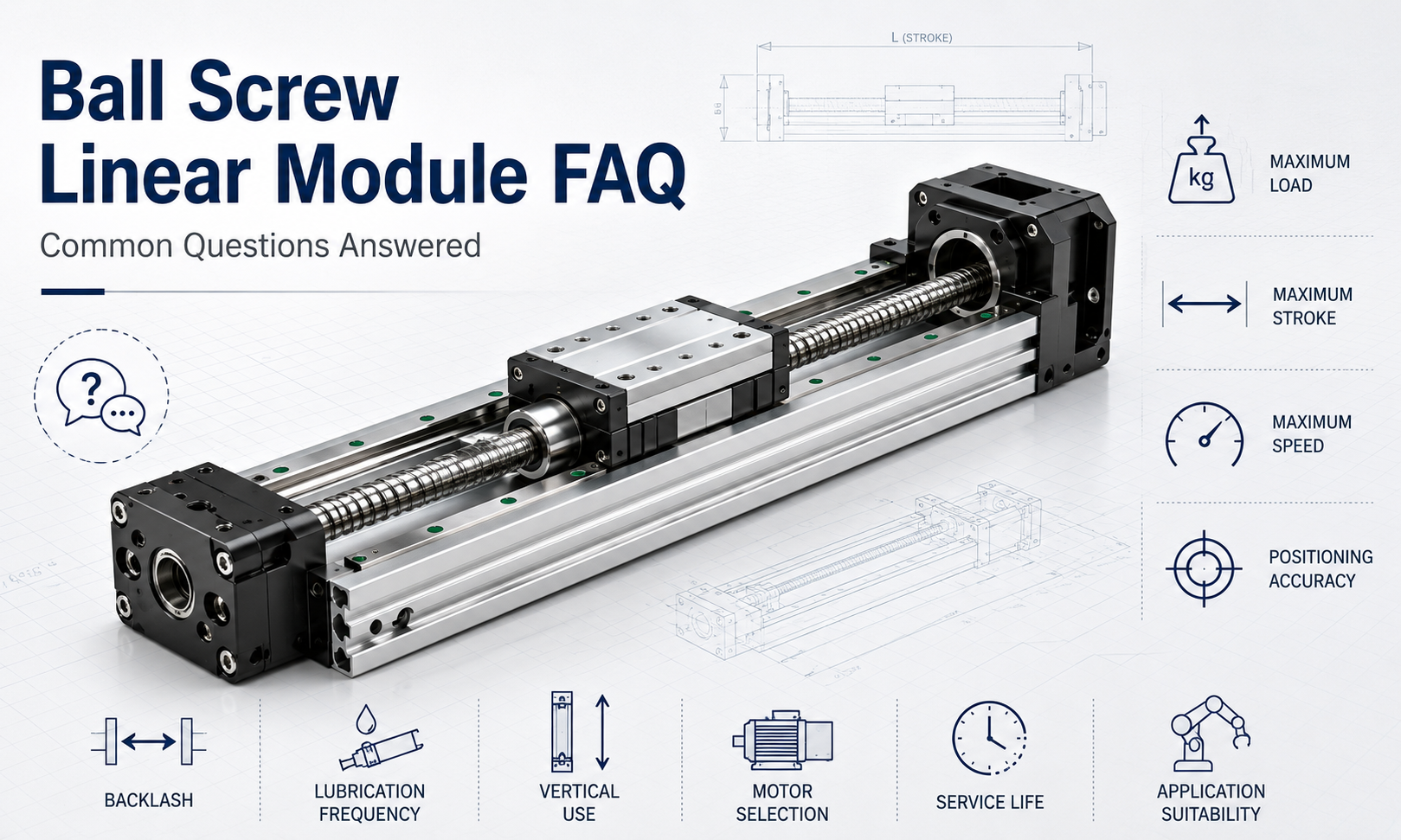
1. What Is a Ball Screw Linear Module?
Aball screw linear moduleis a mechanical positioning unit that converts motor rotation into linear movement. The motor drives a ball screw through a coupling or timing transmission. As the screw rotates, the ball nut and carriage move along the linear guide rail.
A typical ball screw linear module includes:
- An aluminum or steel base
- A precision ball screw and ball nut
- One or more linear guide rails
- A moving carriage
- Fixed-side and support-side bearings
- A motor mount and coupling
- Limit sensors and origin sensors
- A protective cover or sealing structure
Compared with belt-driven modules, ball screw modules generally provide higher positioning accuracy, higher axial rigidity and better low-speed stability. They are commonly used for precision assembly, dispensing, inspection, machining, semiconductor equipment and automated material handling.
2. What Is the Maximum Load of a Ball Screw Linear Module?
There is no single maximum load that applies to every ball screw module. Load capacity depends on the ball screw diameter, screw lead, guide rail size, carriage length, bearing arrangement, installation orientation and operating speed.
Three different load limits should normally be evaluated:
- Axial thrust capacity:the maximum force the ball screw and support bearings can transmit along the direction of movement.
- Guide rail load capacity:the vertical, horizontal and lateral load that the linear guides can support.
- Allowable moment:the resistance of the carriage to pitch, yaw and roll moments caused by an offset load.
A module carrying a centered load on a horizontal surface can usually support more weight than the same module installed vertically or carrying an overhanging load. During acceleration and deceleration, the module must also overcome inertia force.
The approximate acceleration force can be calculated as:
F = m × a
Where:
- Fis the acceleration force in newtons
- mis the moving mass in kilograms
- ais the acceleration in meters per second squared
For vertical applications, gravity must also be included:
F = m × (g + a)
A safety factor should be applied instead of operating continuously at the theoretical maximum rating. The required safety factor depends on shock, vibration, duty cycle, load uncertainty and the consequences of failure.
3. What Is the Maximum Stroke of a Ball Screw Module?
The maximum stroke is limited by the screw length, screw diameter, support arrangement, rotational speed and installation method. As a ball screw becomes longer, it becomes more sensitive to bending, vibration and critical-speed limitations.
When the screw rotational speed approaches its critical speed, the screw can begin to whip or vibrate. This may cause abnormal noise, reduced accuracy, bearing damage and premature screw failure.
Longer strokes may require:
- A larger screw diameter
- A lower screw rotational speed
- A smaller screw lead combined with appropriate motor speed
- Improved screw support
- A rotating-nut structure
- A different transmission system, such as a timing belt or gear rack
Ball screw modules are generally most suitable for short- to medium-stroke precision motion. For very long travel distances, belt-driven or gear-rack modules may provide a more practical solution.
4. How Fast Can a Ball Screw Linear Module Move?
The maximum linear speed is determined mainly by the motor speed, screw lead and transmission ratio.
The theoretical linear speed can be calculated as:
Linear speed = motor speed × screw lead ÷ transmission ratio
For example, if a motor rotates at 3,000 revolutions per minute and drives a ball screw with a 10 mm lead at a 1:1 ratio:
Linear speed = 3,000 × 10 = 30,000 mm/min
This equals 500 mm/s.
However, the theoretical value is not always the safe operating speed. The actual maximum speed may be limited by:
- Ball screw critical speed
- Ball circulation speed
- Support bearing rating
- Coupling speed
- Motor torque at high speed
- Carriage load
- Acceleration distance
- Lubrication condition
- Required positioning stability
A larger screw lead can increase linear speed at the same motor speed, but it may reduce mechanical advantage and increase the required motor torque. Speed selection should therefore be evaluated together with load, acceleration and accuracy.
5. How Accurate Is a Ball Screw Linear Module?
Ball screw modules can provide high positioning accuracy, but actual system accuracy depends on more than the screw accuracy grade.
Important accuracy factors include:
- Ball screw lead accuracy
- Axial backlash
- Ball screw preload
- Guide rail straightness and parallelism
- Support bearing rigidity
- Coupling torsional stiffness
- Motor encoder resolution
- Controller tuning
- Thermal expansion
- Installation surface flatness
- External load and moment
Positioning accuracy and repeatability should not be treated as the same specification.
| Specification | Meaning |
|---|---|
| Positioning accuracy | The difference between the commanded position and the actual reached position across the working stroke. |
| Repeatability | The ability to return to the same position repeatedly under the same operating conditions. |
| Resolution | The smallest theoretical movement that the motor, encoder and control system can command. |
A module may have excellent repeatability but still show accumulated positioning error over a long stroke. Applications requiring absolute dimensional accuracy may need laser calibration, scale feedback or software compensation.
6. Does a Ball Screw Linear Module Have Backlash?
Ball screw transmission normally has much lower backlash than conventional lead screw transmission. However, it should not automatically be considered completely backlash-free.
Backlash can come from several sources:
- Clearance between the ball screw and ball nut
- Insufficient nut preload
- Support bearing clearance
- Flexible coupling deformation
- Loose mounting bolts
- Wear in the screw, nut or bearing system
- Controller or servo tuning errors
Preloaded ball nuts reduce axial clearance by applying an internal preload between the balls and raceways. This improves rigidity and reversing accuracy, but excessive preload increases friction, heat generation and drive torque.
When a module develops increasing backlash during service, the complete transmission chain should be inspected rather than replacing the ball screw immediately.
7. How Often Should a Ball Screw Module Be Lubricated?
There is no universal lubrication interval. Lubrication frequency depends on operating speed, load, stroke, duty cycle, environmental contamination and lubricant type.
Modules operating in clean, low-duty environments may require lubrication only at relatively long intervals. Modules running continuously at high speed or in dusty environments may need much more frequent inspection and replenishment.
The following conditions usually require shorter lubrication intervals:
- High-speed reciprocating movement
- Heavy axial load
- Short-stroke repeated movement
- High operating temperature
- Dust, chips or abrasive particles
- Washdown or moisture exposure
- Vertical installation
- Continuous multi-shift operation
Both the ball screw and linear guide rails must be lubricated. Lubricating only the screw while ignoring the guides can lead to uneven wear, increased resistance and positioning instability.
Over-lubrication should also be avoided. Excess grease can increase drag, collect contamination, generate heat and leak into surrounding equipment. The lubricant should be compatible with the module materials, seals, speed and working temperature.
8. Can a Ball Screw Linear Module Be Installed Vertically?
Yes. Ball screw linear modules can operate vertically, but vertical use requires additional design considerations.
The motor must generate enough torque to lift the load while overcoming friction and acceleration force. It must also control the descending load safely during deceleration and stopping.
Important vertical-axis considerations include:
- Payload and carriage weight
- Required lifting acceleration
- Motor holding torque
- Brake motor selection
- Ball screw lead
- Counterbalance requirements
- Emergency stop behavior
- Power-loss protection
- Allowable bearing and screw thrust
A motor brake is often recommended for vertical axes. The brake prevents the carriage from falling when the servo is disabled or electrical power is lost. The brake is normally intended for holding rather than repeated dynamic stopping.
In heavier vertical systems, a counterweight, gas spring, pneumatic balance cylinder or mechanical locking device may be used to reduce motor load and improve safety.
9. How Do I Select a Motor for a Ball Screw Linear Module?
Motor selection should be based on torque, speed, inertia, acceleration and control requirements. Selecting a motor only by its rated power can result in poor performance.
The calculation should consider:
- Moving payload
- Carriage and tooling mass
- Horizontal or vertical installation
- Ball screw lead
- Transmission efficiency
- Required maximum speed
- Acceleration and deceleration time
- External process force
- Duty cycle
- Reflected inertia
- Safety factor
A smaller screw lead produces more linear thrust for a given motor torque but requires a higher motor speed to achieve the same linear velocity. A larger lead increases travel per revolution but may require more torque and provide less resistance to vertical back-driving.
Servo motors are commonly used when the application requires high acceleration, programmable positioning, closed-loop control and accurate speed regulation. Stepper motors may be suitable for lower-speed, lower-cost systems where the load and acceleration are predictable.
The motor inertia and reflected load inertia should remain within an acceptable ratio for stable servo tuning. The coupling, bearing and motor speed limits must also be checked.
10. How Long Does a Ball Screw Linear Module Last?
Ball screw module life is normally determined by the fatigue life of the ball screw, linear guide rails and support bearings. Actual service life may also be limited by lubrication failure, contamination, incorrect alignment or accidental overload.
Factors that influence service life include:
- Average and peak load
- Acceleration and deceleration
- Travel distance per cycle
- Operating frequency
- Ball screw speed
- Guide rail moment load
- Lubrication quality
- Contamination control
- Installation alignment
- Shock and vibration
- Operating temperature
Fatigue life is not the same as calendar life. A lightly loaded module running occasionally may remain operational for many years. A heavily loaded module operating continuously may reach its rated travel life much sooner.
Service life can be extended by:
- Selecting the module with an adequate safety margin
- Avoiding continuous operation near the maximum load
- Controlling acceleration and impact
- Maintaining correct lubrication
- Preventing dust and chips from entering the module
- Checking coupling and mounting bolts regularly
- Keeping the installation base flat and aligned
- Monitoring noise, temperature and positioning accuracy
11. Can a Ball Screw Module Be Used in Dusty or Wet Environments?
Standard ball screw modules are usually designed for clean industrial environments. Dust, metal chips, coolant, moisture and corrosive chemicals can enter the module and damage the ball screw, guide rails, bearings and sensors.
For harsh environments, possible protective measures include:
- Fully enclosed module structures
- Steel strip covers or bellows
- Positive-pressure air purging
- Special seals and scrapers
- Corrosion-resistant materials
- Protective surface treatments
- Environment-compatible grease
- Remote-mounted sensors and cables
The protection level should be selected according to the actual contaminant type. A cover that blocks large particles may not prevent fine dust, liquid mist or corrosive vapor from entering the mechanism.
12. Are Ball Screw Modules Suitable for Short-Stroke Reciprocating Motion?
Yes, but repeated short-stroke movement can create lubrication problems. When the carriage moves only a small distance, the balls may not distribute lubricant evenly across the full raceway.
This can lead to local lubricant depletion, wear marks and premature fatigue. For very short repeated strokes, the maintenance plan may need:
- More frequent lubrication
- Occasional full-stroke movement
- Special lubricant selection
- Reduced acceleration
- Careful preload selection
The operating pattern should be disclosed during module selection because a short, high-frequency cycle can be more demanding than an occasional full-stroke movement.
13. Can a Ball Screw Module Be Back-Driven?
Many ball screws can be back-driven because of their high transmission efficiency. An external axial force can cause the ball nut to move and rotate the screw.
Back-driving is especially important in vertical applications. A suspended load may descend when motor torque is removed. Whether back-driving occurs depends on the screw lead, friction, preload, load and drivetrain configuration.
A motor brake, mechanical lock or counterbalance should be considered whenever uncontrolled movement could create a safety risk.
14. Why Does a Ball Screw Module Produce Abnormal Noise?
Abnormal noise may be caused by:
- Insufficient or contaminated lubricant
- Misalignment between the motor and screw
- Damaged support bearings
- Loose coupling or fasteners
- Ball screw contamination
- Excessive operating speed
- Screw vibration near critical speed
- Guide rail damage
- Incorrect preload
The module should be stopped and inspected if noise increases suddenly, especially when accompanied by vibration, rising temperature or reduced positioning accuracy.
15. When Should a Ball Screw or Ball Nut Be Replaced?
Replacement may be required when the module shows persistent mechanical symptoms that cannot be corrected through lubrication, alignment or fastening adjustments.
Typical replacement indicators include:
- Backlash exceeding the application tolerance
- Visible damage to the screw raceway
- Pitting, flaking or corrosion
- Abnormal roughness during manual movement
- Repeated positioning errors
- Excessive heat generation
- Metal particles in the lubricant
- Damage to the ball circulation system
The support bearings, coupling and guide rails should be inspected at the same time because similar symptoms can originate from other components.
16. What Applications Are Ball Screw Linear Modules Best Suited For?
Ball screw modules are especially suitable for applications requiring accurate positioning, high thrust, controlled low-speed motion and good repeatability.
Typical applications include:
- Precision dispensing and gluing
- Electronic component assembly
- Vision inspection systems
- Semiconductor processing equipment
- Laser focusing and positioning
- Testing and measurement equipment
- Machine-tool loading systems
- Screwdriving and press-fitting stations
- Medical automation equipment
- Multi-axis Cartesian positioning systems
A ball screw module may not be the best choice when the application requires extremely long travel, exceptionally high speed, minimal maintenance or exposure to severe contamination. In these situations, a timing belt, gear rack, linear motor orelectric cylindermay be more appropriate.
17. What Information Is Needed to Select the Correct Module?
To select a ball screw linear module accurately, provide complete application information rather than only the payload and stroke.
| Selection Item | Required Information |
|---|---|
| Load | Payload, tooling weight, carriage-mounted components and external process force |
| Stroke | Effective travel, safety allowance and total installation space |
| Motion | Maximum speed, acceleration, deceleration and cycle time |
| Accuracy | Positioning accuracy, repeatability and resolution requirements |
| Installation | Horizontal, vertical, wall-mounted or inverted orientation |
| Load position | Center of gravity, overhang distance and moment direction |
| Environment | Dust, moisture, cleanroom level, temperature and chemicals |
| Operation | Daily operating hours, cycles per minute and expected service life |
| Motor | Servo or stepper type, voltage, brake, encoder and controller |
Conclusion
Ball screw linear modules provide a reliable solution for precision linear motion, but their performance depends on correct sizing, installation and maintenance. Maximum load, speed and stroke must be evaluated together with accuracy, moment load, screw critical speed, motor torque and operating environment.
For vertical axes, special attention should be given to braking, back-driving and power-loss protection. For high-duty applications, proper lubrication and contamination control are essential for maintaining accuracy and extending service life.
Providing complete operating data before selection helps ensure that the ball screw module, motor and control system are properly matched to the application.