 English

A ball screw linear module is a precision motion system that converts the rotary motion of a motor into controlled linear movement. By combining a ball screw, ball nut, linear guide, carriage, support bearings and motor connection components within an integrated structure, it provides accurate, rigid and repeatable linear positioning for industrial automation equipment.
The main ball screw linear module features include high positioning accuracy, high repeatability, high structural rigidity, strong thrust capacity, smooth motion, low backlash, compact construction and compatibility with servo motors. These characteristics makeball screw modulesparticularly suitable for applications that require controlled positioning, stable load handling and reliable repetitive motion.
However, the actual performance of a ball screw linear module depends on more than the screw itself. Screw accuracy grade, preload, guide rail precision, bearing arrangement, frame rigidity, motor sizing, assembly quality and control-system tuning all influence the final motion performance.
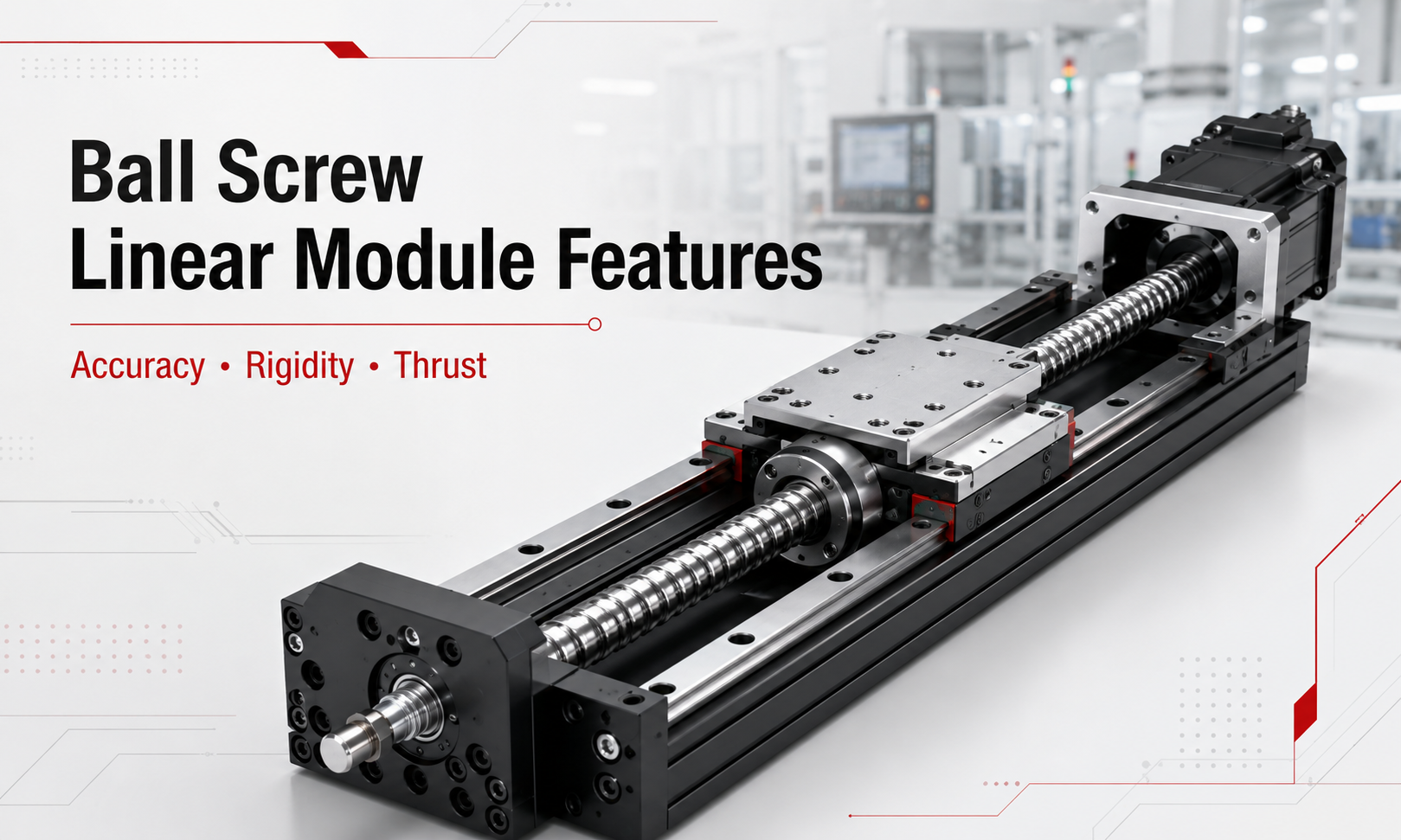
Key Features of a Ball Screw Linear Module
| Feature | Main Benefit | Typical Application Value |
|---|---|---|
| High positioning accuracy | Moves the carriage to a commanded position with limited deviation | Precision assembly, inspection and machining |
| High repeatability | Returns consistently to the same position during repeated cycles | Pick-and-place, dispensing and automated testing |
| High rigidity | Resists deformation under external loads and moments | Machining, pressing and tool-carrying axes |
| High thrust | Generates strong linear force with efficient power transmission | Vertical lifting, clamping and heavy workpiece transfer |
| Smooth motion | Reduces friction and supports stable low-speed movement | Vision inspection, scanning and precision feeding |
| Low backlash | Improves bidirectional positioning and reversal accuracy | Contour motion and frequent forward-reverse cycles |
| Compact structure | Integrates drive and guidance components into one axis | Machines with limited installation space |
| Servo compatibility | Supports closed-loop position, speed and torque control | Programmable automation and synchronized multi-axis systems |
1. High Positioning Accuracy
High positioning accuracy is one of the most important characteristics of a precision ball screw module. Positioning accuracy describes how closely the actual carriage position matches the target position commanded by themotion controller.
The helical raceway of a ball screw is manufactured with controlled lead accuracy. As the screw rotates, the ball nut moves along the screw according to the specified lead. Because the rolling elements reduce sliding friction, the transmission system can produce controlled and predictable linear displacement.
The final positioning accuracy of the module is affected by several factors:
- Ball screw lead accuracy and manufacturing grade
- Ball screw lead error over the effective stroke
- Axial clearance or preload inside the ball nut
- Fixed-end bearing accuracy and preload
- Linear guide straightness and parallelism
- Coupling alignment and torsional stiffness
- Base profile rigidity and mounting flatness
- Servo encoder resolution and control parameters
- Thermal expansion caused by operating temperature
A high-precision screw alone does not guarantee a high-accuracy linear axis. The screw, guide, bearings, carriage and frame must be assembled and aligned as a complete mechanical system. In demanding applications, laser measurement, error mapping or controller-based compensation may be used to reduce systematic positioning errors.
2. High Repeatability
Repeatability refers to the ability of the carriage to return to the same commanded position during multiple motion cycles under the same conditions. It is especially important in automation systems that perform the same operation hundreds or thousands of times.
A ball screw linear module can provide high repeatability because the recirculating balls create a stable rolling contact between the screw shaft and ball nut. When the ball nut is properly preloaded and the support bearings are correctly adjusted, axial movement during direction changes can be minimized.
High repeatability benefits applications such as:
- Electronic component assembly
- Automatic screw fastening
- Adhesive and sealant dispensing
- Vision-camera positioning
- Laser marking and inspection
- Laboratory automation
- Workpiece loading and unloading
Repeatability and positioning accuracy are related, but they are not identical. A module may return to the same position consistently while still having a systematic offset from the commanded coordinate. Therefore, both values should be evaluated when selecting a ball screw actuator.
3. High Structural Rigidity
Rigidity describes the ability of the module to resist deformation when it is subjected to axial forces, radial loads, overhung loads or moment loads. A rigid screw-driven linear stage maintains more stable alignment between the carriage, tool and workpiece.
The rigidity of a ball screw linear module comes from the combined design of several components:
- A rigid aluminum or steel base profile
- One or more precision linear guide rails
- Preloaded guide blocks
- A ball screw with suitable shaft diameter
- Preloaded angular-contact support bearings
- A wide carriage with adequate mounting area
- Short and properly supported load overhangs
High rigidity helps reduce deflection, vibration and positioning variation under changing loads. It is particularly valuable in drilling, milling assistance, pressing, inspection, precision assembly and other applications where the axis carries a process force rather than merely transporting a lightweight component.
The rated payload alone does not fully describe module rigidity. Engineers should also evaluate permissible pitch, yaw and roll moments, load-center distance, carriage length and mounting orientation.
4. High Thrust Capacity
Ball screws are efficient mechanical transmission components that can convert motor torque into substantial axial thrust. This allows a ball screw actuator to move heavier loads or overcome higher process forces than many compact belt-driven systems of a similar size.
The theoretical relationship between motor torque and linear thrust can be expressed as:
F = 2πT / L
Where:
- Fis the theoretical linear thrust
- oris the transmission efficiency
- Tis the input torque
- Lis the ball screw lead
A smaller screw lead generally produces more thrust for the same motor torque, while a larger lead produces more linear travel per revolution. The selected lead therefore influences thrust, speed, motor speed requirements and positioning resolution.
Actual usable thrust must account for acceleration force, friction, gravity, external process loads, screw buckling, critical speed, bearing capacity, motor torque curves and an appropriate safety factor.
5. Smooth and Stable Motion
The recirculating balls inside the nut roll between the screw and nut raceways. This rolling contact creates significantly less friction than a conventional sliding screw. As a result, a ball screw linear module can provide smooth movement, efficient power transmission and stable motion at controlled speeds.
Smooth motion is especially beneficial in applications involving:
- Slow-speed inspection
- Camera scanning
- Precision dispensing
- Sensor calibration
- Optical positioning
- Controlled feeding
Motion quality is also influenced by lubrication, screw straightness, guide alignment, coupling concentricity, motor tuning and load distribution. Incorrect lubrication or misalignment can increase noise, vibration and torque variation even when high-quality components are used.
6. Low Backlash
Backlash is the lost motion that may occur when the direction of travel changes. Excessive backlash reduces bidirectional positioning accuracy and can create inconsistent results during frequent forward and reverse movements.
Precision ball screw modules commonly use preloaded ball nuts to reduce axial clearance. Preload maintains contact between the balls and raceways, improving reversal response and increasing axial rigidity.
Low backlash is important for:
- Bidirectional positioning
- High-frequency reciprocating motion
- Contour and interpolation movement
- Precision tool positioning
- Automated measurement systems
Higher preload is not always better. Excessive preload can increase operating torque, heat generation and wear. The preload level should match the required accuracy, service life, speed and load conditions.
7. Compact Integrated Structure
A ball screw linear module combines the drive mechanism, guiding mechanism, carriage and support structure into a single linear-motion unit. Compared with designing and assembling separate screws, rails, bearing blocks and mounting plates, an integrated module can reduce engineering and installation work.
The compact structure provides several practical advantages:
- Reduced machine footprint
- Simplified mechanical design
- Faster installation and commissioning
- More consistent component alignment
- Easier integration into multi-axis systems
- Convenient motor and sensor mounting
Depending on the operating environment, the module may also include a protective cover, steel strip, bellows or enclosed profile to reduce the entry of dust and debris.
8. Servo Motor Compatibility
Ball screwlinear modulesare commonly driven by AC servo motors because servo systems provide closed-loop control of position, speed and torque. An encoder continuously reports motor position to the drive, allowing the controller to correct motion errors and follow programmed motion profiles.
A servo-driven ball screw module can support:
- Programmable positioning
- Acceleration and deceleration control
- Variable-speed operation
- Torque monitoring
- Electronic camming
- Multi-axis interpolation
- Synchronized gantry motion
- Automatic homing and limit protection
Stepper motors can also be used for simpler or lower-cost applications. However, servo motors are generally preferred when the application requires higher dynamic response, load disturbance correction, torque feedback or reliable high-speed operation.
9. Efficient Power Transmission
The rolling-contact design of a ball screw provides high mechanical efficiency. Less input power is lost as friction compared with many sliding screw mechanisms, which helps reduce motor torque requirements and improves motion responsiveness.
High transmission efficiency can contribute to:
- Lower motor power requirements
- Reduced heat from mechanical friction
- Faster acceleration response
- Improved energy utilization
- More predictable thrust output
Because ball screws are mechanically reversible, a vertical axis may move downward under gravity when motor torque is removed. Vertical installations may therefore require a motor brake, counterbalance, safety brake or other load-holding mechanism.
10. Suitable for Multi-Axis Automation
Ball screw modules can be combined into XY, XZ, XYZ and gantry configurations. Their integrated construction, predictable travel and servo compatibility make them suitable for building programmable Cartesian motion systems.
Typical configurations include:
- XY platform:planar positioning, inspection and dispensing
- XZ system:transfer, loading and vertical handling
- XYZ Cartesian robot:three-dimensional pick-and-place and assembly
- Gantry system:large work-area positioning and synchronized motion
When modules are stacked, the lower axis must carry the mass and dynamic forces of the upper axes. The complete system should therefore be checked for payload, moment load, acceleration, structural deflection and motor capacity.
Performance Factors That Influence Ball Screw Module Features
Ball Screw Accuracy Grade
The screw accuracy grade affects lead error and positioning performance over the full stroke. Ground ball screws are commonly selected for higher-precision systems, while precision-rolled ball screws may provide a suitable balance between performance and cost for general automation.
Ball Screw Lead
The lead determines the linear distance traveled during one screw revolution. A smaller lead generally supports higher thrust and finer mechanical movement, while a larger lead supports higher linear speed at the same motor speed.
Screw Diameter and Unsupported Length
Screw diameter and effective length influence axial stiffness, buckling resistance and critical rotational speed. Long-stroke axes require careful evaluation because increasing screw speed can create vibration or screw whip.
Ball Nut Preload
Preload reduces axial clearance and improves rigidity, but it also increases friction and heat. The selected preload should balance precision, operating torque, speed and service life.
Linear Guide Arrangement
The number, size and spacing of guide rails and guide blocks influence radial load capacity and permissible moment loads. Wider rail spacing and longer carriages generally improve moment resistance.
Support Bearing Arrangement
The fixed end normally uses preloaded angular-contact bearings to control axial and radial movement. The opposite end may use a floating support that accommodates thermal expansion while stabilizing the screw shaft.
Base and Mounting Rigidity
Even a high-rigidity module can deform when installed on an uneven or flexible machine frame. The mounting surface should be flat, clean and sufficiently rigid to support the module over its entire length.
Lubrication and Maintenance
Correct lubrication reduces friction, wear, noise and temperature rise. Lubrication intervals should be determined according to speed, stroke, duty cycle, load, environmental contamination and lubricant type.
Ball Screw Module Strengths and Limitations
| Strengths | Potential Limitations |
|---|---|
| High positioning accuracy and repeatability | Maximum speed may be limited by screw critical speed |
| High axial rigidity and thrust | Very long strokes require careful screw-support design |
| Low backlash with proper preload | Requires regular lubrication |
| Smooth and efficient transmission | Can generate heat during high-speed continuous operation |
| Suitable for servo-controlled positioning | May back-drive in vertical applications |
| Compact and easy to integrate | Normally costs more than a basic belt-driven axis |
Typical Applications
Because of their accuracy, rigidity and thrust performance, ball screw linear modules are widely used in:
- Semiconductor and electronics manufacturing
- Battery production equipment
- Precision assembly machines
- Machine-tool loading systems
- Automatic testing equipment
- Vision inspection systems
- Laser processing equipment
- Medical and laboratory automation
- Packaging and labeling machines
- Robotic pick-and-place systems
How to Select a Ball Screw Linear Module
To select the correct ball screw linear module, define the complete motion requirements rather than considering payload alone.
- Determine the required effective stroke.
- Calculate the moving load and load-center position.
- Confirm horizontal, vertical or inclined installation.
- Calculate acceleration force and external process force.
- Check permissible pitch, yaw and roll moments.
- Define positioning accuracy and repeatability requirements.
- Determine maximum speed and acceleration.
- Evaluate cycle time and operating duty.
- Select the appropriate screw diameter and lead.
- Size the servo motor, brake and coupling.
- Consider dust, moisture, cleanroom or temperature conditions.
- Apply suitable load, speed and service-life safety factors.
Frequently Asked Questions
What is the main feature of a ball screw linear module?
Its main feature is the ability to provide accurate and repeatable linear positioning while maintaining high axial rigidity and strong thrust capacity.
Why does a ball screw module have low backlash?
A precision ball nut can be preloaded so that the balls remain in controlled contact with the screw and nut raceways. This reduces axial clearance during direction reversal.
Is positioning accuracy the same as repeatability?
No. Positioning accuracy measures the difference between the commanded and actual position. Repeatability measures how consistently the module returns to the same position over repeated cycles.
Can a ball screw module be used vertically?
Yes. Vertical applications are common, but the system should include adequate motor torque and may require a holding brake, counterbalance or mechanical safety device to prevent uncontrolled downward movement.
Is a ball screw module suitable for long-stroke, high-speed motion?
It can be used for moderate and some long strokes, but critical screw speed, screw whip and buckling must be checked. A timing belt or rack-and-pinion module may be more suitable for extremely long, high-speed travel.
Does higher preload always improve module performance?
No. Higher preload can improve rigidity and reduce clearance, but excessive preload increases torque, heat and wear. The preload should match the required accuracy, speed and service life.
What maintenance does a ball screw linear module require?
Typical maintenance includes regular lubrication, inspection for contamination, checking fasteners, monitoring abnormal noise and vibration, and verifying coupling, bearing and sensor condition.
Conclusion
The key ball screw linear module features are high positioning accuracy, high repeatability, high rigidity, strong thrust, smooth motion, low backlash, compact construction and servo compatibility. Together, these characteristics make the module a reliable solution for precision automation, assembly, inspection, machining assistance and material-handling systems.
To obtain the expected performance, engineers must select the ball screw, guide rail, bearings, motor and structural configuration as a complete system. Proper mounting, preload, lubrication, alignment and control tuning are equally important for maintaining accuracy and service life.