 English

Ball screw linear modulesare widely used in precision automation systems that require accurate positioning, high thrust, stable repeatability and reliable motion control. By combining a ball screw transmission, linear guide, carriage, support bearings and motor mounting structure into one compact assembly, the module provides a practical solution for converting rotary motor motion into controlled linear movement.
Compared with conventional sliding screw mechanisms, ball screw drives use recirculating steel balls between the screw shaft and ball nut. This rolling contact reduces friction, improves transmission efficiency and supports smooth, precise movement. These characteristics make ball screw linear modules suitable for assembly equipment, inspection systems, machine tools, semiconductor equipment, dispensing machines and many other automated applications.
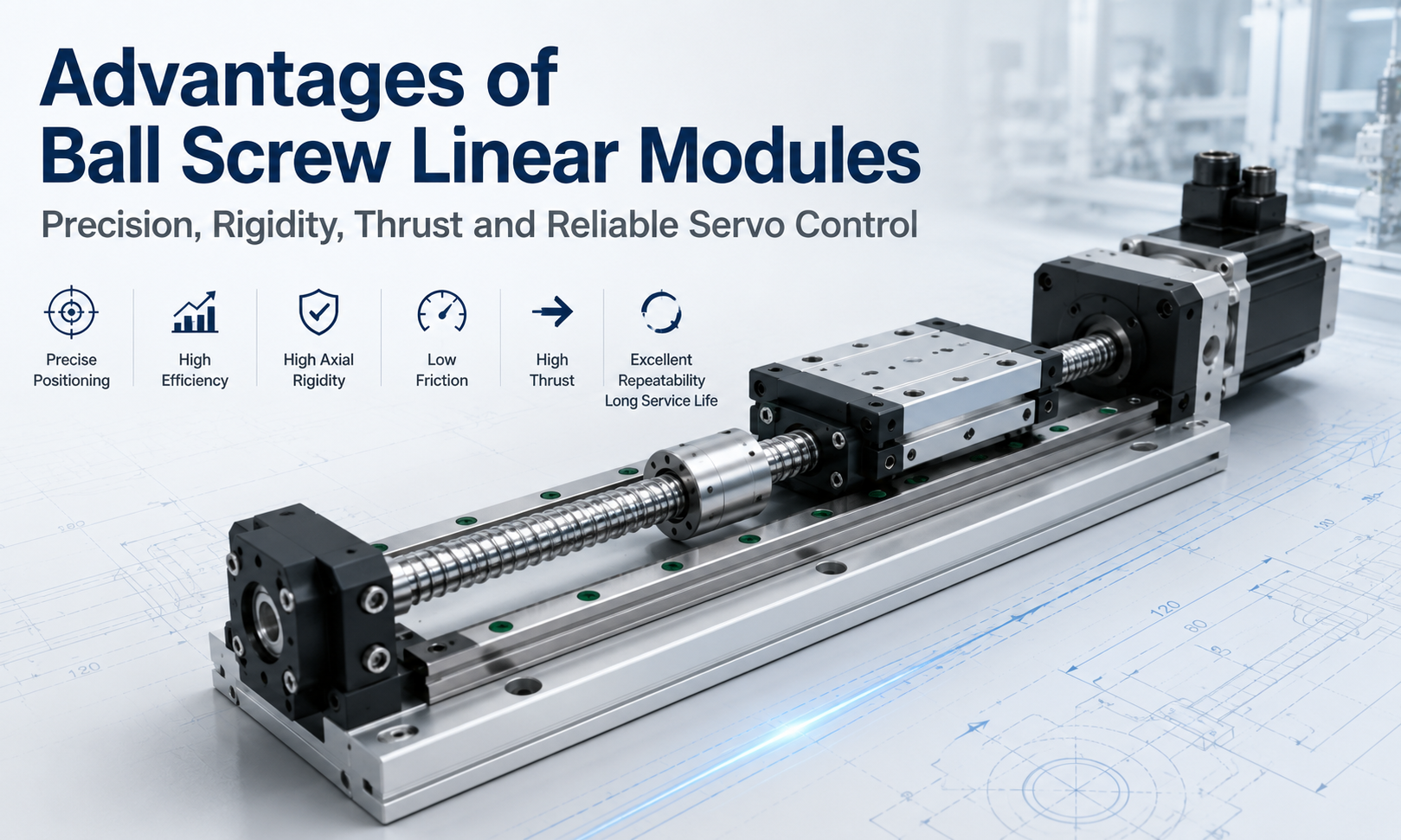
What Are the Main Advantages of Ball Screw Linear Modules?
The main advantages of ball screw linear modules include precise positioning, high mechanical efficiency, strong axial rigidity, low friction, high thrust capacity, good repeatability, reliable servo control and long service life. These advantages help automation equipment achieve more stable production cycles and consistent motion performance.
| Advantage | Engineering Value | Typical Application Benefit |
|---|---|---|
| Precise positioning | Accurate conversion of rotary motion into linear displacement | Improved machining, assembly and inspection accuracy |
| High mechanical efficiency | Lower frictional loss during transmission | Reduced motor torque and energy requirements |
| High axial rigidity | Stable resistance to axial deformation | Better positioning stability under load |
| High thrust | Efficient transmission of motor torque into linear force | Suitable for pressing, lifting and machining operations |
| Good repeatability | Consistent return to programmed positions | Stable automated production cycles |
| Reliable servo control | Supports closed-loop position, speed and torque control | Flexible and programmable motion profiles |
| Smooth operation | Rolling contact reduces stick-slip behavior | Improved low-speed motion and process quality |
| Long service life | Reduced sliding wear under correct lubrication | Lower maintenance frequency and lifecycle cost |
1. Precise Positioning
Precise positioning is one of the most important advantages of a ball screw linear module. The accurately machined helical grooves of the screw shaft and ball nut provide a controlled relationship between screw rotation and carriage displacement. Each motor revolution produces a predictable amount of linear travel according to the screw lead.
This mechanical relationship makes it easier for the control system to calculate and command the required movement. When the module is combined with a servo motor and encoder, the system can continuously monitor the actual position and correct deviations during operation.
Positioning performance is influenced by several factors, including ball screw accuracy grade, preload, support bearing quality, linear guide precision, coupling stiffness, mounting alignment and thermal conditions. A properly selected and installed module can provide stable positioning performance for precision automation equipment.
Typical applications that benefit from precise positioning include:
- Electronic component assembly
- Machine vision inspection
- Laser processing and marking
- Precision dispensing
- Semiconductor handling equipment
- CNC auxiliary motion systems
2. High Mechanical Efficiency
Ball screw transmissions use rolling contact instead of direct sliding contact. Recirculating balls move between the screw shaft and ball nut, significantly reducing frictional resistance during motion.
Higher mechanical efficiency allows more of the motor output torque to be converted into useful linear thrust. As a result, the system may achieve the required load and acceleration with a smaller motor than a comparable sliding screw mechanism.
High transmission efficiency provides several practical benefits:
- Lower motor torque requirements
- Reduced power consumption
- Less heat generated by friction
- Faster response during acceleration and deceleration
- Improved performance during frequent start-stop cycles
The actual efficiency of the complete axis also depends on bearing resistance, guide friction, lubrication condition, coupling alignment and external load. Correct assembly and maintenance are therefore essential for preserving the efficiency advantage.
3. High Axial Rigidity
Axial rigidity describes the ability of the transmission system to resist deformation when an axial force is applied. High axial rigidity is important because elastic deformation can cause positioning errors, vibration and delayed response under changing loads.
Ball screw linear modules can achieve strong axial rigidity through appropriate screw diameter, preload, bearing arrangement and support structure. Preloaded ball nuts reduce axial clearance between the screw shaft and nut, while fixed support bearings help maintain stable screw positioning.
High axial rigidity is especially valuable in applications involving:
- Cutting or machining forces
- Pressing and insertion operations
- Vertical lifting axes
- Rapid acceleration and deceleration
- Frequent direction changes
- Heavy workpieces or tooling
However, rigidity should be evaluated as a complete system characteristic. The module base, carriage, guide rail, mounting plate, machine frame and connecting components must all have sufficient stiffness.
4. Low Friction and Smooth Motion
The rolling contact inside a ball screw produces less friction than the sliding contact used in conventional lead screws. Lower friction supports smoother movement, particularly at low speed or during small positioning adjustments.
Smooth motion is important in processes where speed fluctuation can directly affect product quality. Examples include adhesive dispensing, laser scanning, visual inspection and precision assembly.
Low friction also helps reduce stick-slip behavior. Stick-slip occurs when static friction is higher than dynamic friction, causing the axis to alternate between sticking and suddenly moving. Because ball screw systems have more consistent rolling resistance, they are generally better suited to controlled low-speed movement.
Correct lubrication remains necessary. Insufficient lubrication can increase friction, noise, temperature and wear, while excessive or unsuitable lubricant may also affect operating resistance.
5. High Thrust Capacity
A ball screw linear module can convert motor torque into substantial axial thrust. This makes it suitable for applications that require more force than many standard belt-drivenlinear modulescan provide.
Available thrust depends on the screw diameter, screw lead, ball nut design, motor torque, transmission efficiency, support bearing capacity and operating speed. A smaller screw lead generally produces greater thrust for the same motor torque, although the linear travel per revolution is reduced.
High-thrust ball screw modules are commonly used for:
- Press fitting
- Component insertion
- Clamping operations
- Material lifting
- Drilling and machining feed
- Heavy fixture positioning
When selecting a module, both continuous thrust and peak thrust should be considered. The design must also account for acceleration force, friction, gravity on vertical axes and any external process force.
6. Good Repeatability
Repeatability refers to the ability of the carriage to return to the same commanded position over repeated motion cycles. In automated production, good repeatability is often more important than absolute positioning accuracy because the machine performs the same operation thousands of times.
Ball screw linear modules provide good repeatability because of their precise transmission geometry, low friction, stable guide support and optional preload. When combined with a properly tuned servo system, the module can repeatedly approach target positions with consistent motion behavior.
Good repeatability helps improve:
- Product consistency
- Assembly alignment
- Inspection reliability
- Tool positioning
- Dispensing path consistency
- Production yield
Repeatability may gradually decline if the screw, nut, bearings or guides become worn. Regular inspection, lubrication and contamination control help maintain long-term performance.
7. Reliable Servo Motor Control
Ball screw linear modules work well with servo motors because their rigid transmission structure and predictable screw lead support precise closed-loop control. The servo system can control position, speed and torque according to the programmed motion profile.
An encoder provides real-time feedback to the controller. If the actual position differs from the commanded position, the servo drive adjusts the motor output to reduce the error. This closed-loop operation improves motion stability under changing speeds and loads.
Servo-driven ball screw modules can support functions such as:
- Programmable positioning
- Multi-position movement
- Controlled acceleration and deceleration
- Torque-limited pressing
- Electronic cam profiles
- Multi-axis interpolation
- Synchronized automation sequences
Motor sizing and servo tuning must match the screw lead, moving mass, load inertia, required acceleration and operating cycle. An incorrectly sized or poorly tuned servo system may produce vibration, excessive following error or unstable positioning.
8. Long Service Life
Because the balls roll between the screw shaft and nut, properly lubricated ball screw systems experience less sliding wear than conventional screw mechanisms. This contributes to a long service life when the module operates within its rated load, speed and environmental limits.
Long-term reliability depends on several operating conditions:
- Correct load and moment selection
- Suitable lubrication intervals
- Protection from dust and metal chips
- Accurate installation alignment
- Controlled acceleration and impact load
- Proper bearing and coupling installation
Protective covers, seals or bellows may be required in contaminated environments. Preventing particles from entering the ball circulation path is particularly important because contamination can damage the raceways and reduce positioning performance.
Where Are Ball Screw Linear Module Advantages Most Valuable?
Ball screw linear modules are most valuable in applications where precision, thrust and rigidity are more important than extremely long travel or very high linear speed.
Precision Assembly
Assembly equipment often requires accurate alignment, controlled insertion force and repeated movement between fixed positions. Ball screw modules provide the rigidity and repeatability needed for these processes.
Machine Vision Inspection
Inspection systems require the camera or workpiece to stop at stable, repeatable positions. Smooth motion and precise servo control help improve image consistency and measurement reliability.
Dispensing and Coating
Stable low-speed movement helps maintain a consistent dispensing path, coating thickness and material flow. Ball screw modules are suitable when path accuracy is more important than maximum travel speed.
Machining and Tool Feeding
High axial rigidity and thrust capacity make ball screw modules suitable for drilling, cutting, grinding and other tool-feeding operations with external process forces.
Vertical Lifting
A ball screw axis can provide controlled vertical motion for lifting tools, fixtures or workpieces. Vertical systems should use an appropriate brake motor or mechanical protection to prevent unintended falling during power loss.
Ball Screw Module Compared with Other Linear Drive Types
| Drive Type | Main Advantage | Typical Limitation | Suitable Applications |
|---|---|---|---|
| Ball screw | High precision, rigidity and thrust | Speed and stroke may be limited by screw rotation | Precision positioning, assembly and machining |
| Timing belt | High speed and long stroke | Lower axial rigidity and thrust | Material transfer, handling and pick-and-place |
| Gear rack | Long stroke and heavy-load capability | Requires careful backlash and lubrication control | Gantry systems and long-travel automation |
| Linear motor | Direct drive, high speed and fast response | Higher cost and more demanding control requirements | High-speed precision equipment |
Important Limitations to Consider
Although ball screw linear modules offer many advantages, they are not the best solution for every application. Long screw shafts may be affected by critical speed, vibration and buckling. Extremely high-speed or very long-stroke systems may therefore be better served by timing belt, gear rack or linear motor technology.
Ball screw systems also require proper lubrication and protection from contamination. In vertical installations, the screw may back-drive under load when the motor is unpowered, so a brake or other anti-fall device may be necessary.
The best drive type should be selected according to the complete application rather than positioning accuracy alone.
How to Select a Ball Screw Linear Module
Before selecting a ball screw actuator, evaluate the following parameters:
- Required effective stroke
- Horizontal or vertical installation direction
- Moving payload and tooling weight
- External axial process force
- Required positioning accuracy and repeatability
- Maximum operating speed
- Acceleration and deceleration requirements
- Operating cycle and duty ratio
- Radial, axial and moment loads
- Environmental dust, moisture and temperature
- Motor type, power, torque and brake requirement
- Installation space and mounting direction
Selection should also include an appropriate safety factor. The rated capacities of the ball screw, linear guide, support bearings, coupling and motor must all satisfy the operating conditions.
Frequently Asked Questions
Why are ball screw linear modules accurate?
They use precisely machined screw grooves and recirculating balls to produce predictable linear movement. Preload, accurate guide rails and servo feedback can further improve positioning stability.
Are ball screw modules suitable for heavy loads?
Yes. They can provide high axial thrust and strong rigidity, but the allowable payload also depends on the linear guide capacity, carriage size, moment load, screw diameter and mounting arrangement.
Can a ball screw linear module be installed vertically?
Yes. The motor must provide enough torque to overcome gravity and acceleration forces. A brake motor or mechanical anti-fall device is generally recommended for power-off protection.
Are ball screw modules better than timing belt modules?
Neither drive type is universally better. Ball screw modules are usually preferred for higher precision, rigidity and thrust, whiletiming belt modulesare often better for longer strokes and higher travel speeds.
What affects the service life of a ball screw module?
Service life is affected by load, speed, acceleration, lubrication, contamination, alignment, impact force and operating cycle. Correct sizing and regular maintenance are essential for long-term reliability.
Conclusion
Ball screw linear modules offer a strong combination of positioning accuracy, mechanical efficiency, axial rigidity, thrust capacity, repeatability and servo control performance. Their low-friction rolling transmission supports smooth motion and long service life, making them a reliable choice for many precision automation applications.
To obtain these advantages in actual operation, the module must be selected according to load, stroke, speed, acceleration, installation direction, precision and environmental requirements. Correct motor sizing, structural support, alignment, lubrication and contamination protection are equally important for maintaining stable performance throughout the equipment lifecycle.