 English

Proper lubrication is essential for maintaining the accuracy, smoothness and service life of a ball screw linear module. The ball screw, ball nut, linear guide rails and guide blocks all rely on a stable lubricant film to reduce friction and prevent direct metal-to-metal contact.
Insufficient lubrication can cause increased noise, temperature rise, unstable movement, rapid wear and positioning accuracy loss. However, excessive lubrication can also create resistance, attract contaminants and increase internal pressure. Correct maintenance therefore requires suitable lubricant selection, accurate lubrication points, controlled quantities and appropriate lubrication intervals.
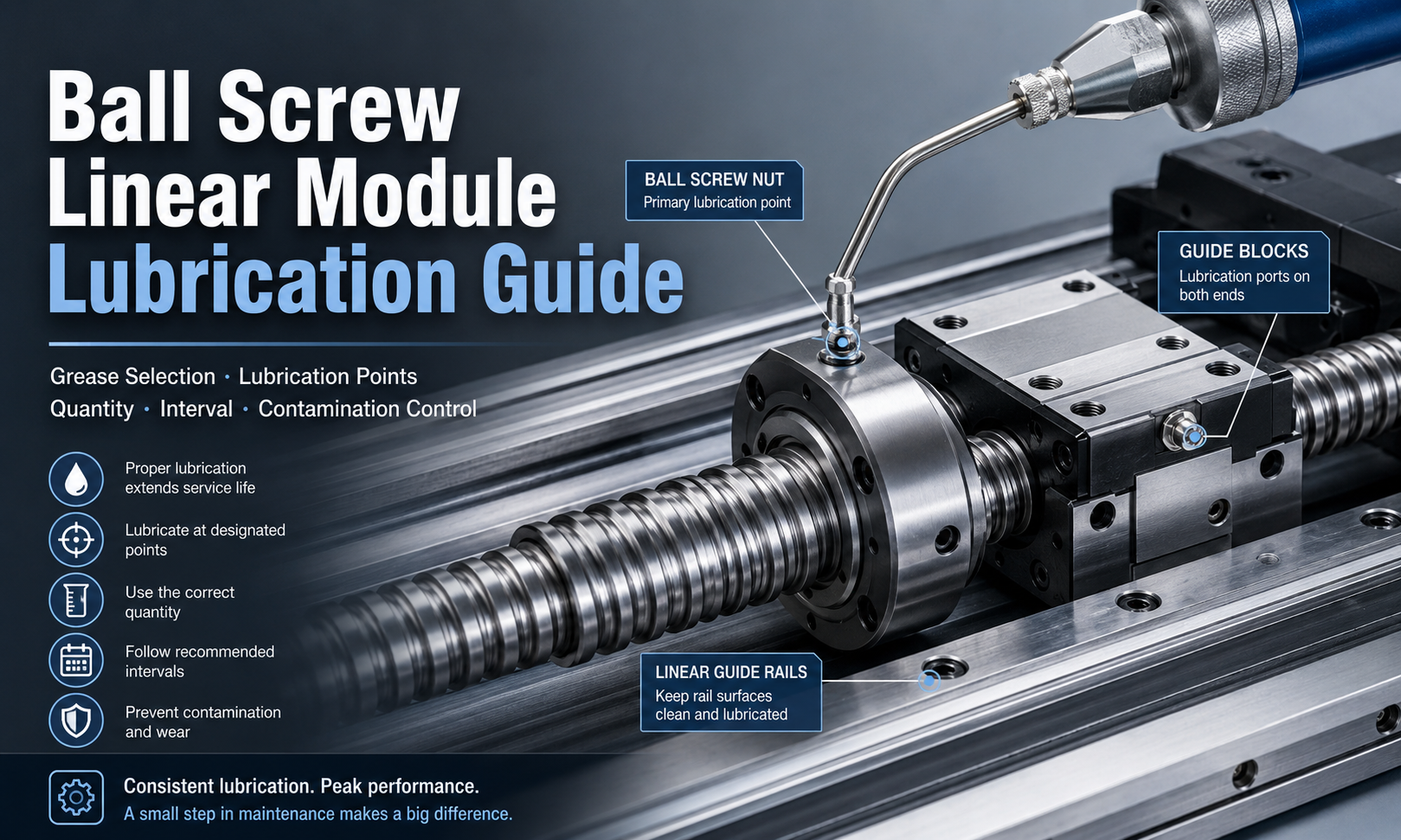
Why Does a Ball Screw Linear Module Need Lubrication?
During operation, the recirculating balls inside the ball nut and guide blocks repeatedly contact the rolling surfaces. Although rolling friction is lower than sliding friction, the components still experience pressure, vibration and temperature changes.
Lubrication performs several important functions:
- Reduces friction between rolling elements and raceways
- Prevents direct metal-to-metal contact
- Reduces wear on the ball screw, ball nut, guide rails and blocks
- Improves motion smoothness at low and high speeds
- Helps maintain positioning accuracy and repeatability
- Reduces operating noise and vibration
- Protects metal surfaces against moisture and corrosion
- Helps remove small wear particles from contact surfaces
- Extends the maintenance life of the linear motion system
Lubrication cannot repair components that are already damaged. If the ball screw has severe pitting, the guide rail is scratched or the ball nut has excessive backlash, the worn components should be inspected and replaced instead of relying only on additional grease.
Grease Lubrication and Oil Lubrication
Ball screw linear modulesare normally lubricated with grease, although oil lubrication may be used in high-speed, centralized or continuously operating systems.
Grease Lubrication
Grease is widely used because it adheres well to the rolling surfaces and remains in the lubrication area for a relatively long time. It is suitable for most industrial automation equipment, including assembly systems, inspection machines, dispensing equipment and material handling systems.
Main advantages of grease lubrication include:
- Simple maintenance procedure
- Longer relubrication interval
- Good sealing and contamination resistance
- Low risk of lubricant leakage
- Suitable for horizontal, vertical and inclined installation
The main limitation is that excessive grease can increase movement resistance, especially in high-speed or low-temperature applications.
Oil Lubrication
Oil has lower flow resistance and can continuously carry heat and contamination away from the contact surfaces. It is often used in high-speed equipment, centralized lubrication systems and applications requiring continuous operation.
Main advantages of oil lubrication include:
- Lower viscous resistance at high speed
- Better heat dissipation
- Continuous lubricant supply when connected to an automatic system
- Easier distribution to multiple lubrication points
Oil lubrication requires suitable seals, pipelines, metering units and collection measures. Oil that is too thin may leak from the module, while oil that is too thick may not flow correctly through small lubrication passages.
How to Select Grease for a Ball Screw Linear Module
The selected grease should be compatible with the ball screw, linear guide, operating speed, load, temperature and surrounding environment. A high-quality lithium-based or lithium-complex grease is commonly used for standard industrial ball screw modules.
Important grease selection factors include:
| Selection Factor | Recommended Consideration |
|---|---|
| Base oil viscosity | Use a viscosity that can form a stable film without creating excessive resistance. |
| Consistency grade | A medium-consistency grease is generally suitable for standard linear motion systems. |
| Operating speed | High-speed modules normally require grease with lower resistance and good mechanical stability. |
| Load | Heavy-load applications may require grease with enhanced load-carrying and anti-wear properties. |
| Temperature | Confirm that the grease remains stable throughout the expected minimum and maximum temperatures. |
| Environment | Cleanrooms, food equipment, vacuum systems and corrosive environments may require specialized lubricants. |
| Material compatibility | The lubricant should be compatible with seals, scrapers, plastic circulation components and protective covers. |
Do not select grease only by color or appearance. Two greases with a similar color may use different base oils, thickeners and additives.
Avoid Mixing Different Greases
Different greases may be chemically incompatible. Mixing them can cause separation, hardening, softening or reduced lubricating performance. When changing to another lubricant type, remove as much of the old grease as possible and confirm compatibility before applying the new grease.
Lubrication Points on a Ball Screw Linear Module
A ball screw linear module usually contains two main lubrication areas: the ball screw assembly and the linear guide assembly.
Ball Screw and Ball Nut
The ball screw lubrication point is generally located on the ball nut or carriage. Some modules include a grease nipple, threaded lubrication port or connected lubrication tube. Grease applied through this point enters the ball nut circulation system and spreads along the screw raceway during movement.
If the module does not include a dedicated lubrication port, a small amount of grease may be applied evenly to the exposed screw raceway. The carriage should then be moved slowly through its travel to distribute the lubricant.
Linear Guide Rails and Guide Blocks
The guide blocks may have grease nipples or lubrication ports on their end caps. Some compact modules use a centralized channel that distributes lubricant to multiple guide blocks.
When direct access to the guide block is unavailable, a thin and even layer of grease may be applied to the guide rail raceways. Moving the carriage slowly allows the guide blocks to collect and distribute the grease internally.
Support Bearings
The fixed-end and floating-end support bearings are often pre-lubricated and sealed during assembly. They normally do not require frequent external lubrication. Do not inject grease into the bearing housing unless the module design includes a designated lubrication point.
Coupling and Motor Components
Flexible couplings, servo motors and motor mounts normally do not require grease during routine module maintenance. Applying grease to the coupling can attract dust and may interfere with clamping or alignment.
How to Lubricate a Ball Screw Linear Module
The lubrication procedure should be performed with the equipment stopped and protected against unexpected startup.
- Stop the machine and disconnect or lock out the power supply.
- Move the carriage to a position where the lubrication ports and exposed raceways are accessible.
- Remove protective covers or bellows only when necessary.
- Wipe away dust, old grease and loose contamination with a clean, lint-free cloth.
- Inspect the screw, guide rails, seals and scrapers for damage.
- Confirm that the new lubricant is clean and compatible with the existing lubricant.
- Apply a controlled amount of grease through the designated lubrication ports.
- If no port is available, apply a thin and even layer to the specified raceways.
- Move the carriage slowly through the full usable stroke several times.
- Remove excess grease that is pushed out around the seals or collected at the stroke ends.
- Reinstall all protective covers and confirm that no tools or cloths remain inside the module.
- Run the module at low speed and check noise, resistance, temperature and motion smoothness.
Do not operate the module at maximum speed immediately after relubrication. A short low-speed running period helps distribute the lubricant and discharge excess grease from the circulation areas.
How Much Grease Should Be Applied?
Lubrication quantity depends on the screw diameter, nut size, guide block size, stroke, speed and lubrication structure. The module manufacturer’s maintenance instructions should be used whenever an exact quantity is available.
In general, the objective is to create a thin and continuous lubricant film rather than completely filling the ball nut, guide blocks or module cavity.
Signs that the quantity may be sufficient include:
- A thin lubricant film is visible on the active raceways
- The carriage moves smoothly after several low-speed cycles
- Operating noise decreases or remains stable
- No large amount of grease is forced out of the seals
- Motor current and movement resistance remain normal
Applying a large quantity at one time does not necessarily extend the lubrication interval. A moderate quantity applied at the correct interval is usually more effective than completely filling the internal space.
Recommended Lubrication Intervals
There is no universal lubrication interval for every ball screw linear module. Maintenance frequency must be adjusted according to travel distance, operating time, speed, load, temperature and contamination level.
| Operating Condition | Lubrication Consideration |
|---|---|
| Clean environment and intermittent operation | Use the standard preventive maintenance interval specified for the equipment. |
| Continuous production | Inspect and relubricate more frequently because the accumulated travel distance increases rapidly. |
| High-speed reciprocating motion | Shorten the interval and monitor grease condition, temperature and motor current. |
| Heavy load or high acceleration | Use shorter inspection intervals because the rolling contact stress is higher. |
| Dusty or machining environment | Inspect frequently and prevent contaminated grease from entering the ball nut and guide blocks. |
| High-temperature environment | Check for grease oxidation, drying and leakage. |
| Long periods of inactivity | Inspect for corrosion or grease separation before restarting the module. |
Lubrication can be scheduled by operating hours, calendar time, accumulated travel distance or production cycles. For equipment with highly variable use, accumulated travel distance is often more representative than calendar time.
Factors That Shorten the Lubrication Interval
The relubrication interval should be shortened when the module operates under one or more of the following conditions:
- High-speed continuous reciprocation
- Frequent acceleration and deceleration
- Heavy payload or high moment load
- Vertical installation
- High ambient temperature
- Dust, metal chips or abrasive particles
- Coolant, water mist or chemical exposure
- Long stroke with limited lubricant redistribution
- Frequent cleaning of the exposed screw and guide rails
- Operation near the maximum rated speed or load
A lubrication inspection should also be performed after major maintenance, long-distance transportation, extended storage or accidental contamination.
Contamination Prevention During Lubrication
Lubricant contamination is one of the main causes of premature ball screw and guide rail wear. Dust, chips and hardened grease can circulate through the rolling contact areas and damage the precision raceways.
Use the following practices to reduce contamination:
- Clean the grease nipple before connecting the grease gun
- Use a dedicated grease gun for each lubricant type
- Keep lubricant containers closed when not in use
- Do not reuse grease removed from the module
- Use clean, lint-free cloths and tools
- Replace damaged seals, scrapers and protective covers
- Prevent chips and coolant from entering the module opening
- Do not apply grease with bare hands
- Store lubricant away from moisture, dust and direct sunlight
When the existing grease is heavily contaminated, simply adding new grease may push abrasive material deeper into the circulation system. The module should first be cleaned according to the manufacturer’s approved maintenance procedure.
Risks of Over-Lubrication
More lubricant does not always provide better protection. Excessive grease can cause several operating problems.
- Increased movement resistance
- Higher servo motor current
- Temperature rise in the ball nut or guide blocks
- Reduced maximum speed
- Unstable low-speed movement
- Grease leakage around seals and covers
- Contamination of sensors, cables or nearby products
- Collection of dust and abrasive particles
- Increased pressure inside sealed circulation areas
After lubrication, excess grease that accumulates at the ends of the stroke or around the seals should be removed. The module should then be operated at low speed while the drive load and temperature are observed.
Symptoms of Insufficient Lubrication
The following symptoms may indicate that the lubricant film is insufficient or has deteriorated:
- Dry or metallic operating noise
- Increasing friction or motor current
- Uneven movement at low speed
- Higher ball nut or guide block temperature
- Visible dryness on the screw or guide raceways
- Brown or black wear residue
- Reduced positioning repeatability
- Vibration during acceleration or direction changes
These symptoms may also be caused by misalignment, contamination, bearing damage, excessive preload or component wear. Lubrication should therefore be inspected together with the mechanical condition of the module.
Automatic Lubrication Systems
Automatic lubrication can be useful for modules installed in continuous production lines, inaccessible areas or multi-axis systems with many lubrication points. A centralized system can deliver measured quantities of grease or oil at programmed intervals.
An automatic system should include:
- A lubricant reservoir
- A pump or pressure source
- Metering distributors
- Compatible tubing and fittings
- Check valves where required
- Low-level or pressure monitoring
- A maintenance method for confirming lubricant delivery
Automatic lubrication does not eliminate inspection. Blocked tubes, empty reservoirs and failed metering units can leave the module without lubrication even when the control system continues operating.
Lubrication Maintenance Checklist
- Confirm the correct lubricant specification
- Check the lubricant storage condition and expiration guidance
- Clean all lubrication ports before use
- Inspect the ball screw and guide rails for contamination
- Check seals, scrapers and protective covers
- Apply lubricant to the correct points
- Control the lubrication quantity
- Move the carriage slowly to distribute the lubricant
- Remove excess grease
- Check motor current, noise and temperature after lubrication
- Record the maintenance date, lubricant type and quantity
- Set the next inspection according to the actual operating condition
Frequently Asked Questions
What grease should be used for a ball screw linear module?
A high-quality grease designed for ball screws and linear guides is generally suitable. The final selection should consider speed, load, temperature, environment and compatibility with the existing grease and sealing materials.
Can ordinary bearing grease be used?
Some general-purpose bearing greases may work in standard conditions, but they are not automatically suitable for every precision linear motion system. Grease consistency, base oil viscosity, additives and compatibility should be verified before use.
Should the ball screw and guide rails use the same grease?
Many modules use one compatible grease for both components, simplifying maintenance. However, specialized applications may require different lubricants. Follow the module and component manufacturer’s specifications.
How often should a ball screw module be lubricated?
The interval depends on operating time, accumulated travel, speed, load, temperature and contamination. Continuous, high-speed or dusty applications require more frequent inspection than clean, intermittent applications.
Can grease be applied directly to the exposed ball screw?
Yes, when no dedicated lubrication port is available and the module design permits it. Apply only a thin, even layer to the raceway and move the carriage slowly to distribute the grease.
Why does the motor current increase after lubrication?
A temporary increase may occur when fresh grease is being distributed. A large or persistent increase may indicate excessive grease, unsuitable viscosity, contamination, misalignment or mechanical damage.
Can different grease brands be mixed?
They should not be mixed unless their base oils, thickeners and additives are confirmed to be compatible. When changing lubricant, remove the old grease as completely as practical.
Conclusion
Effective lubrication of a ball screw linear module depends on more than simply adding grease. The correct lubricant must be applied to the ball nut and guide blocks in a controlled quantity and at an interval matched to the actual operating conditions.
Regular cleaning, contamination prevention, seal inspection and maintenance records are equally important. By avoiding both insufficient lubrication and over-lubrication, the module can maintain smooth movement, stable positioning accuracy and reliable service life.