 English

As industrial automation continues to evolve toward higher precision, faster production speeds, and smarter manufacturing, linear modules have become one of the most important motion control components in modern machinery. From semiconductor manufacturing and CNC machining to packaging lines and robotic systems, linear modules are widely used wherever accurate and repeatable linear motion is required.
Compared with traditional motion solutions assembled from separate guide rails, ball screws, motors, and mounting structures, alinear moduleintegrates all critical mechanical components into a compact, pre-engineered system. This integrated design not only simplifies machine development but also delivers significant improvements in positioning accuracy, reliability, maintenance efficiency, and overall production performance.
Whether driven by a ball screw, timing belt, rack and pinion, or linear motor, modern linear modules provide engineers with a standardized solution that reduces engineering complexity while improving machine performance throughout its lifecycle.
This article explains the majorlinear module advantages, discusses why manufacturers increasingly replace conventional linear motion assemblies with integrated modules, and helps engineers understand how these systems improve industrial productivity while reducing total operating costs.
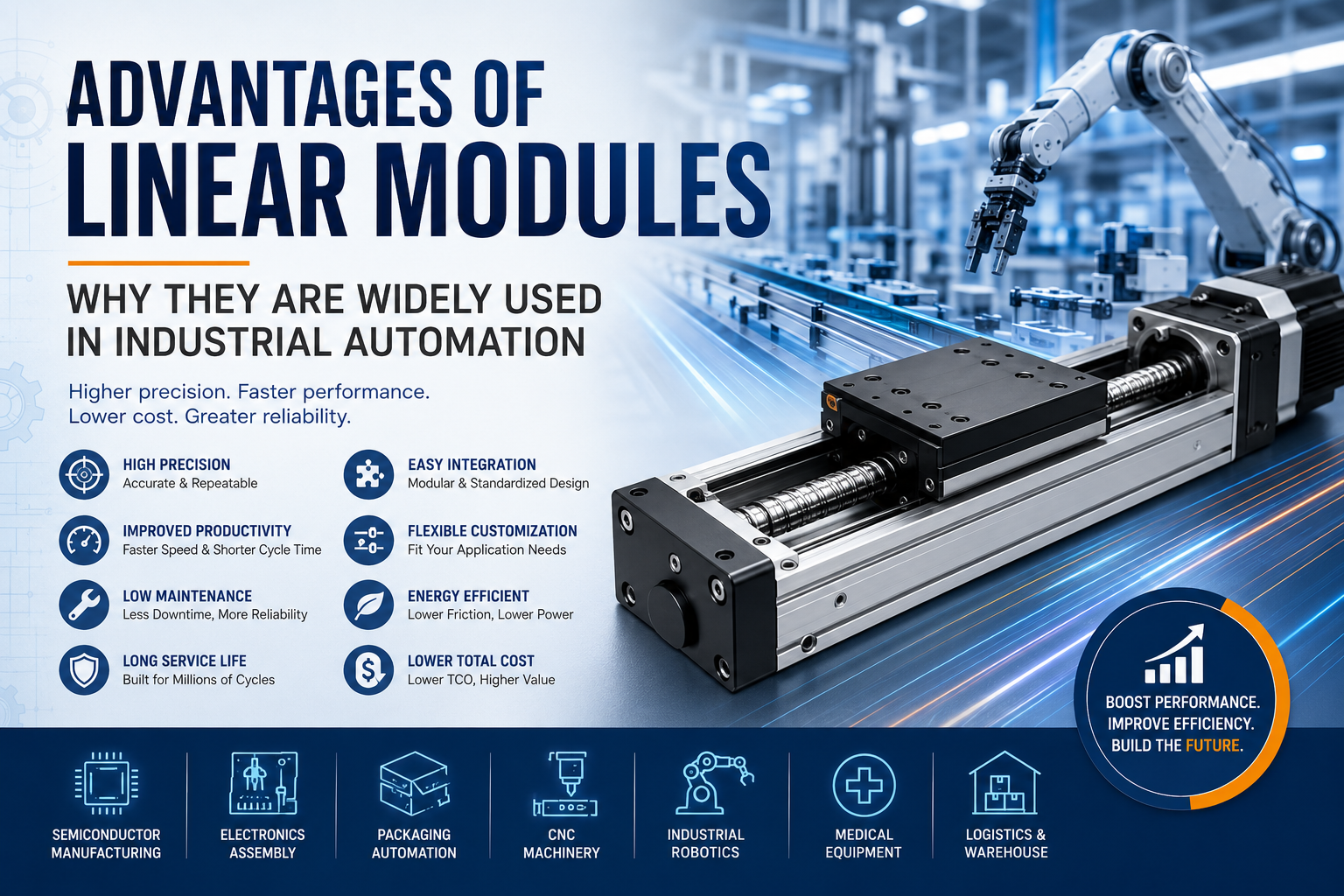
Why Are Linear Modules Becoming the Standard in Industrial Automation?
Manufacturing equipment today faces increasing demands for productivity, flexibility, and precision. Machines are expected to operate continuously while maintaining micron-level positioning accuracy and minimizing downtime. Traditional custom-built motion systems often require extensive mechanical alignment, complicated assembly procedures, and regular maintenance.
Linear modules address these challenges by combining multiple motion components into one optimized platform. A typical module integrates:
- Linear guide rails
- Drive mechanism (ball screw, timing belt, rack and pinion, or linear motor)
- Sliding carriage
- Rigid aluminum or steel base
- Motor mounting interface
- Lubrication system
- Protective cover or sealing system
- Sensor mounting positions
Because these components are factory assembled and precisely aligned, machine builders can significantly shorten design cycles while achieving more consistent motion performance than manually assembled systems.
The growing adoption of Industry 4.0, collaborative robotics, and automated production lines has further accelerated the demand for modular linear motion solutions capable of supporting flexible manufacturing environments.
Main Advantages of Linear Modules
The popularity of linear modules comes from the combination of multiple engineering advantages rather than a single performance improvement. These benefits influence nearly every stage of machine design, production, operation, and maintenance.
- Higher positioning accuracy
- Improved productivity
- Reduced maintenance requirements
- Easy system integration
- Flexible customization
- Energy-efficient operation
- Long service life
- Lower total cost of ownership
The following sections explain each advantage in detail.
1. Higher Precision for Accurate Positioning
One of the most significant advantages of linear modules is their ability to provide highly accurate and repeatable linear motion. Precision is critical in industries where even a few micrometers of positioning error can affect product quality or manufacturing yield.
Unlike manually assembled motion systems, integrated linear modules are manufactured with carefully controlled tolerances. The guide rails, drive mechanism, and carriage are precisely aligned during production, minimizing installation errors and improving repeatability.
Several design features contribute to higher positioning precision:
- High-quality linear guide rails reduce lateral movement.
- Precision-ground ball screws minimize transmission error.
- Rigid structural bases reduce mechanical deformation.
- Factory alignment eliminates installation inaccuracies.
- Servo motor compatibility enables closed-loop positioning control.
Depending on the drive technology, repeatability can range from approximately ±0.05 mm for belt-driven systems to ±0.01 mm or better for precisionball screw modules, while linear motor systems may achieve micron-level positioning accuracy.
Higher positioning precision directly improves product consistency, reduces defective parts, and supports advanced manufacturing applications such as electronic assembly, laser processing, semiconductor equipment, and precision inspection systems.
2. Improved Productivity Through Faster Motion
Modern production lines require equipment capable of moving faster without sacrificing accuracy. Linear modules are specifically designed to optimize motion efficiency while maintaining smooth acceleration and deceleration profiles.
Compared with traditional custom-built linear mechanisms, integrated modules allow:
- Higher maximum travel speeds
- Faster acceleration
- Reduced vibration during movement
- Shorter cycle times
- Improved machine throughput
Timingbelt linear modulesare especially suitable for high-speed, long-stroke applications because the belt transmission allows rapid movement with relatively low inertia. Ball screw modules provide an excellent balance between speed and positioning accuracy for medium-speed precision applications, while linear motor modules eliminate mechanical transmission components entirely for extremely dynamic motion.
The improvement in production efficiency becomes particularly noticeable in repetitive pick-and-place operations, automated assembly lines, packaging systems, and logistics equipment where thousands of motion cycles occur every day.
| Drive Type | Main Productivity Advantage | Typical Application |
|---|---|---|
| Timing Belt Module | High travel speed | Packaging, logistics, material handling |
| Ball Screw Module | High precision with stable speed | CNC equipment, inspection machines |
| Linear Motor Module | Ultra-fast acceleration | Semiconductor and high-speed automation |
3. Reduced Maintenance Requirements
Maintenance costs represent a significant portion of a machine's lifetime operating expenses. One of the key benefits of linear modules is their ability to reduce routine maintenance through optimized mechanical design and integrated lubrication systems.
Because the drive components, guide rails, bearings, and structural frame are engineered as a complete unit, wear is distributed more evenly than in manually assembled systems. Many modern linear modules also include sealed guide rails, dust protection covers, and centralized lubrication ports that simplify preventive maintenance.
The reduced number of exposed moving components also decreases contamination from dust, coolant, or production debris, helping maintain stable motion performance over long operating periods.
Lower maintenance requirements result in:
- Reduced machine downtime
- Lower maintenance labor costs
- Longer component life
- Higher equipment availability
- More predictable maintenance schedules
For manufacturers operating multiple production lines, these improvements translate directly into higher equipment utilization and reduced operating costs.
4. Easy Integration into Automation Systems
Another major advantage of linear modules is their ease of integration into various automation systems. Traditional linear motion systems often require engineers to source individual components separately, including guide rails, drive mechanisms, bearings, support structures, couplings, and motor mounts. Each component must be carefully selected, machined, assembled, and aligned before the system can operate reliably.
An integrated linear module eliminates much of this engineering work. Because the module is designed, manufactured, and tested as a complete motion unit, machine builders can focus on overall equipment design rather than spending valuable time on motion system assembly.
Most industrial linear modules feature standardized mounting interfaces, allowing them to be installed quickly onto machine frames made from aluminum profiles, welded steel structures, or custom bases. Motor mounting kits are also available for common servo motors and stepper motors, reducing installation complexity even further.
The modular design offers several integration advantages:
- Factory-aligned motion components reduce installation errors.
- Standard mounting holes simplify mechanical assembly.
- Compatible motor mounting interfaces save engineering time.
- Integrated cable routing improves machine appearance and reliability.
- Sensor mounting positions simplify limit switch installation.
- Standardized dimensions make future upgrades easier.
For original equipment manufacturers (OEMs), system integrators, and automation equipment builders, these features significantly reduce engineering workload while shortening product development cycles.
As manufacturing increasingly demands shorter delivery times and faster equipment deployment, the ability to integrate linear motion systems quickly has become an important competitive advantage.
5. Flexible Customization for Different Applications
No two automation projects are exactly the same. Different industries require different stroke lengths, payload capacities, positioning accuracy, environmental protection levels, and motion speeds. One of the reasons linear modules are so widely adopted is their excellent flexibility and customization capability.
Instead of designing a completely new motion mechanism for every project, engineers can customize a standardized linear module according to application requirements while maintaining proven mechanical reliability.
Typical customization options include:
- Travel stroke length
- Drive mechanism selection
- Motor type and mounting configuration
- Guide rail size
- Load capacity
- Protective cover options
- Cleanroom compatibility
- Anti-corrosion surface treatment
- Lubrication configuration
- Encoder and sensor options
For example, a semiconductor production line may prioritize micron-level positioning accuracy and cleanroom compatibility, while an automated warehouse system may require long travel distances and high operating speed. Both applications can utilize linear modules but with entirely different configurations.
Multi-axis systems further expand customization possibilities. Single-axis modules can be combined into XY, XZ, XYZ, gantry, orCartesian robotconfigurations to perform complex motion tasks such as pick-and-place operations, palletizing, dispensing, laser cutting, inspection, and automated assembly.
This modular flexibility allows manufacturers to standardize equipment platforms while still meeting diverse customer requirements.
6. Higher Energy Efficiency
Energy consumption has become an increasingly important consideration in industrial automation. Rising electricity costs and sustainability initiatives encourage manufacturers to adopt equipment that delivers higher productivity while consuming less energy.
Modern linear modules contribute to improved energy efficiency in several ways.
First, precision guide rails significantly reduce friction during movement. Lower friction means the drive motor requires less torque to move the same payload, reducing electrical power consumption throughout continuous operation.
Second, optimized transmission efficiency allows more motor output to be converted into useful linear motion. Ball screw systems offer excellent mechanical efficiency for precision positioning, while timing belt systems minimize rotating mass during high-speed movement.
Third, integrated structural rigidity minimizes vibration and unnecessary mechanical losses. Smooth motion profiles also reduce repeated acceleration loads on motors and servo drives.
Energy-saving characteristics include:
- Lower friction during operation.
- Optimized mechanical transmission efficiency.
- Reduced motor load.
- Less heat generation.
- Higher overall machine efficiency.
- Lower long-term electricity costs.
When combined with modern servo control systems that optimize acceleration and deceleration automatically, linear modules help manufacturers reduce operating expenses while maintaining high production efficiency.
7. Long Service Life and High Reliability
Industrial production equipment is often expected to operate continuously for thousands of hours every year. Reliability is therefore one of the most important factors when selecting linear motion equipment.
Linear modules are engineered to provide long service life through optimized structural design, precision manufacturing, and high-quality mechanical components.
Several factors contribute to their durability:
- High-strength aluminum or steel structural bases.
- Precision linear guide rails with hardened raceways.
- Wear-resistant bearings.
- Optimized preload design.
- Effective lubrication systems.
- Protective sealing against contaminants.
Because all components are designed to work together as an integrated system, stress distribution remains more uniform than in manually assembled motion systems. This reduces uneven wear and extends the operational life of both guide rails and drive mechanisms.
Many industrial linear modules are capable of operating for millions of travel cycles under appropriate loading conditions and regular preventive maintenance.
The long operational lifespan helps manufacturers achieve:
- Higher equipment availability.
- Reduced replacement frequency.
- Lower spare parts inventory.
- Improved production stability.
- Reduced unexpected downtime.
For automated production lines operating 24 hours per day, long-term reliability often provides greater economic value than initial purchase price alone.
8. Lower Total Cost of Ownership (TCO)
Although the purchase price of an integrated linear module may appear higher than buying individual mechanical components separately, the overall cost throughout the equipment's lifetime is usually much lower.
Total Cost of Ownership (TCO) includes far more than initial purchasing expenses. It also considers engineering design, assembly time, installation, maintenance, replacement parts, production downtime, and operating efficiency.
Integrated linear modules reduce costs across nearly every stage of the equipment lifecycle.
| Cost Category | Traditional Assembly | Integrated Linear Module |
|---|---|---|
| Mechanical Design | High engineering effort | Reduced engineering workload |
| Assembly Time | Long | Short |
| Alignment | Manual adjustment required | Factory aligned |
| Maintenance | Frequent inspection | Simplified maintenance |
| Machine Downtime | Higher | Lower |
| Operating Efficiency | Depends on assembly quality | Consistently high |
Over several years of operation, the savings generated through improved productivity, reduced maintenance, and lower downtime frequently exceed the initial purchase cost difference.
For this reason, many manufacturers evaluate linear modules based on lifecycle value rather than purchase price alone.
Advantages Compared with Traditional Linear Motion Assemblies
Understanding the advantages of linear modules becomes easier when comparing them directly with traditional motion systems assembled from separate components.
| Comparison Item | Traditional Assembly | Linear Module |
|---|---|---|
| Installation | Complex | Simple |
| Alignment Accuracy | Depends on assembly | Factory calibrated |
| Maintenance | More frequent | Less frequent |
| Engineering Time | Long | Short |
| Reliability | Variable | Highly consistent |
| Scalability | Limited | Excellent |
| Expansion | Difficult | Easy |
These advantages explain why integrated linear modules have become the preferred solution in modern industrial automation equipment across a wide range of industries.
Applications That Benefit Most from Linear Modules
The advantages of linear modules can be found across nearly every industry that requires controlled linear motion. Their combination of precision, speed, reliability, and flexibility makes them suitable for both standard automation equipment and highly specialized manufacturing systems.
Although different industries prioritize different performance characteristics, the modular design allows manufacturers to configure linear modules to meet specific application requirements.
Semiconductor Manufacturing
Semiconductor production requires extremely high positioning accuracy, cleanroom compatibility, and vibration-free motion. Linear motor modules and precision ball screw modules are widely used in wafer handling, chip inspection, precision dispensing, and automated testing equipment.
The high repeatability of linear modules helps ensure consistent manufacturing quality while minimizing positioning errors that could affect semiconductor yields.
Electronics Assembly
Electronic components continue to become smaller while production volumes increase. Automated assembly machines rely on linear modules for PCB handling, connector insertion, soldering, vision inspection, and component placement.
High-speed motion combined with accurate positioning enables manufacturers to improve production efficiency without sacrificing product quality.
Packaging Automation
Packaging equipment demands rapid and continuous motion over long production cycles. Timing belt linear modules are particularly suitable for carton handling, labeling, sorting, sealing, palletizing, and product transfer systems.
The ability to operate at high speed with relatively low maintenance makes linear modules an ideal solution for modern packaging lines.
CNC Machinery
Precision machining equipment requires rigid motion systems capable of maintaining accurate positioning under varying loads. Ball screw linear modules provide excellent rigidity and repeatability for drilling, engraving, milling, laser processing, and precision machining applications.
Industrial Robotics
Many robotic systems use linear modules as additional motion axes to increase workspace and flexibility. Single-axis modules can be combined into multi-axis Cartesian robots capable of performing pick-and-place, material handling, assembly, dispensing, welding, and inspection tasks.
Compared with custom mechanical structures, modular linear systems simplify robot development while reducing engineering costs.
Medical Equipment
Medical automation often requires smooth, precise, and low-noise motion. Linear modules are commonly used in laboratory automation, diagnostic equipment, sample handling, imaging systems, and pharmaceutical production machinery.
Their compact design and reliable positioning contribute to accurate testing procedures and consistent equipment performance.
Logistics and Warehouse Automation
Automated warehouses rely on fast and reliable motion systems to transport products efficiently. Linear modules support automated storage and retrieval systems (AS/RS), sorting equipment, shuttle systems, and robotic handling stations.
High-speed belt-driven modules are especially effective in applications involving long travel distances and frequent operating cycles.
How to Maximize the Advantages of a Linear Module
Selecting a high-quality linear module is only the first step toward achieving excellent machine performance. Proper selection, installation, and maintenance all contribute to maximizing the benefits throughout the equipment lifecycle.
Select the Appropriate Drive System
Different drive mechanisms offer different performance characteristics. Engineers should select the drive technology according to application requirements rather than focusing on a single specification.
| Drive Type | Main Advantage | Best For |
|---|---|---|
| Ball Screw | High precision and rigidity | Precision positioning |
| Timing Belt | High speed and long stroke | Material handling |
| Rack and Pinion | Heavy load and long travel | Large automation systems |
| Linear Motor | Ultra-high speed and accuracy | High-end automation |
Choose the Correct Load Capacity
The payload should include not only the weight of the workpiece but also fixtures, tooling, acceleration forces, and external loads. Selecting an undersized module may shorten service life, while excessive oversizing increases equipment costs unnecessarily.
Install the Module Correctly
Proper mounting is essential for maintaining factory alignment. The installation surface should be sufficiently rigid and flat to prevent structural deformation during operation.
Engineers should follow the manufacturer's recommended tightening sequence and torque specifications when mounting the module.
Perform Preventive Maintenance
Although linear modules require relatively little maintenance, regular lubrication, cleaning, and inspection remain important for maximizing operational life.
Preventive maintenance typically includes:
- Cleaning guide rails and protective covers.
- Checking lubrication condition.
- Inspecting drive belts or ball screws.
- Verifying mounting bolt tightness.
- Monitoring positioning accuracy.
- Replacing worn components before failure occurs.
A planned maintenance schedule minimizes unexpected downtime and helps maintain consistent production performance.
Common Misconceptions About Linear Module Advantages
Higher Price Does Not Mean Higher Cost
Some buyers compare only the initial purchase price of a linear module with the cost of individual mechanical components. However, engineering time, assembly labor, installation, maintenance, and machine downtime all contribute to the actual lifetime cost of the equipment.
In many applications, integrated linear modules deliver a significantly lower total cost of ownership despite a higher initial purchase price.
High Precision Is Not Always Necessary
Not every application requires micron-level positioning accuracy. For example, packaging systems and material handling equipment often benefit more from high speed and long travel than ultra-high precision.
Selecting the appropriate module according to application requirements produces better overall value than simply choosing the highest precision available.
Customization Does Not Mean Starting From Scratch
Many users assume that customization requires designing an entirely new motion system. In reality, most manufacturers customize standardized linear module platforms by adjusting stroke length, motor configuration, guide rail size, sensors, and protective options, allowing faster delivery while maintaining proven reliability.
Frequently Asked Questions
What are the main advantages of linear modules?
The primary advantages include high positioning accuracy, increased productivity, reduced maintenance, easy integration, flexible customization, energy efficiency, long service life, and lower total cost of ownership.
Why are linear modules better than traditional linear motion assemblies?
Integrated linear modules are factory aligned, easier to install, more reliable, and require less maintenance than systems assembled from separate mechanical components.
Do linear modules improve production efficiency?
Yes. Higher travel speeds, faster acceleration, smoother motion, and improved repeatability reduce cycle times and increase machine throughput.
Which industries benefit the most from linear modules?
Semiconductor manufacturing, electronics assembly, CNC machining, industrial robotics, packaging automation, medical equipment, logistics automation, and automated inspection systems all benefit significantly from linear modules.
Are linear modules energy efficient?
Yes. Precision guide systems, efficient drive mechanisms, and optimized structural design reduce friction and motor load, lowering overall energy consumption.
Can linear modules be customized?
Yes. Most manufacturers offer customized stroke lengths, drive systems, payload capacities, motor interfaces, protective covers, cleanroom configurations, and sensor options to meet specific application requirements.
How long do linear modules typically last?
Service life depends on operating conditions, load, speed, maintenance, and environmental factors. With proper installation and regular maintenance, industrial linear modules can operate reliably for millions of motion cycles.
How do linear modules reduce maintenance costs?
Integrated lubrication systems, factory alignment, protective sealing, and optimized mechanical design reduce component wear, simplify servicing, and minimize unexpected equipment downtime.
Conclusion
Linear modules have become a fundamental technology in modern industrial automation because they combine multiple engineering advantages into a single integrated motion platform. Compared with traditional linear motion assemblies, they offer higher precision, faster operation, improved reliability, simplified installation, flexible customization, and significantly lower maintenance requirements.
Beyond their technical performance, linear modules also provide substantial economic benefits. Reduced engineering time, shorter machine assembly, lower operating costs, increased equipment availability, and longer service life all contribute to a lower total cost of ownership throughout the lifecycle of industrial equipment.
Whether designing a compact laboratory instrument, a high-speed packaging machine, a precision CNC system, or a large multi-axis automation line, selecting the appropriate linear module helps manufacturers improve productivity, maintain consistent product quality, and build automation systems that remain competitive in today's rapidly evolving manufacturing environment.
Understanding the advantages of linear modules is therefore essential for equipment designers, system integrators, and manufacturing engineers seeking reliable, efficient, and future-ready linear motion solutions.