 English

Choosing between aball screw linear moduleand abelt driven linear moduleis one of the most important decisions when designing an automated linear motion system. Although both types convert motor rotation into controlled linear movement, they offer significantly different performance in positioning accuracy, travel speed, stroke length, load capacity, rigidity, maintenance, cost, and environmental suitability.
A ball screw driven linear module is generally preferred when the application requires high positioning accuracy, strong axial rigidity, stable low-speed motion, and precise repeatability. A belt driven linear module is usually more suitable for high-speed movement, long travel distances, short cycle times, and cost-sensitive automation where extremely high positioning precision is not required.
However, the correct choice cannot be made by comparing only accuracy or speed. Engineers must evaluate the complete motion requirement, including payload, stroke, acceleration, duty cycle, mounting orientation, environmental conditions, service life, control method, and total system cost.
This guide provides a detailedball screw vs belt driven linear modulecomparison to help machine builders, automation engineers, equipment manufacturers, and purchasing teams select the most appropriate linear motion solution.
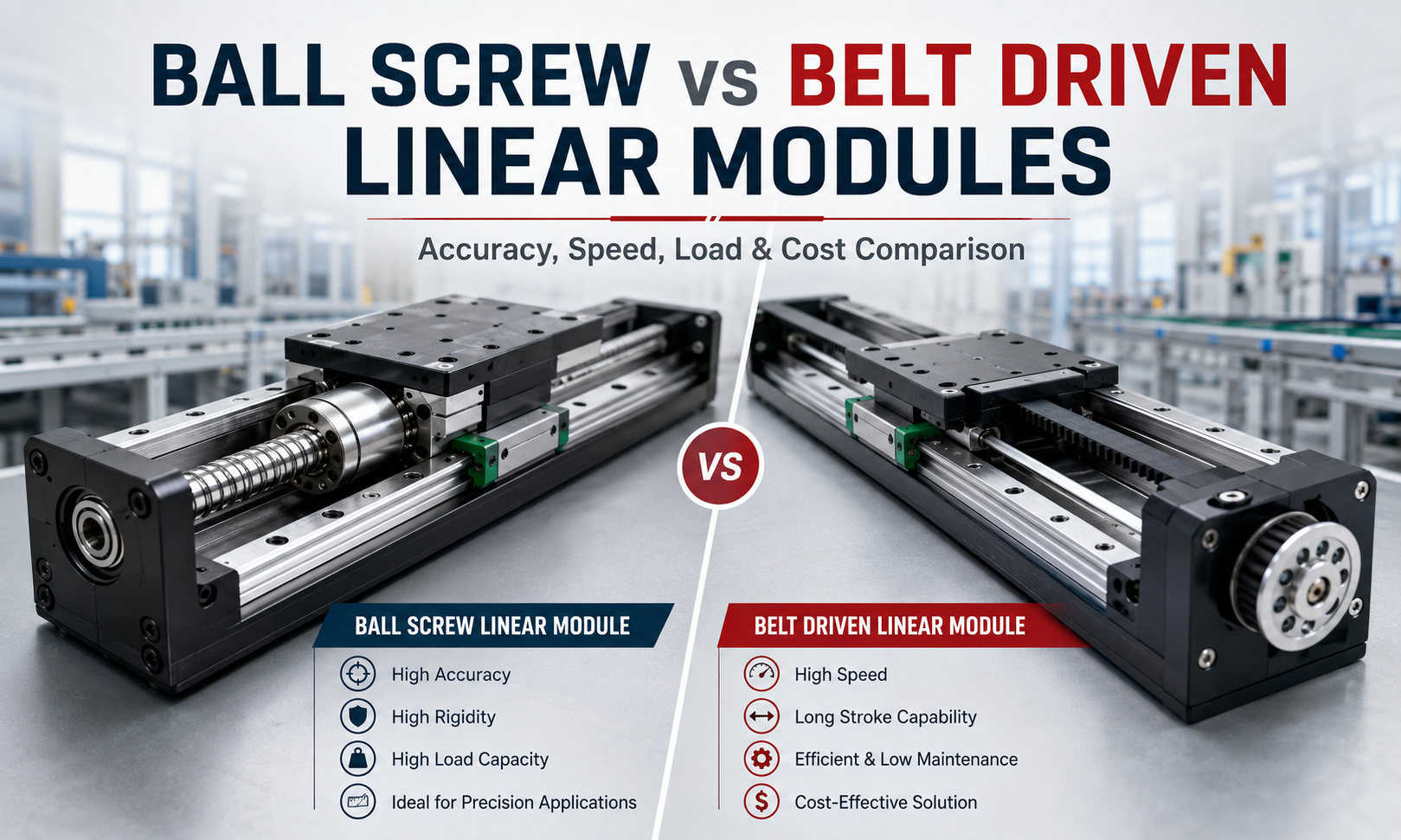
What Is a Ball Screw Linear Module?
Aball screw linear moduleuses a precision ball screw and ball nut assembly to convert the rotary motion of a servo motor or stepper motor into linear movement. Recirculating steel balls roll between the screw shaft and nut, reducing sliding friction and improving transmission efficiency.
The motor is normally connected to the ball screw through a flexible coupling or an integrated drive structure. When the screw rotates, the ball nut moves along the screw axis. The carriage of the linear module is connected to the nut and supported by one or more linear guide rails.
This structure provides accurate positioning, good repeatability, strong thrust transmission, and high mechanical rigidity. Ball screw modules are widely used in precision assembly, semiconductor equipment, machine tools, dispensing systems, inspection equipment, laser processing, laboratory automation, and other applications requiring controlled and repeatable motion.
Main Characteristics of Ball Screw Linear Modules
- High positioning accuracy and repeatability
- Good axial rigidity
- Stable movement at low and medium speeds
- High transmission efficiency
- Suitable for vertical and horizontal motion
- Strong thrust capability
- Available with preload to reduce backlash
- Suitable for precision servo control
What Is a Belt Driven Linear Module?
Abelt driven linear moduleuses a timing belt, drive pulley, driven pulley, and carriage connection block to convert motor rotation into linear movement. The motor rotates the drive pulley, causing the timing belt to move around the pulleys. The carriage is connected to the belt and travels along the guide system.
Because the belt transmission does not require a long rotating screw shaft, belt driven modules can achieve high travel speeds over long strokes. Their structure is relatively simple, lightweight, and economical, making them suitable for material handling, packaging, pick-and-place systems, sorting equipment, logistics automation, and long-stroke gantry systems.
The timing belt teeth engage with the pulley teeth to reduce slippage during normal operation. However, the belt remains an elastic transmission component. Belt stretch, tension variation, load changes, and long-term wear can affect positioning performance.
Main Characteristics of Belt Driven Linear Modules
- High travel speed
- High acceleration capability
- Suitable for long strokes
- Relatively low moving mass
- Simple mechanical structure
- Lower initial cost in many applications
- Suitable for rapid point-to-point transfer
- Easy integration into multi-axis automation systems
Ball Screw vs Belt Driven Linear Module: Quick Comparison
| Comparison Factor | Ball Screw Linear Module | Belt Driven Linear Module |
|---|---|---|
| Positioning Accuracy | Generally higher | Moderate, depending on belt tension and control |
| Repeatability | Excellent for precision positioning | Good for general transfer applications |
| Travel Speed | Moderate to high | Generally higher |
| Acceleration | Limited by screw inertia and critical speed | Well suited for rapid acceleration |
| Stroke Length | Better for short and medium strokes | Better for long strokes |
| Axial Rigidity | High | Lower because of belt elasticity |
| Thrust Capacity | Generally higher | Suitable for light and medium loads |
| Backlash Control | Can be minimized with preload | Affected by belt tension and elasticity |
| Noise | May produce screw and bearing noise at high speed | Usually quiet during normal operation |
| Maintenance | Requires lubrication and screw inspection | Requires belt tension and wear inspection |
| Initial Cost | Usually higher | Usually lower |
| Typical Applications | Precision positioning and machining | High-speed transport and long-stroke handling |
Accuracy Comparison
Accuracy is usually the first factor considered in aball screw vs belt drive comparison. In most precision automation applications, ball screwlinear modulesprovide better positioning accuracy than belt driven systems.
A precision-ground or accurately manufactured ball screw has a defined lead that controls how far the nut travels for each screw revolution. When combined with servo control, an encoder, suitable linear guides, and proper preload, the system can achieve stable and repeatable positioning.
Belt driven systems can also provide reliable positioning, especially for general pick-and-place and material transfer operations. However, their performance is affected by the elasticity of the timing belt. The belt can stretch slightly under load, during acceleration, or after long-term operation. Temperature changes, belt tension, pulley quality, and installation alignment can also influence positioning consistency.
Positioning Accuracy
Positioning accuracy describes how closely the carriage reaches the commanded position. Ball screw modules normally perform better because screw lead accuracy is mechanically defined and the drive system has greater axial stiffness.
A belt driven module may reach a commanded location consistently under stable conditions, but its absolute position can vary when the load, acceleration, belt tension, or travel direction changes.
Repeatability
Repeatability describes the ability of the linear module to return to the same position repeatedly. A properly selected belt module can provide good repeatability for packaging, loading, sorting, and transfer operations.
For applications such as precision dispensing, electronic assembly, optical inspection, laser focusing, or component alignment, a preloadedball screw moduleis usually the safer choice.
Backlash and Elastic Deformation
Ball screw backlash can be reduced through preload, double-nut structures, precise manufacturing, and suitable bearing support. Belt driven systems do not have screw-nut backlash, but they experience elastic deformation and tension-related position variation.
Therefore, a belt drive should not automatically be considered backlash-free. The more useful question is whether the complete system can maintain the required positioning performance under actual payload and acceleration conditions.
Speed Comparison
When high travel speed is the main requirement, a belt driven linear module usually has an advantage. The belt and pulley structure supports rapid carriage movement without rotating a long, heavy screw shaft.
A ball screw rotates along its entire length. As the screw becomes longer or rotates faster, vibration, deflection, heat generation, and critical speed limitations become increasingly important. These factors can limit the practical speed of long-stroke ball screw systems.
Belt driven modules are therefore commonly selected for high-speed transport, packaging, sorting, palletizing, loading, and long-distance pick-and-place operations.
Acceleration and Cycle Time
Belt driven modules often support rapid acceleration because the transmission has lower rotational inertia than a long ball screw. This helps reduce cycle time in applications involving repeated point-to-point movement.
A ball screw module may still provide fast movement, especially over short and medium strokes. However, selecting an excessively large screw diameter or lead can increase rotational inertia and motor requirements.
High Speed Does Not Always Mean Higher Productivity
The maximum rated speed of a linear module should not be the only selection criterion. Productivity depends on acceleration, deceleration, settling time, positioning stability, payload, stroke, and duty cycle.
A belt module may travel faster, but additional settling time may be required if the system vibrates after stopping. A ball screw module may have a lower maximum speed but reach the target position with less oscillation in a precision process.
Stroke Length Comparison
Stroke length is another major difference between ball screw and belt driven linear modules. Ball screw systems are generally more practical for short and medium travel distances, while belt driven systems are better suited for long strokes.
As a ball screw becomes longer, the screw shaft becomes more sensitive to bending, vibration, thermal expansion, and critical speed. A larger screw diameter or additional support structure may be required, increasing cost, weight, and drive inertia.
A timing belt can transmit motion over a much longer module length without the same rotating-shaft limitations. This makes belt driven linear modules suitable for long production lines, large gantry systems, warehouse automation, pallet transfer, and multi-station handling.
For extremely long strokes, rack and pinion or linear motor systems may also be considered, especially when high load capacity, continuous operation, or very high dynamic performance is required.
Load Capacity and Thrust Comparison
The load rating of a linear module depends on more than its drive method. Linear guide size, carriage length, profile rigidity, bearing arrangement, mounting orientation, speed, acceleration, and load position all influence the actual allowable load.
However, when comparing similarly sized systems, a ball screw module normally provides stronger axial thrust and greater drive rigidity. It is therefore commonly used for pressing, machining feed, vertical lifting, controlled insertion, clamping, and other force-intensive operations.
Belt driven modules are generally better suited for light and medium payload transfer. Heavy payloads can still be moved with a belt system, but a wider or stronger belt, larger pulleys, a more powerful motor, and lower acceleration may be required.
Payload Is Not the Same as Thrust
Payload describes the mass carried by the carriage. Thrust describes the linear force required to accelerate, lift, push, pull, or resist an external process force.
A horizontal belt driven module may transport a relatively heavy payload at moderate acceleration, but it may not be suitable for an operation requiring strong continuous pushing force. A ball screw module is usually better for applications where axial force is a primary requirement.
Moment Load Capacity
Pitch, yaw, and roll moments are mainly supported by the linear guide system rather than the ball screw or timing belt. Engineers should evaluate the center of gravity, cantilever distance, carriage spacing, guide rail size, and mounting direction.
A module with a suitable drive system can still fail prematurely if the payload creates excessive moment loads on the carriage.
Rigidity and Motion Stability
Ball screw modules normally provide higher axial rigidity because the load is transmitted through the screw, ball nut, support bearings, and rigid mechanical connections. This helps the carriage resist displacement under changing process forces.
A timing belt has inherent elasticity. When the system accelerates, decelerates, reverses direction, or experiences an external force, the belt can stretch slightly. This may create vibration, overshoot, or additional settling time.
For cutting, drilling, precision dispensing, pressing, scanning, or inspection processes, the higher rigidity of a ball screw module can improve motion stability and process consistency.
For simple transfer operations where the carriage moves to a position, releases or collects a product, and then moves again, the elasticity of a belt system may not create a practical problem.
Vertical Installation Comparison
Both ball screw and belt driven linear modules can be installed vertically, but the design requirements are different.
A ball screw system is commonly selected for vertical axes because it provides high thrust, good rigidity, and controlled positioning. However, most standard ball screws are not completely self-locking. A brake motor, counterbalance, safety device, or mechanical locking mechanism may still be necessary to prevent the load from falling during power loss.
A belt driven vertical axis can provide high speed and long travel, but belt strength, tooth engagement, tension, motor brake capacity, and emergency holding requirements must be carefully evaluated. A belt failure on a vertical axis may allow the carriage to fall if no independent safety mechanism is installed.
For safety-critical vertical applications, the drive method should be selected together with a complete fall-prevention strategy.
Noise and Vibration Comparison
Belt driven linear modules are often quieter than ball screw systems during high-speed travel. Timing belts produce smooth motion when pulley alignment and belt tension are correct.
Ball screw modules may generate noise from recirculating balls, support bearings, couplings, and screw rotation. Noise can increase at high rotational speed, with insufficient lubrication, poor alignment, worn bearings, or damaged screw surfaces.
However, an incorrectly tensioned belt can also create vibration, resonance, tooth engagement noise, or pulley wear. Noise performance depends on product quality, installation, operating speed, maintenance, and structural resonance.
Maintenance Requirements
Ball Screw Module Maintenance
Ball screw linear modules require regular lubrication of the ball screw and linear guide system. Contamination should be prevented from entering the screw raceway, nut, bearings, and guide blocks.
- Check lubrication condition at scheduled intervals
- Inspect the screw for dirt, corrosion, or damage
- Check support bearings and coupling condition
- Verify mounting bolts and motor connections
- Monitor backlash, noise, temperature, and positioning accuracy
Belt Driven Module Maintenance
Belt driven modules do not require lubrication on the timing belt itself, but the linear guides may still require grease. Belt condition and tension should be inspected regularly.
- Inspect the belt for cracks, wear, missing teeth, or edge damage
- Check belt tension
- Inspect drive and driven pulleys
- Check pulley alignment and bearing condition
- Monitor positioning drift, abnormal noise, and vibration
Neither design is maintenance-free. The correct maintenance schedule depends on travel distance, operating speed, load, contamination, temperature, duty cycle, and manufacturer recommendations.
Service Life Comparison
The service life of a ball screw module is affected by dynamic load, axial force, speed, lubrication, contamination, alignment, preload, and operating duty. A correctly sized and maintained ball screw can provide long and predictable service life.
The service life of a belt driven module depends heavily on belt material, belt tension, pulley diameter, tooth engagement, acceleration, load, temperature, and operating environment. Timing belts are wear components and may require periodic replacement.
A lower-cost module does not always have a lower lifetime cost. Engineers should include replacement parts, production downtime, maintenance labor, lubrication, inspection frequency, and expected operating life when comparing systems.
Cost Comparison
Belt driven linear modules generally have a lower initial cost because their transmission structure is simpler and does not require a precision ball screw and ball nut assembly. The cost advantage can become more significant for long-stroke systems.
Ball screw modules usually have a higher purchase price, especially when the application requires a precision screw, preload, high-grade support bearings, protective covers, or high-accuracy assembly.
However, the purchase price is only one part of the total cost. A lower-cost belt module may become expensive if insufficient rigidity or accuracy causes product defects, slow settling, repeated calibration, or frequent belt replacement.
Similarly, using a high-precision ball screw module for a simple transport task may increase equipment cost without creating measurable production benefits.
Total Cost of Ownership Should Include
- Initial module purchase price
- Motor and drive requirements
- Installation and commissioning time
- Lubrication and maintenance labor
- Replacement belt, screw, bearing, or coupling costs
- Production downtime
- Energy consumption
- Product quality and rejection risk
- Expected service life
Environmental Suitability
Dust and Contamination
Ball screws are sensitive to abrasive particles and contamination because dirt can enter the ball circulation path and damage the raceway. Protective covers, seals, bellows, or fully enclosed module structures may be required.
Timing belts can also be damaged by dust, chips, oil, and chemical exposure. Particles trapped between the belt and pulley can damage the teeth or reduce engagement quality.
Cleanroom Applications
Both drive types can be designed for cleanroom use, but the module must be specifically configured with suitable lubrication, sealing materials, low-particle components, and contamination control.
A standard industrial module should not automatically be assumed suitable for semiconductor, pharmaceutical, medical, or other clean production environments.
High Temperature and Chemical Exposure
High temperature can affect lubricant viscosity, screw expansion, belt tension, belt material strength, seals, bearings, and positioning accuracy. Chemical compatibility should also be checked when the module is exposed to cleaning agents, solvents, oil, or corrosive substances.
Control System Differences
Both ball screw and belt driven linear modules can be controlled by servo motors or stepper motors. The control architecture may include a motor encoder, external linear encoder, limit sensors, home sensors, andmotion controller.
Ball screw modules are often easier to tune for precision positioning because of their higher mechanical rigidity. Belt driven systems may require careful adjustment of acceleration, deceleration, servo gain, jerk, and settling time to avoid oscillation.
For high-accuracy belt driven applications, an external linear encoder can measure the actual carriage position instead of relying only on motor rotation. This can improve closed-loop positioning performance, although it also increases cost and control complexity.
Application Differences
Applications Better Suited to Ball Screw Linear Modules
- Precision dispensing and adhesive application
- Electronic component assembly
- Semiconductor processing equipment
- Vision inspection and measurement systems
- Laser cutting, engraving, and focusing
- CNC machine feeding
- Precision drilling and tapping
- Laboratory and medical automation
- Controlled insertion and press-fit processes
- Vertical lifting requiring high rigidity
Applications Better Suited to Belt Driven Linear Modules
- High-speed pick-and-place systems
- Packaging machinery
- Sorting and distribution equipment
- Material transfer systems
- Warehouse and logistics automation
- Long-stroke gantry robots
- Pallet handling systems
- Loading and unloading equipment
- Labeling and printing machines
- Multi-station production line transfer
How to Choose Between Ball Screw and Belt Driven Linear Modules
Choose a Ball Screw Linear Module When:
- High positioning accuracy is required
- Repeatability directly affects product quality
- The system must resist external process forces
- High axial thrust is required
- The application involves precision low-speed movement
- The module is used for controlled vertical lifting
- Stroke length is short or moderate
- Settling time must be minimized
- Mechanical rigidity is more important than maximum speed
Choose a Belt Driven Linear Module When:
- High travel speed is the main requirement
- The system requires a long stroke
- Short point-to-point cycle time is important
- The payload is light or moderate
- Positioning accuracy requirements are not extremely strict
- The application mainly performs transport or transfer
- Lower initial cost is important
- The machine requires a lightweight moving system
- The module will be integrated into a long gantry or Cartesian system
Important Parameters to Confirm Before Selection
Before purchasing either type of linear module, prepare a complete application specification. Selecting only by model size or maximum payload can result in poor performance or premature failure.
- Effective stroke:Confirm the required working travel and reserve space for acceleration, deceleration, and safety limits.
- Payload:Include the tooling, workpiece, cables, sensors, brackets, and moving accessories.
- Mounting orientation:Specify horizontal, vertical, wall-mounted, inverted, or inclined installation.
- Required speed:Define normal operating speed rather than only maximum speed.
- Acceleration:High acceleration can create larger forces than constant-speed travel.
- Positioning accuracy:Distinguish between absolute accuracy, repeatability, and resolution.
- External force:Include pressing, cutting, insertion, friction, and process resistance.
- Duty cycle:Confirm operating hours, cycles per minute, travel distance, and rest periods.
- Moment load:Calculate the center-of-gravity offset and cantilever distance.
- Environment:Identify dust, oil, humidity, cleanroom, temperature, chemicals, and washdown requirements.
- Service life:Define the expected operating life and acceptable maintenance intervals.
- Safety requirements:Include brakes, limit switches, covers, emergency stops, and vertical fall protection.
Common Selection Mistakes
Selecting Only by Maximum Speed
A module with a high maximum speed may not provide the best cycle time if it requires slow acceleration, long settling time, or frequent maintenance.
Ignoring Load Offset
A payload mounted far from the carriage creates significant moment loads. The total payload may appear acceptable while the guide system is overloaded.
Assuming Belt Drives Have No Positioning Error
Timing belts reduce mechanical slippage through tooth engagement, but belt elasticity, tension, wear, and structural deformation still affect position.
Assuming Ball Screws Are Self-Locking
Most ball screws can back-drive under external force. Vertical axes may require a brake, counterbalance, or mechanical safety device.
Comparing Only Purchase Price
The least expensive module may create higher lifetime costs through downtime, product defects, maintenance, or early replacement.
Using Excessive Accuracy Requirements
Specifying precision beyond the actual process requirement increases module, motor, control, and installation costs. Accuracy requirements should be based on the final product and process tolerance.
Ball Screw vs Belt Driven Linear Module Selection Examples
Precision Dispensing System
A dispensing system must apply adhesive along a controlled path with consistent bead width. Positioning stability, smooth low-speed movement, and minimal path error are critical. A ball screw linear module is generally the better option.
High-Speed Packaging Transfer
A packaging machine must move lightweight products rapidly between stations over a long stroke. High speed and acceleration are more important than micron-level accuracy. A belt driven linear module is usually more economical and productive.
Vertical Component Lifting
A vertical axis lifts a fixture and holds it accurately during assembly. High thrust, rigidity, and braking safety are important. A ball screw module with a brake motor and appropriate fall-prevention system is commonly selected.
Long-Stroke Gantry Robot
Agantry robotmust move products across several meters of a production line. A belt driven module can provide long travel and high speed without the critical speed limitations of a long rotating ball screw.
Machine Tool Feed Axis
A feed axis must resist cutting force and maintain stable positioning. A ball screw system is generally preferred because of its rigidity, thrust capability, and precision.
Frequently Asked Questions
Which is more accurate, a ball screw or a belt driven linear module?
A ball screw linear module is generally more accurate because it provides higher axial rigidity, controlled screw lead, and the option of preload. Belt driven modules can provide good repeatability for transfer applications but are more affected by elasticity and tension.
Which linear module is faster?
A belt driven linear module is normally faster, especially for long-stroke applications. It avoids the critical speed and vibration limitations associated with long rotating ball screws.
Which type is better for heavy loads?
A ball screw module is generally better when heavy loads are combined with high thrust, vertical motion, or strong external process forces. The final selection must also consider guide size, moment load, speed, and mounting orientation.
Can a belt driven module achieve precise positioning?
Yes. A properly designed belt driven module can provide reliable positioning for many industrial applications. Performance can be improved through correct tensioning, servo control, structural rigidity, and an external linear encoder when necessary.
Is a ball screw module suitable for long strokes?
Ball screw modules can be designed for long strokes, but screw diameter, support method, critical speed, vibration, thermal expansion, and motor inertia must be evaluated. Belt, rack and pinion, or linear motor systems may be more practical for very long travel.
Which system requires less maintenance?
The answer depends on the application. Ball screw modules require lubrication and contamination control. Belt modules require tension and wear inspection. Both systems require regular maintenance of their linear guides, bearings, fasteners, sensors, and drive components.
Which option has the lower cost?
Belt driven modules usually have a lower initial cost, particularly for long strokes. Ball screw modules may provide better value when accuracy, rigidity, thrust, and process stability directly affect production quality.
Conclusion
There is no single winner in theball screw vs belt driven linear modulecomparison. Each drive method is designed for a different combination of motion requirements.
Choose a ball screw linear module when positioning accuracy, repeatability, axial rigidity, thrust, low-speed stability, and controlled motion are the main priorities. Choose a belt driven linear module when speed, acceleration, long stroke, lightweight construction, and lower initial cost are more important.
The best selection should be based on the complete operating condition rather than one isolated specification. Payload, stroke, speed, acceleration, accuracy, mounting direction, process force, environmental conditions, service life, safety, and total cost must all be evaluated together.
By defining these requirements clearly before selecting the module, engineers can avoid oversizing, insufficient accuracy, premature component wear, unstable motion, and unnecessary equipment costs while building a more reliable and efficient automation system.