 English

Linear modules have become one of the most important motion solutions in modern industrial automation. They are designed to provide accurate, repeatable, and efficient linear motion by integrating mechanical transmission components, guide systems, drive units, and control interfaces into a compact and standardized platform.
Compared with traditional motion systems assembled from individual components, linear modules offer superior performance, simplified installation, improved reliability, and lower maintenance requirements. Their modular architecture also enables engineers to build customized automation systems more efficiently while reducing overall engineering complexity.
Today, linear modules are widely used in CNC machining, semiconductor manufacturing, electronics assembly, packaging equipment, medical automation, logistics systems, industrial robots, and countless other applications where precise and reliable linear motion is essential.
However, not all users fully understand why linear modules have become the preferred choice for modern automation equipment. Their popularity is not based on a single advantage, but rather on a combination of outstanding mechanical and control characteristics that work together to improve machine performance.
This article explores the most important features of linear modules, including high positioning accuracy, high operating speed, excellent rigidity, long stroke capability, modular construction, smooth motion, low noise operation, flexible configuration, and many other characteristics that make linear modules an indispensable component of industrial automation.
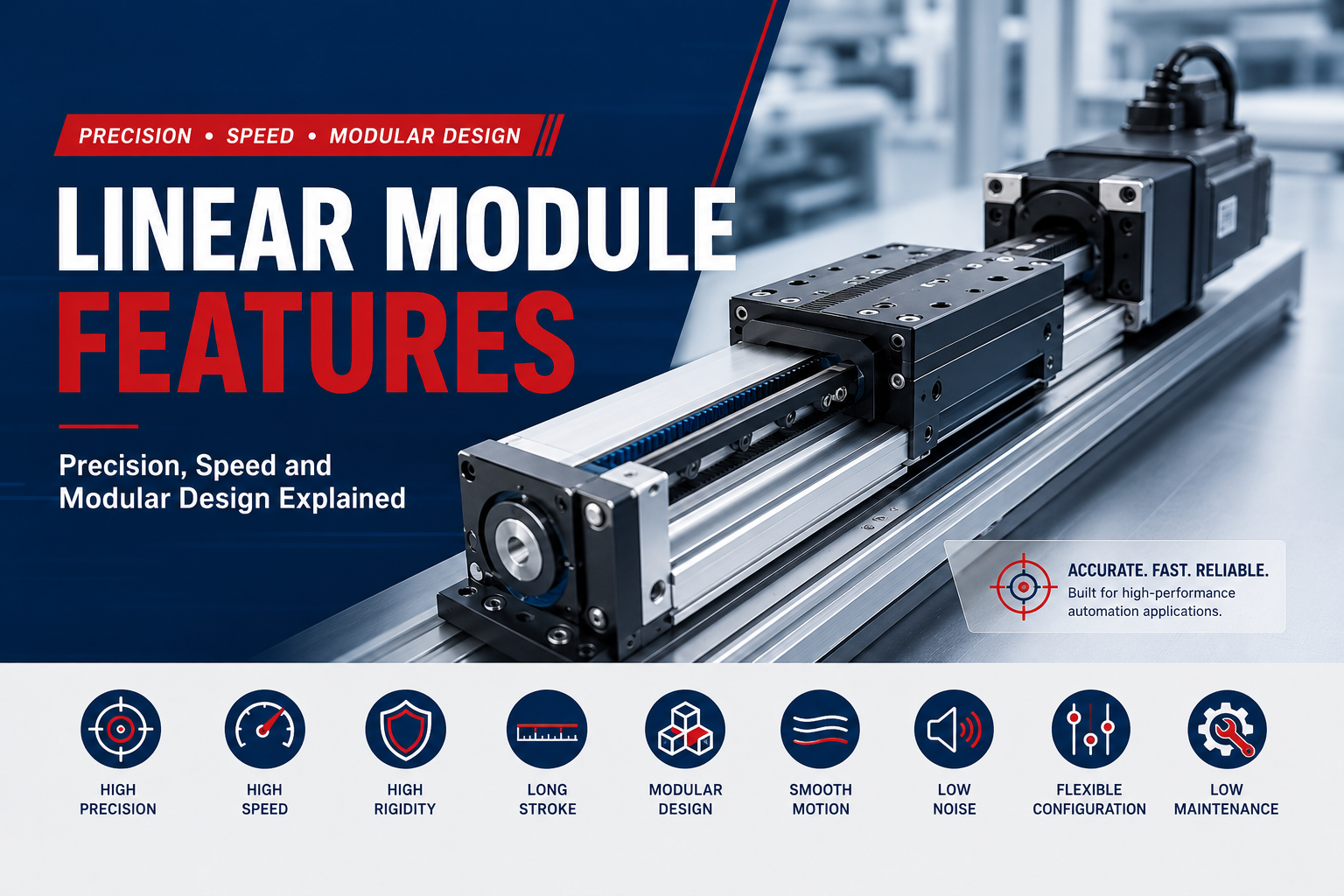
Table of Contents
- What Are the Main Features of Linear Modules?
- Why Features Matter in Industrial Automation
- Overview of Key Linear Module Features
- High Precision
- High Speed
- High Rigidity
- Long Stroke Capability
- Modular Design
- Smooth Motion
- Low Noise Operation
- Flexible Configuration
- Excellent Repeatability
- Easy Integration
- Low Maintenance
- Feature Comparison
- Industry Applications
- Frequently Asked Questions
- Conclusion
What Are the Main Features of Linear Modules?
A linear module combines multiple precision mechanical components into a single integrated motion platform. Instead of assembling guide rails, drive mechanisms, bearings, couplings, motor mounts, and support structures separately, manufacturers integrate these elements into a complete system that is optimized for performance, reliability, and ease of installation.
This integrated design provides numerous advantages compared with conventional motion systems. Engineers benefit from simplified machine design, shorter assembly time, improved positioning performance, and reduced maintenance throughout the equipment lifecycle.
Although different linear module types are optimized for different applications, most industrial linear modules share several common characteristics:
- High positioning accuracy
- Excellent repeatability
- High operating speed
- Strong structural rigidity
- Long service life
- Modular construction
- Flexible customization
- Smooth and stable motion
- Easy maintenance
- Excellent compatibility with automation systems
Together, these characteristics enable linear modules to satisfy the increasingly demanding requirements of intelligent manufacturing, precision engineering, and industrial automation.
Why Features Matter in Industrial Automation
Every automation project has different performance priorities. Some production lines require micron-level positioning accuracy, while others focus on high-speed transportation, heavy payload handling, or long travel distances. Understanding the characteristics of a linear module helps engineers select equipment that delivers the best balance between performance, reliability, and cost.
For example, choosing a module with insufficient rigidity may reduce positioning accuracy under heavy loads, while selecting a module that cannot achieve the required speed may limit production efficiency. Similarly, inadequate environmental protection can shorten equipment life in dusty manufacturing environments.
Evaluating the key features of a linear module before selecting a product reduces engineering risk and improves the long-term performance of the entire automation system.
Overview of Key Linear Module Features
| Feature | Primary Benefit | Main Value |
|---|---|---|
| High Precision | Accurate positioning | Improved product quality |
| High Speed | Faster production | Higher productivity |
| High Rigidity | Stable operation | Better machining accuracy |
| Long Stroke | Extended working range | Large equipment capability |
| Modular Design | Easy integration | Flexible machine design |
| Smooth Motion | Reduced vibration | Higher precision |
| Low Noise | Comfortable operation | Better working environment |
| Flexible Configuration | Custom solutions | Broader application range |
| Low Maintenance | Reduced downtime | Lower operating cost |
The following sections examine each of these features in detail, explaining how they influence machine performance and why they are important in modern industrial automation.
Feature 1: High Precision
One of the defining characteristics of a modern linear module is its ability to achieve highly accurate positioning. Precision is essential in industries such as semiconductor manufacturing, electronics assembly, CNC machining, laser processing, and medical automation, where even small positioning errors can affect product quality.
High precision is achieved through the combination of precision linear guides, high-quality drive mechanisms, rigid structural design, and advanced servo control systems. Depending on the drive technology, repeatability can reach several micrometers or even sub-micron levels.
Factors That Influence Precision
- Linear guide quality
- Drive mechanism accuracy
- Servo control performance
- Structural rigidity
- Assembly precision
- Thermal stability
Applications Requiring High Precision
- Semiconductor manufacturing
- Optical inspection
- Laser processing
- Medical equipment
- CNC machine tools
- Electronic assembly
Feature 2: High Speed
High operating speed is another defining feature of modern linear modules. As manufacturing industries continue to pursue higher productivity and shorter production cycles, automation equipment must be capable of moving workpieces quickly while maintaining positioning accuracy and operational stability.
Linear modules are specifically engineered to support rapid acceleration, high travel speeds, and continuous operation. By combining lightweight moving components, low-friction linear guides, optimized transmission systems, and high-performance servo motors, modern linear modules can achieve impressive dynamic performance without sacrificing reliability.
The maximum speed of a linear module depends largely on its drive mechanism. Belt driven modules generally provide the highest travel speeds over long distances, while linear motor modules deliver exceptional acceleration and dynamic response.Ball screw modules, although optimized for precision, also offer sufficient speed for many high-accuracy manufacturing applications.
Benefits of High-Speed Operation
- Shorter production cycles.
- Higher manufacturing efficiency.
- Improved machine throughput.
- Reduced idle time between operations.
- Better return on automation investment.
Factors Affecting Maximum Speed
- Drive mechanism type.
- Motor power and torque.
- Moving mass.
- Stroke length.
- Guide rail quality.
- Control system performance.
Typical High-Speed Applications
- Packaging machinery
- Logistics automation
- Pick-and-place robots
- Electronic assembly
- Sorting systems
- High-speed inspection equipment
Feature 3: High Rigidity
Rigidity refers to the ability of a linear module to resist deformation under load. A highly rigid structure maintains positioning accuracy even when carrying heavy payloads or operating under high acceleration, making rigidity one of the most important indicators of overall machine performance.
Modern linear modules achieve excellent rigidity through optimized aluminum or steel base structures, precision linear guide systems, robust bearing arrangements, and carefully engineered drive mechanisms. High rigidity minimizes vibration, reduces deflection, and improves machining quality in demanding industrial environments.
For applications such as CNC machining, laser cutting, precision dispensing, and automated assembly, insufficient rigidity can lead to positioning errors, inconsistent product quality, and premature component wear.
Advantages of High Rigidity
- Improved positioning accuracy.
- Reduced structural vibration.
- Higher load capacity.
- Greater machine stability.
- Longer service life.
- Better repeatability.
How Manufacturers Improve Rigidity
- High-strength aluminum extrusion.
- Steel reinforcement where required.
- Wide linear guide spacing.
- Large guide blocks.
- Precision bearing support.
- Optimized structural analysis.
Applications Requiring High Rigidity
- CNC machining centers
- Laser cutting machines
- Heavy-duty automation
- Precision measurement equipment
- Industrial assembly systems
Feature 4: Long Stroke Capability
Unlike many conventional linear actuators, linear modules can be manufactured with a wide range of travel lengths to accommodate different industrial applications. Depending on the drive mechanism, stroke lengths may range from only a few millimeters to several meters.
Long stroke capability is particularly valuable in warehouse automation, material handling,gantry robots, automated production lines, and large inspection systems where components must travel over significant distances while maintaining consistent motion quality.
Belt driven and rack and pinion linear modules are especially suitable for long travel applications because their drive mechanisms are not limited by the critical speed constraints associated with long ball screws.
Benefits of Long Stroke Design
- Greater working area.
- Improved production flexibility.
- Reduced equipment complexity.
- Suitable for large automation systems.
- Easy integration into gantry robots.
Typical Long-Stroke Applications
- Warehouse automation
- Material transfer systems
- Automated storage systems
- Large-format printing equipment
- Industrial gantry robots
- Automotive production lines
Feature 5: Modular Design
One of the greatest advantages of modern linear modules is their modular design philosophy. Instead of requiring engineers to design every mechanical component individually, manufacturers integrate guide rails, drive mechanisms, bearings, support structures, motor interfaces, and mounting features into standardized modules that can be combined to create complete motion systems.
This modular architecture dramatically reduces engineering time, simplifies installation, and allows machine builders to develop customized automation equipment using standardized building blocks.
Whether constructing a simple single-axis positioning system or a complex multi-axis Cartesian robot, modular linear motion systems provide outstanding flexibility while maintaining consistent performance and reliability.
Benefits of Modular Design
- Shorter machine development time.
- Simplified installation.
- Easy maintenance.
- Excellent scalability.
- Flexible customization.
- Reduced engineering cost.
- High compatibility with automation components.
Common Modular Configurations
| Configuration | Description | Typical Applications |
|---|---|---|
| Single-Axis Module | One-direction linear motion | Material transfer |
| XY Motion System | Two-axis positioning | Dispensing, inspection |
| XYZ Cartesian Robot | Three-axis motion platform | Assembly, pick and place |
| Multi-Axis Gantry | Large coordinated motion system | Heavy industrial automation |
Why Modular Design Is Important
As manufacturing systems become increasingly flexible and intelligent, equipment builders require standardized motion platforms that can be quickly adapted to changing production requirements. Modular linear modules provide this flexibility by allowing engineers to replace, expand, or reconfigure individual motion axes without redesigning the entire machine.
This modular approach also improves spare parts management, simplifies future upgrades, and reduces total lifecycle costs, making it one of the most valuable characteristics of modern industrial linear motion systems.
Feature 6: Smooth Motion
Smooth motion is one of the most valuable characteristics of a high-quality linear module. During operation, the carriage should move continuously and consistently without noticeable vibration, sticking, or sudden changes in velocity. Stable motion not only improves positioning accuracy but also protects sensitive workpieces and extends the service life of mechanical components.
Smooth linear movement is achieved through the combination of precision linear guide rails, high-quality bearings, optimized drive mechanisms, accurate machining, and advanced servo motion control. Together, these components minimize friction and ensure uniform motion throughout the entire stroke.
For industries such as semiconductor manufacturing, precision dispensing, laser processing, optical inspection, and electronics assembly, smooth motion directly affects product quality and production consistency.
Benefits of Smooth Motion
- Higher positioning stability.
- Reduced vibration.
- Better surface finish during machining.
- Lower mechanical wear.
- Improved product quality.
- Longer equipment lifespan.
Factors Affecting Motion Smoothness
- Guide rail accuracy.
- Bearing quality.
- Drive mechanism precision.
- Servo tuning.
- Machine rigidity.
- Assembly quality.
Feature 7: Low Noise Operation
As industrial equipment becomes increasingly sophisticated, low operating noise has become an important performance indicator for modern automation systems. A well-designed linear module generates minimal noise during operation, providing a more comfortable working environment while also indicating smooth mechanical performance.
Low noise is achieved through precision manufacturing, optimized bearing design, high-quality guide systems, properly tensioned drive mechanisms, and effective lubrication. Reduced vibration also contributes significantly to quieter operation.
In industries such as medical equipment, laboratory automation, electronics manufacturing, and office automation, quiet operation is particularly important because excessive mechanical noise may interfere with sensitive equipment or operator comfort.
Advantages of Low Noise
- Improved workplace environment.
- Reduced vibration.
- Higher perceived equipment quality.
- Lower mechanical stress.
- Greater operator comfort.
Feature 8: Flexible Configuration
Modern linear modules are designed to support a wide variety of configurations, allowing manufacturers to tailor motion systems to specific production requirements. Rather than offering only fixed models, mostlinear module manufacturersprovide numerous options for drive mechanisms, guide systems, stroke lengths, motor mounting, sensors, protective covers, and multi-axis combinations.
This flexibility enables machine builders to create highly customized automation equipment without designing an entirely new motion platform from scratch.
Common Customization Options
- Custom stroke length.
- Servo or stepper motor compatibility.
- Multiple drive mechanisms.
- Various guide rail sizes.
- Horizontal or vertical installation.
- Integrated cable management.
- Protective covers.
- Special environmental protection.
Advantages of Flexible Configuration
- Supports diverse applications.
- Simplifies equipment design.
- Reduces engineering time.
- Improves production flexibility.
- Facilitates future expansion.
Feature 9: Excellent Repeatability
Repeatability describes a linear module's ability to return to the same position repeatedly under identical operating conditions. While positioning accuracy measures the difference between the commanded position and the actual position, repeatability evaluates consistency over multiple cycles.
High repeatability is essential in automated assembly, precision dispensing, laser marking, semiconductor manufacturing, and robotic applications where identical movements must be repeated thousands or even millions of times.
Modern linear modules achieve outstanding repeatability through precision guide systems, rigid mechanical structures, high-quality drive components, and advanced closed-loop servo control.
Benefits of High Repeatability
- Consistent product quality.
- Stable production processes.
- Reduced rejection rates.
- Higher automation reliability.
- Improved manufacturing precision.
Feature 10: Easy Integration
Industrial automation increasingly relies on standardized components that can be integrated quickly into larger production systems. Linear modules are designed with this requirement in mind, providing standardized mounting interfaces, motor connections, sensor locations, and communication compatibility.
Whether integrating with PLCs, servo systems, industrial robots, vision systems, or manufacturing execution systems (MES), modern linear modules simplify system integration and reduce commissioning time.
Integration Advantages
- Standardized mounting interfaces.
- Compatible with mainstream servo motors.
- Easy sensor installation.
- Simple electrical wiring.
- Supports multi-axis synchronization.
- Fast machine commissioning.
Feature 11: Low Maintenance
Another important advantage of modern linear modules is their relatively low maintenance requirement. Because manufacturers optimize guide systems, drive mechanisms, lubrication methods, and protective structures during product development, maintenance intervals are generally longer than those of traditional self-assembled motion systems.
Many fully enclosed linear modules effectively protect internal components from dust, coolant, and debris, significantly reducing contamination-related failures and extending maintenance cycles.
Maintenance Benefits
- Lower operating costs.
- Reduced machine downtime.
- Longer service life.
- Simplified maintenance procedures.
- Higher production availability.
Summary of Key Linear Module Features
| Feature | Main Advantage | Industrial Value |
|---|---|---|
| High Precision | Accurate positioning | Improved product quality |
| High Speed | Fast production | Higher efficiency |
| High Rigidity | Stable structure | Heavy-load capability |
| Long Stroke | Extended travel | Large automation systems |
| Modular Design | Flexible integration | Reduced engineering cost |
| Smooth Motion | Reduced vibration | Better process stability |
| Low Noise | Quiet operation | Improved working environment |
| Flexible Configuration | Custom solutions | Broader application range |
| Excellent Repeatability | Consistent positioning | Reliable production |
| Easy Integration | Simple installation | Shorter development cycle |
| Low Maintenance | Reduced servicing | Lower lifecycle cost |
Rather than relying on a single performance advantage, modern linear modules combine multiple engineering features to deliver comprehensive motion solutions. The integration of precision, speed, rigidity, modularity, and reliability enables manufacturers to build highly efficient automation systems capable of meeting the demands of Industry 4.0 and intelligent manufacturing.
How to Evaluate Linear Module Features
Selecting a linear module involves much more than comparing product specifications. Engineers should evaluate the complete combination of performance characteristics to ensure the selected module matches the requirements of the intended application. A module with the highest positioning accuracy may not be the best choice if the application primarily requires long travel distances or high operating speeds.
The evaluation process should consider mechanical performance, environmental conditions, system integration requirements, maintenance expectations, and overall lifecycle cost. By balancing these factors, manufacturers can optimize both machine performance and long-term operating efficiency.
Key Evaluation Criteria
| Evaluation Factor | Questions to Consider | Recommended Feature Priority |
|---|---|---|
| Positioning Accuracy | Does the application require micron-level positioning? | High Precision, High Rigidity |
| Production Speed | Is cycle time a critical factor? | High Speed, Smooth Motion |
| Payload Capacity | Will the module carry heavy loads? | High Rigidity |
| Travel Distance | Does the application require long stroke movement? | Long Stroke Capability |
| Machine Expansion | Will additional motion axes be added later? | Modular Design, Flexible Configuration |
| Operating Environment | Will the module operate in dusty or harsh conditions? | Low Maintenance, Protective Design |
| Integration Requirements | Must the module communicate with existing automation systems? | Easy Integration |
Linear Module Features Across Different Industries
Different industries prioritize different performance characteristics depending on their manufacturing processes. Understanding these priorities helps engineers choose the most appropriate linear module for each application.
| Industry | Most Important Features |
|---|---|
| Semiconductor Manufacturing | High Precision, Smooth Motion, Excellent Repeatability |
| CNC Machine Tools | High Rigidity, High Precision |
| Electronics Assembly | High Speed, High Precision, Easy Integration |
| Packaging Equipment | High Speed, Long Stroke, Low Maintenance |
| Warehouse Automation | Long Stroke, Flexible Configuration |
| Industrial Robots | Modular Design, High Speed, Repeatability |
| Medical Equipment | Smooth Motion, Low Noise, High Precision |
| Inspection Systems | Repeatability, Precision, Motion Stability |
Feature Comparison by Application
| Application | Most Important Features |
|---|---|
| Pick and Place Systems | High Speed, Repeatability |
| Laser Cutting | Precision, Rigidity, Smooth Motion |
| Automated Assembly | Precision, Modular Design |
| Material Handling | Long Stroke, High Speed |
| Vision Inspection | Smooth Motion, Repeatability |
| Medical Automation | Low Noise, Precision |
| Large Gantry Systems | Rigidity, Flexible Configuration |
Frequently Asked Questions (FAQ)
1. What are the main features of a linear module?
The primary features include high precision, high speed, excellent rigidity, long stroke capability, modular construction, smooth motion, low noise operation, flexible configuration, outstanding repeatability, easy integration, and low maintenance requirements.
2. Why is high precision important?
High precision ensures accurate positioning, improves manufacturing quality, reduces production errors, and supports demanding applications such as semiconductor processing, laser machining, and CNC manufacturing.
3. Which type of linear module offers the highest speed?
Belt driven linear modules generally provide the highest travel speeds over long distances, while linear motor modules deliver the highest acceleration and dynamic performance.
4. What does rigidity mean in a linear module?
Rigidity refers to the structural stiffness of the module. A rigid linear module resists deformation under load, improving positioning accuracy, stability, and machining quality.
5. Why is modular design beneficial?
Modular design simplifies machine development, shortens installation time, supports future expansion, and allows engineers to build customized automation systems using standardized motion components.
6. What is repeatability?
Repeatability is the ability of a linear module to return to the same position repeatedly under identical operating conditions. High repeatability is essential for consistent manufacturing quality.
7. Are linear modules suitable for harsh industrial environments?
Yes. Many industrial linear modules are available with enclosed designs, protective covers, corrosion-resistant materials, and specialized sealing systems for dusty, humid, or contaminated environments.
8. Can linear modules be customized?
Yes. Most manufacturers offer customization options including stroke length, motor selection, guide rail size, protective covers, sensors, mounting methods, and multi-axis configurations.
9. What industries benefit most from linear modules?
Linear modules are widely used in CNC machining, semiconductor manufacturing, electronics production, industrial robotics, packaging machinery, warehouse automation, medical equipment, laboratory automation, and precision inspection systems.
10. How do linear modules reduce maintenance costs?
Integrated mechanical design, optimized lubrication systems, enclosed structures, and precision manufacturing reduce wear, minimize contamination, and extend maintenance intervals, resulting in lower total operating costs.
Conclusion
Modern linear modules combine multiple advanced engineering features into a compact and highly efficient motion platform. Their high precision, fast operating speed, structural rigidity, long stroke capability, modular architecture, smooth motion, low noise, and excellent repeatability make them essential components in today's industrial automation systems.
Rather than evaluating a linear module based on a single specification, engineers should consider the complete combination of performance characteristics together with the application's accuracy requirements, travel distance, payload, operating environment, and production objectives. Selecting the right balance of features leads to higher productivity, improved product quality, and lower lifecycle costs.
As Industry 4.0, smart manufacturing, and intelligent robotics continue to evolve, linear modules will play an increasingly important role in enabling flexible, efficient, and highly automated production systems. Understanding the key features of linear modules provides a solid foundation for selecting the optimal linear motion solution for both current and future automation projects.