 English

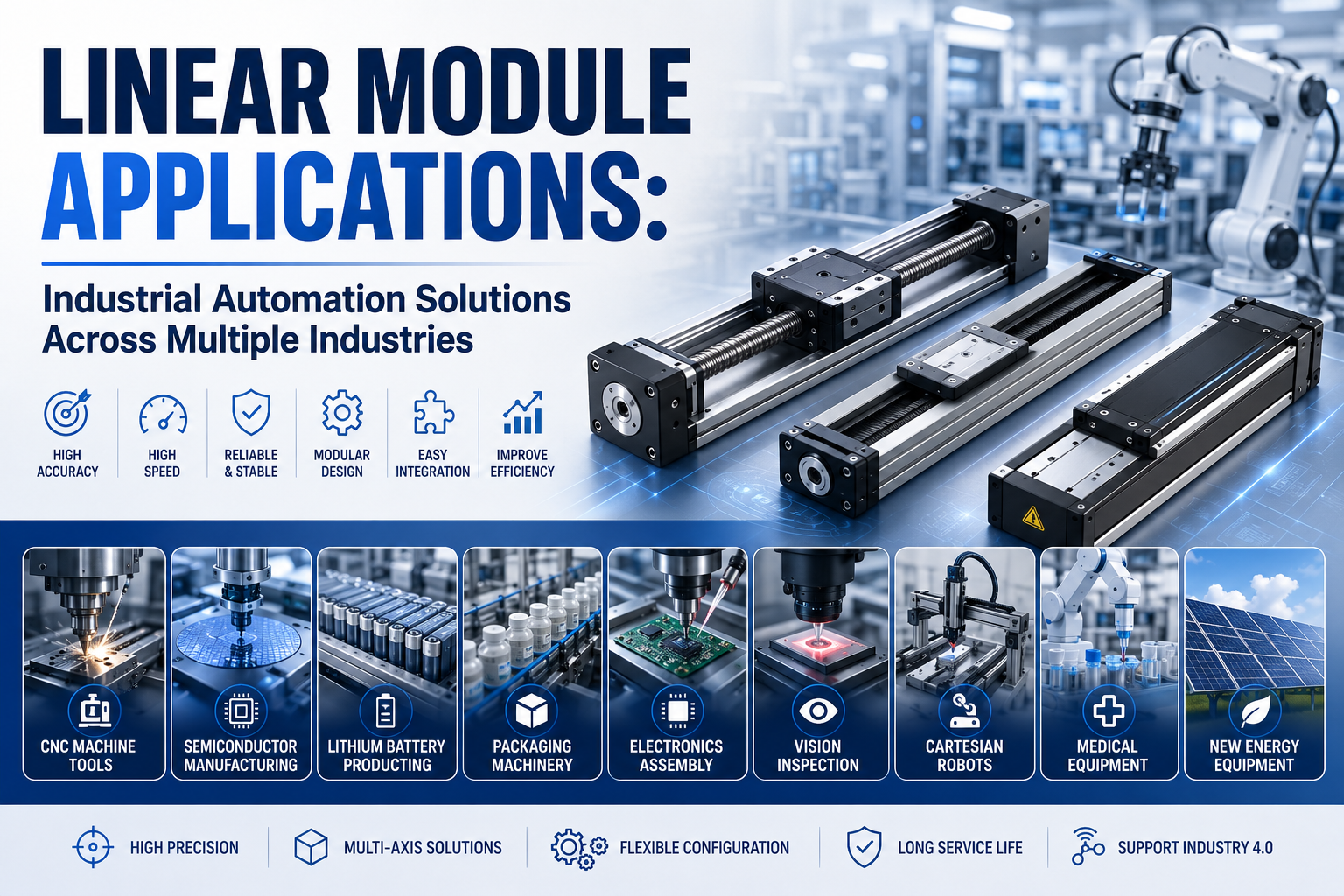
Linear moduleshave become one of the most widely used motion control components in modern industrial automation. By integrating linear guides, drive mechanisms, transmission systems, and motor interfaces into a compact assembly, linear modules provide accurate, reliable, and repeatable linear motion for countless manufacturing processes.
From high-speed packaging lines to micron-level semiconductor equipment, linear modules play a critical role in improving production efficiency, positioning accuracy, equipment reliability, and manufacturing flexibility. Different industries have different motion requirements, and modern linear modules are available in multiple drive types—including ball screw, timing belt, rack and pinion, and linear motor systems—to satisfy these diverse applications.
Compared with traditional self-designed linear motion mechanisms, standardized linear modules significantly shorten equipment development cycles, reduce engineering complexity, simplify installation, and lower long-term maintenance costs. Their modular design also allows easy integration into both new automation equipment and existing production lines.
This guide explores the major industrial applications of linear modules, explains why they are widely adopted across different industries, and discusses how engineers select the appropriate linear motion solution for specific manufacturing environments.
Why Linear Modules Are Used in Modern Industrial Automation
Almost every automated machine requires accurate and repeatable linear motion. Whether moving products between workstations, positioning a camera for inspection, transporting semiconductor wafers, or loading parts into CNC machine tools, linear motion is essential for achieving consistent manufacturing quality.
Linear modules offer several important advantages over traditional custom-built mechanical systems:
- High positioning accuracy.
- Excellent repeatability.
- High operating speed.
- Compact integrated structure.
- Simple installation.
- Reduced maintenance requirements.
- Flexible multi-axis combinations.
- Easy motor integration.
Because of these advantages, linear modules have become standard components in industrial automation equipment throughout the world.
Overview of Major Linear Module Applications
| Industry | Main Application | Recommended Drive Type |
|---|---|---|
| CNC Machine Tools | Loading, positioning, machining assistance | Ball Screw Module |
| Semiconductor Manufacturing | Wafer handling and precision positioning | Linear Motor Module |
| Lithium Battery Production | Cell assembly and material transfer | Ball Screw / Timing Belt |
| Packaging Machinery | Sorting, labeling and packaging | Timing Belt Module |
| Electronics Assembly | PCB assembly and dispensing | Ball Screw Module |
| Vision Inspection | Camera positioning | Ball Screw / Linear Motor |
| Cartesian Robots | Multi-axis automation | Various Module Types |
| Medical Equipment | Precision sampling and automation | Ball Screw Module |
| New Energy Equipment | Assembly and inspection | Timing Belt / Ball Screw |
1. Linear Modules in CNC Machine Tools
CNC machine tools require high rigidity, excellent positioning accuracy, and stable repeatability to ensure machining quality. Linear modules are widely used in auxiliary automation systems surrounding CNC equipment, including automatic loading and unloading, workpiece transfer, tool changing, fixture positioning, and robotic feeding systems.
Although the primary feed axes of CNC machines often use precision ball screws or linear motors integrated into the machine structure, external automation equipment frequently adopts standardized linear modules to simplify system integration and reduce engineering costs.
Typical CNC Applications
- Automatic loading systems.
- Automatic unloading systems.
- Tool magazine positioning.
- Fixture movement.
- Robot transfer units.
- Laser cutting automation.
- Grinding machine automation.
- CNC production lines.
Ball screw linear modulesare commonly selected because they provide high rigidity, excellent positioning accuracy, and reliable long-term performance under continuous industrial operation.
Benefits for CNC Automation
- Improved machining consistency.
- Reduced operator intervention.
- Higher production efficiency.
- Better repeatability.
- Reduced machine idle time.
- Easy integration with industrial robots.
2. Linear Modules in Semiconductor Equipment
Semiconductor manufacturing represents one of the most demanding automation industries. Equipment used for wafer fabrication, chip packaging, lithography, and inspection requires extremely high positioning accuracy, smooth motion, low vibration, and cleanroom compatibility.
Linear motor modules and ultra-precision ball screw modules are widely used throughout semiconductor production because they provide micron-level positioning performance with excellent repeatability.
Typical Semiconductor Applications
- Wafer transportation.
- Wafer alignment.
- Lithography positioning.
- Chip packaging.
- Automatic testing equipment.
- AOI systems.
- Semiconductor inspection machines.
Many semiconductor manufacturers also require cleanroom-certified linear modules designed to minimize particle generation while maintaining high-speed precision motion.
Key Performance Requirements
- Micron-level positioning accuracy.
- Ultra-high repeatability.
- Low vibration.
- Low particle generation.
- High acceleration.
- Stable thermal performance.
Because semiconductor production operates continuously around the clock, equipment reliability and long service life are equally important considerations when selecting linear modules.
3. Linear Modules in Lithium Battery Production
The rapid development of electric vehicles and energy storage systems has driven continuous expansion of the lithium battery manufacturing industry. Modern battery production lines require highly automated equipment capable of operating continuously with excellent precision, stability, and production efficiency.
Linear modules are widely used throughout the lithium battery manufacturing process, including electrode production, cell assembly, module assembly, PACK production, inspection, and material handling. Different manufacturing stages require different motion characteristics, making the selection of the appropriate drive mechanism especially important.
Typical Lithium Battery Applications
- Electrode sheet transfer.
- Cell loading and unloading.
- Cell stacking equipment.
- Laser welding positioning.
- Battery module assembly.
- PACK production lines.
- Automatic inspection systems.
- Material transportation.
Ball screw modules are commonly used in precision positioning processes such as welding and inspection, while timing belt modules are preferred for high-speed transportation and long-stroke material handling.
Advantages in Battery Manufacturing
- High positioning accuracy.
- Stable long-term operation.
- Reduced equipment downtime.
- Fast production cycles.
- Easy integration into automated production lines.
- Support for continuous 24-hour operation.
As lithium battery production continues toward larger-scale intelligent manufacturing, multi-axis linear module systems are increasingly replacing traditional manual handling methods.
4. Linear Modules in Pick and Place Automation
Pick and place systems are among the most common applications of linear modules. These systems repeatedly move components from one location to another with high speed and precision, making them essential in electronics manufacturing, packaging, medical devices, automotive production, and many other industries.
Linear modules provide the linear motion required for X, Y, and Z axes, while robotic grippers or vacuum suction cups complete the actual picking operation.
Typical Pick and Place Applications
- Electronic component handling.
- PCB loading.
- Automatic assembly.
- Material sorting.
- Food packaging.
- Medical product handling.
- Injection molding automation.
- Machine tending.
High-speed timing belt modules are often selected for horizontal transportation because they provide long travel distances and excellent operating efficiency. Ball screw modules are commonly used for vertical axes requiring higher positioning accuracy.
Advantages in Pick and Place Systems
- Shorter cycle times.
- Higher positioning precision.
- Reduced manual labor.
- Improved production consistency.
- Easy multi-axis integration.
- Flexible configuration for different products.
Modern pick and place equipment frequently combines multiple linear modules to formCartesian robotscapable of complex automated handling tasks.
5. Linear Modules in Packaging Machinery
Packaging machinery requires continuous, reliable, and high-speed motion to maximize production efficiency. Linear modules are widely used in filling, labeling, sealing, carton forming, product sorting, palletizing, and packaging transportation systems.
Because packaging equipment often operates at high production rates, timingbelt linear modulesare widely adopted due to their excellent speed capability, long stroke options, and relatively low maintenance requirements.
Typical Packaging Applications
- Product feeding.
- Carton loading.
- Automatic labeling.
- Sealing equipment.
- Palletizing systems.
- Sorting conveyors.
- Bottle positioning.
- Case packing.
Some precision packaging equipment, such as pharmaceutical packaging machines, also uses ball screw modules where accurate positioning is critical.
Benefits for Packaging Automation
- Higher production throughput.
- Continuous operation.
- Stable positioning.
- Reduced maintenance.
- Easy product changeover.
- Improved packaging quality.
6. Linear Modules in Electronics Assembly
Consumer electronics manufacturing demands exceptional precision, repeatability, and production efficiency. Smartphones, tablets, wearable devices, automotive electronics, and communication equipment all require highly automated assembly systems equipped with accurate motion control.
Linear modules are widely used in PCB assembly, screw fastening, dispensing, soldering, laser marking, connector insertion, adhesive application, and automated inspection equipment.
Typical Electronics Manufacturing Applications
- PCB positioning.
- Automatic dispensing.
- Screw driving.
- Laser marking.
- Connector assembly.
- Soldering automation.
- Component insertion.
- Electronic testing.
Ball screw modules are commonly selected because of their excellent positioning accuracy and repeatability, ensuring consistent assembly quality even during high-volume production.
Advantages for Electronics Production
- Micron-level positioning capability.
- Excellent repeatability.
- Reduced assembly defects.
- Higher production yield.
- Support for high-speed automation.
- Long-term production stability.
As electronic products continue to become smaller and more complex, the demand for high-precision linear motion systems continues to increase throughout the electronics manufacturing industry.
7. Linear Modules in Vision Inspection Systems
Machine vision technology has become an essential part of modern industrial automation. By combining industrial cameras, image processing software, sensors, and precision motion systems, vision inspection equipment can automatically detect product dimensions, appearance, defects, assembly quality, and positioning accuracy.
To ensure accurate image acquisition, the camera or inspected product must move precisely to the required position. Linear modules provide smooth, repeatable, and vibration-free linear motion, making them ideal for vision inspection systems.
Typical Vision Inspection Applications
- AOI (Automated Optical Inspection).
- Dimension measurement.
- Surface defect inspection.
- Barcode and QR code scanning.
- Electronic component inspection.
- Precision positioning for industrial cameras.
- 3D vision measurement.
- Automated quality inspection.
For applications requiring micron-level positioning, ball screw modules and linear motor modules are commonly selected because of their excellent positioning accuracy and repeatability.
Advantages in Vision Systems
- High positioning accuracy.
- Excellent repeatability.
- Smooth motion with low vibration.
- Fast inspection cycles.
- Improved inspection consistency.
- Easy integration with industrial cameras.
High-precision motion control ensures that every captured image is taken from the correct position, greatly improving inspection reliability and reducing false detection rates.
8. Linear Modules in Cartesian Robots
Cartesian robots, also known as gantry robots or XYZ robots, are among the most common automation systems built using linear modules. By combining multiple single-axis modules, engineers can create two-axis, three-axis, or even multi-axis robotic systems capable of performing complex linear motion tasks.
Compared with articulated robots, Cartesian robots provide higher rigidity, greater positioning accuracy, simpler programming, and lower overall investment for many industrial applications.
Typical Cartesian Robot Applications
- Material handling.
- Machine loading and unloading.
- Automatic assembly.
- Dispensing.
- Welding.
- Palletizing.
- Laser processing.
- Automated storage systems.
Different drive mechanisms may be combined within the same Cartesian robot. Timing belt modules are often used for long horizontal travel, while ball screw modules are selected for vertical axes requiring greater positioning precision.
Benefits of Multi-Axis Linear Modules
- Modular structure.
- Flexible configuration.
- Large working area.
- Excellent positioning accuracy.
- Easy maintenance.
- Simple expansion.
- Reduced engineering costs.
Because of their modular architecture, Cartesian robots can be customized for almost any industrial automation task while maintaining excellent reliability and ease of maintenance.
9. Linear Modules in Medical Equipment
Medical automation equipment requires smooth motion, high positioning accuracy, low noise, and exceptional operational reliability. Linear modules are increasingly used in laboratory automation, diagnostic systems, pharmaceutical manufacturing, medical imaging equipment, and sample handling devices.
Medical applications often require compact structures, clean operation, and highly repeatable positioning to ensure accurate testing and patient safety.
Typical Medical Applications
- Automatic sample handling.
- Laboratory automation.
- Blood analysis equipment.
- Medical imaging positioning.
- Pharmaceutical filling machines.
- Diagnostic instruments.
- DNA analysis systems.
- Automated testing equipment.
Ball screw modules are widely used because they provide stable precision motion while generating relatively low operating noise.
Advantages in Medical Automation
- High positioning precision.
- Low vibration.
- Quiet operation.
- Excellent repeatability.
- Long service life.
- High reliability.
As healthcare automation continues to develop, demand for compact and maintenance-friendly linear motion systems is expected to grow steadily.
10. Linear Modules in New Energy Automation
The rapid growth of renewable energy technologies has created increasing demand for highly automated production equipment. Linear modules are widely used in manufacturing systems for solar panels, fuel cells, hydrogen equipment, energy storage systems, and electric vehicle components.
These production lines require accurate positioning, high-speed material transfer, and continuous operation to achieve high manufacturing efficiency while maintaining strict quality standards.
Typical New Energy Applications
- Solar panel assembly.
- Battery module inspection.
- Hydrogen equipment manufacturing.
- Fuel cell assembly.
- Energy storage production.
- Electric vehicle component assembly.
- Automatic material transfer.
- Online inspection systems.
Depending on the production process, manufacturers may select timing belt modules for high-speed transportation or ball screw modules for precision assembly operations.
Advantages for New Energy Equipment
- Improved production efficiency.
- Stable positioning.
- Reduced maintenance.
- Flexible production line configuration.
- High reliability.
- Support for intelligent manufacturing.
As global investment in renewable energy continues to increase, linear modules will play an increasingly important role in next-generation intelligent manufacturing systems.
How to Choose the Right Linear Module for Different Applications
Selecting the appropriate linear module requires evaluating multiple technical factors rather than considering only one performance parameter. Different industries have different priorities, including positioning accuracy, travel speed, load capacity, environmental conditions, service life, and equipment cost.
Engineers should first define the application requirements and then determine the most suitable drive mechanism according to the operating conditions.
Key Selection Factors
- Payload weight.
- Required stroke.
- Maximum operating speed.
- Acceleration.
- Positioning accuracy.
- Repeatability.
- Working environment.
- Motor type.
- Installation space.
- Maintenance requirements.
A properly selected linear module not only improves equipment performance but also extends service life and reduces maintenance costs throughout the machine lifecycle.
Recommended Linear Module Types by Industry
| Industry | Recommended Module | Main Reason |
|---|---|---|
| CNC Machine Tools | Ball Screw Module | High rigidity and positioning accuracy |
| Semiconductor Manufacturing | Linear Motor Module | Ultra-high precision and dynamic performance |
| Lithium Battery Production | Ball Screw / Timing Belt | Precision and high productivity |
| Pick and Place | Timing Belt + Ball Screw | High speed with accurate vertical motion |
| Packaging Machinery | Timing Belt Module | Long stroke and high speed |
| Electronics Assembly | Ball Screw Module | Excellent repeatability |
| Vision Inspection | Linear Motor / Ball Screw | Micron-level positioning |
| Cartesian Robots | Multiple Module Combination | Flexible multi-axis automation |
| Medical Equipment | Ball Screw Module | Smooth and accurate motion |
| New Energy Equipment | Timing Belt / Ball Screw | High-speed automated production |
Common Mistakes When Selecting Linear Modules for Industrial Applications
- Selecting a module based only on maximum speed.
- Ignoring payload and acceleration calculations.
- Choosing excessive positioning accuracy for simple applications.
- Overlooking environmental protection requirements.
- Selecting insufficient stroke length.
- Ignoring future equipment expansion.
- Using the same module type for every application.
- Failing to match the motor correctly.
Each industrial application has unique operating conditions. Selecting a linear module should always involve a comprehensive evaluation of performance, reliability, maintenance, and future scalability rather than relying on a single specification.
Frequently Asked Questions
What industries commonly use linear modules?
Linear modules are widely used in CNC machining, semiconductor manufacturing, lithium battery production, electronics assembly, packaging machinery, industrial robotics, medical equipment, logistics automation, vision inspection, and many other industrial automation applications.
Which type of linear module is best for high-speed applications?
Timing belt linear modules and linear motor modules are generally the best choices for high-speed applications because they provide excellent travel speed and dynamic performance.
Which linear module provides the highest positioning accuracy?
Linear motor modules provide the highest positioning accuracy, followed by precision ball screw modules. The appropriate choice depends on application requirements and budget.
Why are linear modules widely used in CNC automation?
They improve loading efficiency, reduce manual operation, provide accurate positioning, and integrate easily with industrial robots and automated production systems.
Can one linear module be used in multiple industries?
Yes. Standardized linear modules are highly versatile and can be configured for different applications by changing stroke length, motor type, guide rail size, and drive mechanism.
Why are linear modules suitable for semiconductor equipment?
Because they provide high positioning accuracy, excellent repeatability, low vibration, and cleanroom-compatible designs required by semiconductor manufacturing processes.
Are linear modules suitable for multi-axis robot systems?
Yes. Multiple single-axis modules can be combined into XY, XZ, XYZ, or gantry robot configurations to perform complex automated motion tasks.
How do linear modules improve manufacturing efficiency?
They reduce cycle time, improve positioning accuracy, increase equipment reliability, simplify machine design, and minimize maintenance requirements, resulting in higher overall productivity.
Conclusion
Linear modules have become indispensable components in modern industrial automation. Their ability to deliver accurate, reliable, and repeatable linear motion makes them suitable for an enormous range of industries, including CNC machining, semiconductor manufacturing, lithium battery production, electronics assembly, packaging, medical equipment, machine vision, logistics, and renewable energy systems.
By selecting the appropriate drive mechanism and matching it to the application's specific requirements, manufacturers can significantly improve equipment performance, shorten production cycles, reduce maintenance costs, and increase long-term operational reliability.
As Industry 4.0, intelligent manufacturing, robotics, and digital production continue to evolve, linear modules will play an even more important role in enabling flexible, efficient, and highly automated manufacturing systems. Understanding where and how linear modules are applied helps engineers design smarter equipment and build future-ready automation solutions.