 English

Linear modules are one of the most widely used motion systems in modern industrial automation. They convert rotary or electromagnetic power into accurate linear movement and serve as the foundation of countless automated machines, including CNC equipment, robotic systems, semiconductor manufacturing lines, packaging machinery, medical devices, and precision inspection platforms.
Although all linear modules perform the same basic function—moving a load along a straight path—not all modules are designed for the same applications. Different drive mechanisms, structural designs, accuracy levels, and load capacities result in several distinct types of linear modules, each optimized for specific industrial requirements.
Choosing the correctlinear moduletype directly affects machine performance, positioning accuracy, operating speed, maintenance requirements, and total ownership cost. A module that performs exceptionally well in a high-speed packaging system may not be suitable for precision semiconductor manufacturing, while a heavy-duty rack and pinion system may be unnecessary for a compact laboratory automation project.
This guide explains the major types of linear modules available today, includingball screw linear modules, belt driven linear modules, rack and pinion systems, linear motor modules, and miniature linear modules. You'll also learn how to compare their advantages, limitations, and ideal application scenarios to make the right selection for your automation project.
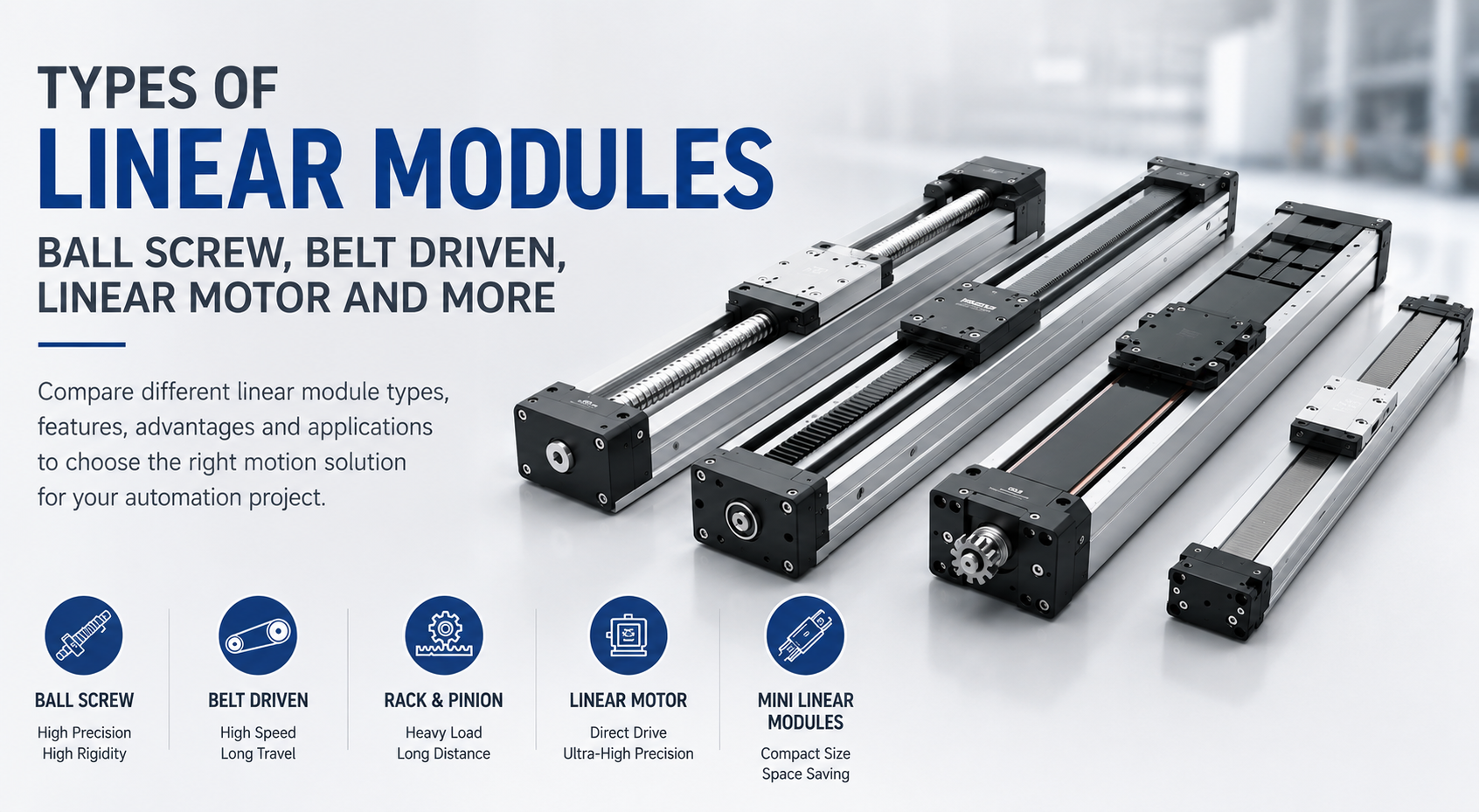
Table of Contents
- What Are the Different Types of Linear Modules?
- How Are Linear Modules Classified?
- Overview of Major Linear Module Types
- Ball Screw Linear Modules
- Belt Driven Linear Modules
- Rack and Pinion Linear Modules
- Linear Motor Modules
- Mini Linear Modules
- Single-Axis and Multi-Axis Linear Modules
- Open and Fully Enclosed Linear Modules
- How to Choose the Right Linear Module Type
- Comparison Table
- Industry Applications
- Frequently Asked Questions
- Conclusion
What Are the Different Types of Linear Modules?
A linear module can be classified in several different ways depending on its drive mechanism, structural design, motion configuration, installation method, or intended industrial application. However, in engineering practice, the most common classification is based on the drive system because it has the greatest influence on performance characteristics such as positioning accuracy, maximum speed, payload capacity, stroke length, and maintenance requirements.
The five primary categories include:
- Ball Screw Linear Modules
- Belt Driven Linear Modules
- Rack and Pinion Linear Modules
- Linear Motor Modules
- Mini Linear Modules
Each type offers unique advantages. Ball screw systems provide exceptional positioning accuracy, belt driven modules excel in long-travel and high-speed applications, rack and pinion systems are designed for heavy-duty movement over extended distances, linear motors deliver unmatched acceleration and precision, while miniature modules support compact automation equipment with limited installation space.
How Are Linear Modules Classified?
Manufacturers and automation engineers generally classify linear modules according to several technical criteria. Understanding these classification methods helps engineers compare products more effectively and select the most appropriate solution for their specific requirements.
Classification by Drive Method
| Drive Method | Main Characteristics | Typical Applications |
|---|---|---|
| Ball Screw | High precision, high rigidity | CNC machines, semiconductor equipment |
| Belt Driven | High speed, long travel | Packaging, logistics, material handling |
| Rack and Pinion | Heavy load, unlimited stroke potential | Large gantry systems, welding automation |
| Linear Motor | Direct drive, ultra-high precision | Precision manufacturing, electronics |
Classification by Structural Design
Linear modules can also be categorized according to their mechanical construction.
- Open Linear Modules
- Semi-Enclosed Linear Modules
- Fully Enclosed Linear Modules
- Dustproof Linear Modules
- Cleanroom Linear Modules
Structural design influences environmental protection, maintenance frequency, contamination resistance, and overall service life. Fully enclosed modules are generally preferred for dusty factory environments, while cleanroom modules are specifically designed for semiconductor, pharmaceutical, and laboratory applications.
Classification by Motion Configuration
Another common classification method is based on the number of motion axes integrated into the system.
| Configuration | Description |
|---|---|
| Single-Axis Module | Performs linear motion along one axis. |
| Dual-Axis Module | Combines two independent axes for planar movement. |
| Three-Axis Cartesian Robot | Provides X-Y-Z positioning for automation tasks. |
| Multi-Axis Gantry System | Supports complex automation and robotic applications. |
Overview of Major Linear Module Types
Although dozens of specialized linear module designs exist, most industrial automation systems rely on one of five fundamental types. Each has been developed to solve specific engineering challenges involving speed, precision, travel distance, payload, and operating environment.
| Linear Module Type | Accuracy | Speed | Stroke | Typical Load | Best For |
|---|---|---|---|---|---|
| Ball Screw Linear Module | ★★★★★ | ★★★☆☆ | Medium | Heavy | Precision positioning |
| Belt Driven Linear Module | ★★★☆☆ | ★★★★★ | Long | Medium | High-speed automation |
| Rack and Pinion Module | ★★★☆☆ | ★★★★☆ | Very Long | Very Heavy | Large industrial systems |
| Linear Motor Module | ★★★★★ | ★★★★★ | Medium | Light to Medium | Ultra-precision motion |
| Mini Linear Module | ★★★★☆ | ★★★★☆ | Short | Light | Compact automation equipment |
In the following sections, we will examine each linear module type in detail, including its working principle, structural design, performance characteristics, advantages, disadvantages, and the industrial applications where it performs best.
This guide explains the major types of linear modules available today, including ball screw linear modules, belt driven linear modules, rack and pinion systems, linear motor modules, and miniature linear modules. You'll also learn how to compare their advantages, limitations, and ideal application scenarios to make the right selection for your automation project.
Table of Contents
- What Are the Different Types of Linear Modules?
- How Are Linear Modules Classified?
- Overview of Major Linear Module Types
- Ball Screw Linear Modules
- Belt Driven Linear Modules
- Rack and Pinion Linear Modules
- Linear Motor Modules
- Mini Linear Modules
- Single-Axis and Multi-Axis Linear Modules
- Open and Fully Enclosed Linear Modules
- How to Choose the Right Linear Module Type
- Comparison Table
- Industry Applications
- Frequently Asked Questions
- Conclusion
What Are the Different Types of Linear Modules?
A linear module can be classified in several different ways depending on its drive mechanism, structural design, motion configuration, installation method, or intended industrial application. However, in engineering practice, the most common classification is based on the drive system because it has the greatest influence on performance characteristics such as positioning accuracy, maximum speed, payload capacity, stroke length, and maintenance requirements.
The five primary categories include:
- Ball Screw Linear Modules
- Belt Driven Linear Modules
- Rack and Pinion Linear Modules
- Linear Motor Modules
- Mini Linear Modules
Each type offers unique advantages. Ball screw systems provide exceptional positioning accuracy, belt driven modules excel in long-travel and high-speed applications, rack and pinion systems are designed for heavy-duty movement over extended distances, linear motors deliver unmatched acceleration and precision, while miniature modules support compact automation equipment with limited installation space.
How Are Linear Modules Classified?
Manufacturers and automation engineers generally classify linear modules according to several technical criteria. Understanding these classification methods helps engineers compare products more effectively and select the most appropriate solution for their specific requirements.
Classification by Drive Method
| Drive Method | Main Characteristics | Typical Applications |
|---|---|---|
| Ball Screw | High precision, high rigidity | CNC machines, semiconductor equipment |
| Belt Driven | High speed, long travel | Packaging, logistics, material handling |
| Rack and Pinion | Heavy load, unlimited stroke potential | Large gantry systems, welding automation |
| Linear Motor | Direct drive, ultra-high precision | Precision manufacturing, electronics |
Classification by Structural Design
Linear modules can also be categorized according to their mechanical construction.
- Open Linear Modules
- Semi-Enclosed Linear Modules
- Fully Enclosed Linear Modules
- Dustproof Linear Modules
- Cleanroom Linear Modules
Structural design influences environmental protection, maintenance frequency, contamination resistance, and overall service life. Fully enclosed modules are generally preferred for dusty factory environments, while cleanroom modules are specifically designed for semiconductor, pharmaceutical, and laboratory applications.
Classification by Motion Configuration
Another common classification method is based on the number of motion axes integrated into the system.
| Configuration | Description |
|---|---|
| Single-Axis Module | Performs linear motion along one axis. |
| Dual-Axis Module | Combines two independent axes for planar movement. |
| Three-Axis Cartesian Robot | Provides X-Y-Z positioning for automation tasks. |
| Multi-Axis Gantry System | Supports complex automation and robotic applications. |
Overview of Major Linear Module Types
Although dozens of specialized linear module designs exist, most industrial automation systems rely on one of five fundamental types. Each has been developed to solve specific engineering challenges involving speed, precision, travel distance, payload, and operating environment.
| Linear Module Type | Accuracy | Speed | Stroke | Typical Load | Best For |
|---|---|---|---|---|---|
| Ball Screw Linear Module | ★★★★★ | ★★★☆☆ | Medium | Heavy | Precision positioning |
| Belt Driven Linear Module | ★★★☆☆ | ★★★★★ | Long | Medium | High-speed automation |
| Rack and Pinion Module | ★★★☆☆ | ★★★★☆ | Very Long | Very Heavy | Large industrial systems |
| Linear Motor Module | ★★★★★ | ★★★★★ | Medium | Light to Medium | Ultra-precision motion |
| Mini Linear Module | ★★★★☆ | ★★★★☆ | Short | Light | Compact automation equipment |
In the following sections, we will examine each linear module type in detail, including its working principle, structural design, performance characteristics, advantages, disadvantages, and the industrial applications where it performs best.
Linear Motor Modules
Linear motor modules represent one of the most advanced motion solutions available in modern industrial automation. Unlike conventional drive systems that rely on mechanical transmission components such as ball screws, timing belts, or rack and pinion mechanisms, linear motor modules generate motion directly through electromagnetic force. This direct-drive technology eliminates mechanical transmission losses, backlash, and wear associated with traditional drive systems.
Because there is no physical contact between rotating transmission components, linear motor modules deliver exceptional positioning accuracy, extremely high acceleration, rapid response times, and virtually maintenance-free operation. They have become the preferred solution for industries requiring ultra-high precision and dynamic performance.
How Linear Motor Modules Work
A linear motor consists of two primary components: the primary coil assembly and the permanent magnet track. When electrical current flows through the motor coils, an electromagnetic field is generated that interacts with the permanent magnets, producing direct linear thrust. The moving carriage travels along precision linear guide rails while a high-resolution linear encoder continuously measures its actual position for closed-loop motion control.
Because the drive force acts directly on the moving platform, there is no mechanical backlash or transmission error, allowing extremely accurate positioning even during high-speed operation.
Main Components
- Primary motor coil
- Permanent magnet track
- Linear encoder
- Linear guide rails
- Motion controller
- Servo drive
- Cooling system
- Carriage assembly
Advantages
- No mechanical transmission backlash.
- Ultra-high positioning accuracy.
- Extremely high acceleration.
- Outstanding dynamic response.
- Very low maintenance requirements.
- Minimal mechanical wear.
- Excellent repeatability.
- Suitable for cleanroom environments.
Limitations
- Higher initial investment.
- More sophisticated control system required.
- Heat management must be considered.
- Requires high-resolution feedback devices.
- Not always necessary for general automation.
Typical Applications
- Semiconductor manufacturing
- Wafer handling systems
- Optical inspection equipment
- Electronics assembly
- Medical imaging systems
- Precision measurement equipment
- Scientific research platforms
Mini Linear Modules
Mini linear modules are compact motion systems specifically designed for applications where installation space is limited but positioning accuracy remains important. Their lightweight construction and small footprint make them ideal for precision automation equipment, laboratory instruments, electronics manufacturing, and miniature robotic systems.
Although significantly smaller than standard industrial linear modules, mini linear modules still incorporate many of the same engineering principles, including precision guide rails, compact drive mechanisms, integrated bearings, and high-quality motion control components.
Typical Features
- Compact dimensions.
- Lightweight structure.
- High positioning accuracy.
- Low moving inertia.
- Easy system integration.
- Suitable for confined spaces.
Typical Applications
- Medical analyzers
- Laboratory automation
- Electronic component assembly
- Small pick-and-place systems
- Vision inspection equipment
- Desktop automation devices
Single-Axis and Multi-Axis Linear Modules
Linear modules can also be classified according to the number of motion axes incorporated into the automation system. While single-axis modules perform movement along one linear direction, multiple modules can be combined to create complex Cartesian motion systems capable of positioning in two or three dimensions.
Single-Axis Linear Modules
A single-axis linear module performs motion along only one direction, typically the X, Y, or Z axis. These modules are widely used in applications requiring simple linear positioning, material transfer, lifting, or feeding operations.
Advantages
- Simple installation.
- Lower overall cost.
- Easy maintenance.
- High reliability.
- Flexible integration into larger systems.
Multi-Axis Linear Modules
Multi-axis systems combine two or more linear modules into a coordinated motion platform. Depending on the application, configurations may include XY tables, XYZ Cartesian robots,gantry robots, or customized multi-axis automation systems capable of handling complex positioning tasks.
Modern motion controllers synchronize multiple servo motors simultaneously, enabling coordinated movement with high precision and excellent repeatability.
Common Configurations
| Configuration | Motion Capability | Typical Applications |
|---|---|---|
| Single Axis | One-dimensional movement | Linear transfer |
| XY System | Two-dimensional positioning | Dispensing, inspection |
| XYZ Cartesian Robot | Three-dimensional positioning | Pick and place, assembly |
| Gantry Robot | Large-area coordinated motion | Material handling, palletizing |
Open vs Fully Enclosed Linear Modules
Another important classification is based on structural protection. Depending on the operating environment, manufacturers offer both open-type and fully enclosed linear modules. The appropriate choice depends largely on contamination levels, maintenance requirements, and environmental conditions.
Open Linear Modules
Open linear modules expose their guide rails and drive components directly to the surrounding environment. This design simplifies maintenance and generally reduces manufacturing costs, making it suitable for clean production environments where contamination is minimal.
Advantages
- Lower purchase cost.
- Easy maintenance.
- Simple component replacement.
- Reduced overall weight.
Limitations
- Less protection against dust.
- More frequent cleaning required.
- Not suitable for harsh environments.
Fully Enclosed Linear Modules
Fully enclosed linear modules incorporate protective covers that shield internal drive components and guide rails from dust, metal chips, coolant, and other contaminants. This design significantly improves service life and reduces maintenance frequency in demanding industrial environments.
Advantages
- Excellent contamination protection.
- Longer service life.
- Reduced maintenance.
- Improved reliability.
- Suitable for harsh industrial environments.
Typical Applications
- CNC machining centers
- Laser cutting systems
- Woodworking machinery
- Dust-intensive manufacturing
- General factory automation
Comparison of Major Linear Module Types
| Module Type | Precision | Speed | Stroke | Load Capacity | Cost | Recommended Applications |
|---|---|---|---|---|---|---|
| Ball Screw | Excellent | Medium | Medium | High | High | Precision positioning |
| Belt Driven | Good | Excellent | Long | Medium | Medium | Fast automation systems |
| Rack and Pinion | Good | High | Very Long | Very High | High | Heavy-duty machinery |
| Linear Motor | Excellent | Excellent | Medium | Medium | Very High | Ultra-precision equipment |
| Mini Linear Module | Very Good | High | Short | Light | Medium | Compact automation |
Each type of linear module has been developed to meet different engineering requirements. Selecting the most appropriate solution depends on balancing accuracy, speed, stroke length, payload capacity, environmental conditions, maintenance expectations, and overall project budget.
How to Choose the Right Linear Module Type
Selecting the right linear module is not simply a matter of choosing the highest precision or the fastest speed. The optimal solution depends on the specific requirements of your application, including payload, travel distance, positioning accuracy, operating speed, installation space, environmental conditions, and budget.
A systematic selection process helps engineers balance performance and cost while ensuring long-term reliability. Choosing an oversized module may unnecessarily increase equipment costs, while selecting an undersized module can reduce service life and compromise machine performance.
Key Selection Factors
| Selection Factor | Questions to Consider | Recommended Module Type |
|---|---|---|
| Positioning Accuracy | Is micron-level positioning required? | Ball Screw or Linear Motor |
| Travel Distance | Does the application require several meters of travel? | Belt Driven or Rack & Pinion |
| Operating Speed | Is maximum productivity the priority? | Belt Driven or Linear Motor |
| Payload Capacity | Will the module carry heavy equipment? | Ball Screw or Rack & Pinion |
| Installation Space | Is available space limited? | Mini Linear Module |
| Working Environment | Will the system operate in dust or coolant? | Fully Enclosed Module |
| Budget | Is minimizing investment important? | Belt Driven or Mini Module |
Recommended Selection Process
- Define the payload and required stroke.
- Determine positioning accuracy and repeatability requirements.
- Calculate maximum operating speed and acceleration.
- Evaluate the working environment.
- Select the appropriate drive technology.
- Choose guide rail size and motor specifications.
- Verify structural rigidity and safety factors.
- Review maintenance requirements and total ownership cost.
Linear Module Types by Industry
Different industries prioritize different performance characteristics. Understanding these priorities helps engineers identify the most suitable linear module type for each application.
| Industry | Recommended Module Type | Main Advantages |
|---|---|---|
| Semiconductor Manufacturing | Linear Motor | Ultra-high precision and clean operation |
| CNC Machine Tools | Ball Screw | Excellent rigidity and positioning accuracy |
| Packaging Machinery | Belt Driven | High speed and long travel |
| Automotive Manufacturing | Rack & Pinion | Heavy load capacity |
| Medical Equipment | Mini Linear Module | Compact size and precise motion |
| Warehouse Automation | Belt Driven | Fast material transportation |
| Robotics | Ball Screw or Belt Driven | Flexible motion solutions |
| Electronics Assembly | Linear Motor | High-speed precision positioning |
Maintenance Considerations for Different Linear Module Types
Maintenance requirements vary depending on the drive mechanism and operating environment. Proper preventive maintenance extends service life, improves positioning accuracy, and minimizes unexpected downtime.
| Module Type | Primary Maintenance Tasks |
|---|---|
| Ball Screw | Lubricate screw, inspect bearings, check backlash. |
| Belt Driven | Inspect belt tension, replace worn belts, clean guide rails. |
| Rack & Pinion | Lubricate gears, inspect gear wear, verify alignment. |
| Linear Motor | Check cooling system, encoder performance, and controller diagnostics. |
| Mini Linear Module | Clean guide rails and inspect miniature bearings. |
Regardless of module type, regular cleaning, proper lubrication, and periodic inspection of moving components significantly improve operational reliability and extend equipment life.
Frequently Asked Questions (FAQ)
1. How many types of linear modules are available?
The most common industrial types include ball screw linear modules, belt driven linear modules, rack and pinion modules, linear motor modules, and mini linear modules. They may also be classified by structural design or motion configuration.
2. Which linear module offers the highest positioning accuracy?
Linear motor modules generally provide the highest positioning accuracy because they eliminate mechanical transmission components. Ball screw linear modules are also widely used for high-precision applications.
3. Which type is best for long travel distances?
Belt driven andrack & pinion linear modulesare the preferred choices for long-stroke applications due to their ability to operate efficiently over extended distances.
4. Which linear module is best for heavy loads?
Ball screw and rack & pinion systems typically provide higher load capacity and greater structural rigidity than other drive mechanisms.
5. Are belt driven modules accurate enough?
Yes. Modern belt driven linear modules provide excellent repeatability for many industrial automation applications. However, for ultra-high precision positioning, ball screw or linear motor systems are generally preferred.
6. What is the advantage of a linear motor module?
Linear motors eliminate mechanical transmission, providing direct-drive motion with exceptional speed, acceleration, positioning accuracy, and reduced maintenance requirements.
7. Can multiple linear modules be combined?
Yes. Multiple single-axis modules can be combined to create XY tables, XYZ Cartesian robots, gantry systems, and fully customized multi-axis automation platforms.
8. Should I choose an open or fully enclosed module?
Open modules are suitable for clean environments and easier maintenance, while fully enclosed modules provide superior protection against dust, chips, and coolant in industrial settings.
9. Which module type requires the least maintenance?
Linear motor modules generally require the least mechanical maintenance because they eliminate traditional transmission components such as screws, belts, and gears.
10. Can linear modules be customized?
Yes. Most manufacturers offer customized solutions based on travel length, payload, motor configuration, mounting orientation, environmental protection, and multi-axis integration requirements.
Conclusion
Linear modules are available in a wide range of configurations, each designed to solve different engineering challenges. Ball screw linear modules excel in precision positioning, belt driven systems deliver outstanding speed over long travel distances, rack and pinion modules support heavy-duty industrial automation, linear motor modules provide unmatched dynamic performance, and mini linear modules enable compact, space-saving machine designs.
Rather than searching for a universally "best" linear module, engineers should focus on selecting the module type that best matches the application's technical requirements. Factors such as positioning accuracy, travel distance, payload, operating speed, environmental conditions, maintenance expectations, and total lifecycle cost should all be considered during the selection process.
As industrial automation continues to evolve toward higher precision, faster production, and smarter manufacturing, linear module technologies will continue to advance. Understanding the strengths and limitations of each module type enables equipment designers, automation engineers, and manufacturers to build more efficient, reliable, and competitive motion systems for the future.