 English

Modern automation equipment depends on precise, repeatable, and reliable linear motion. Whether in semiconductor manufacturing, CNC machining, medical devices, packaging lines, or robotic automation, components must move accurately along a straight path while carrying different loads at various speeds.
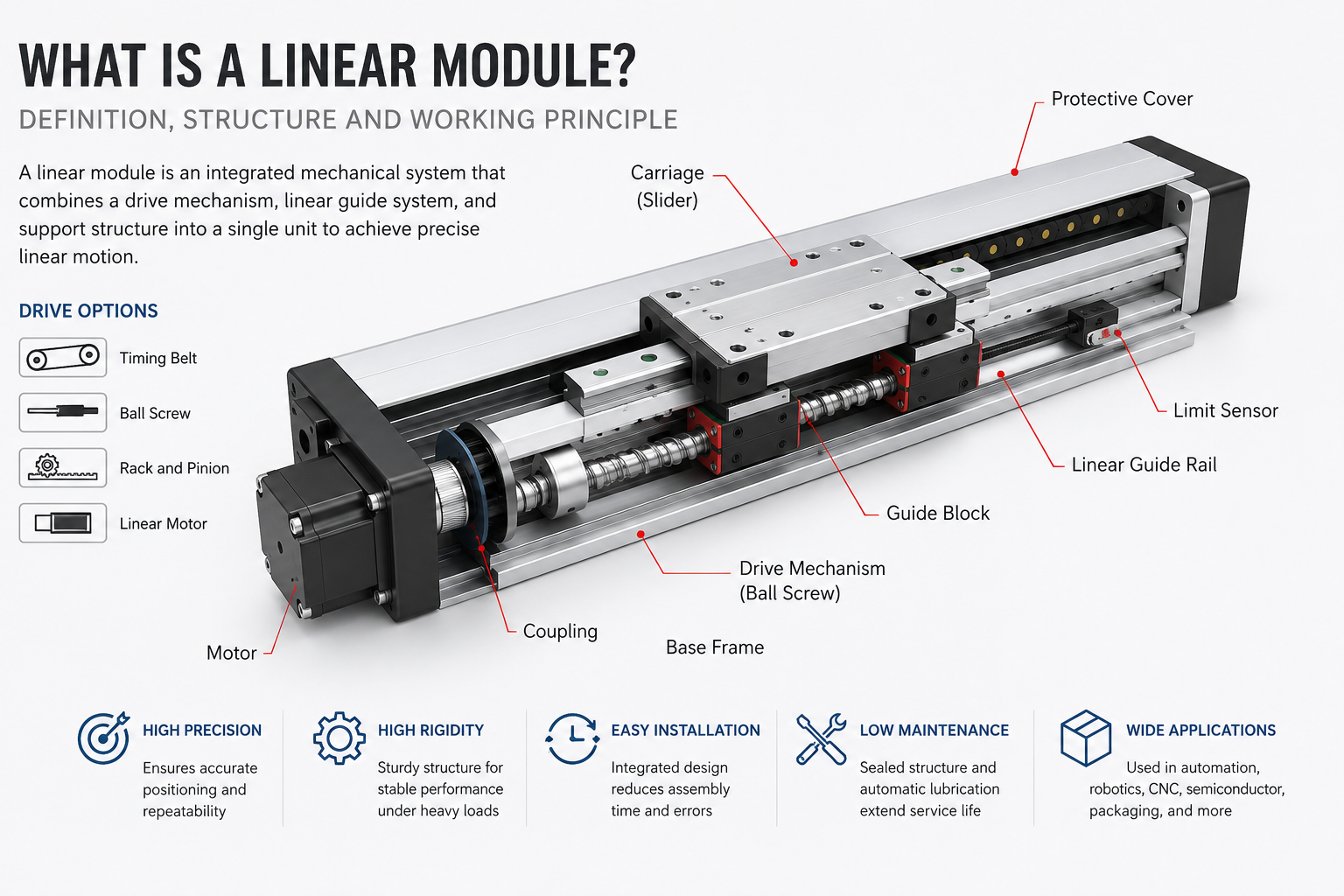
A linear module is one of the most widely used motion systems for accomplishing this task. By integrating linear guides, drive mechanisms, support structures, and motion components into a compact unit, a linear module provides an efficient solution for converting rotary motion into controlled linear movement.
Compared with assembling separate motion components individually, integratedlinear modulessimplify machine design, reduce installation time, improve positioning accuracy, and increase system reliability.
This guide explains everything beginners and engineers need to know about linear modules, including:
-
Definition
-
Basic structure
-
Main components
-
Working principles
-
Types of linear modules
-
Advantages
-
Applications
-
Selection considerations
-
Frequently asked questions
Whether you're selecting your first linear motion system or designing industrial automation equipment, this article provides a complete overview.
What Is a Linear Module?
A linear module is an integrated mechanical system designed to produce precise linear motion. It combines multiple motion transmission components into a single assembly capable of moving loads accurately along one axis.
Unlike standalone linear guides that only provide guidance, a linear module includes both the guidance system and the drive mechanism. This enables controlled positioning using electric motors, pneumatic actuators, or other motion sources.
A standard linear module typically consists of:
-
Aluminum profile or steel base
-
Linear guide rails
-
Guide blocks
-
Drive system
-
Carriage (slider)
-
Bearings
-
Limit sensors
-
Protective covers
-
Lubrication system
The drive mechanism may use:
-
Timing belt
-
Ball screw
-
Rack and pinion
-
Linear motor
Depending on application requirements.
Why Are Linear Modules Important?
Industrial automation requires motion systems that are:
-
Highly accurate
-
Repeatable
-
Reliable
-
Easy to install
-
Easy to maintain
-
Compact
Linear modules integrate multiple mechanical elements into one standardized unit, reducing engineering complexity while improving machine performance.
Compared with building a custom linear motion system from separate components, integrated modules significantly reduce:
-
Assembly time
-
Alignment errors
-
Maintenance cost
-
Machine footprint
-
Development cycle
Basic Structure of a Linear Module
Although manufacturers offer different designs, most linear modules share the same structural architecture.
Base Frame
The base provides rigidity and supports all internal components.
Common materials include:
-
Aluminum extrusion
-
Aluminum alloy
-
Steel
-
Stainless steel
The frame maintains alignment under dynamic loading.
Linear Guide Rails
Linear guide rails determine the motion path.
They ensure smooth movement while resisting:
-
Vertical loads
-
Horizontal loads
-
Moment loads
Precision rails significantly influence positioning accuracy.
Guide Blocks
Guide blocks travel along the rails using recirculating ball bearings or roller bearings.
Their primary functions include:
-
Load support
-
Motion guidance
-
Friction reduction
-
Position stability
Drive System
The drive mechanism converts rotary motor motion into linear displacement.
Common drive systems include:
-
Timing belts
-
Ball screws
-
Rack and pinion
-
Linear motors
Each drive type offers different advantages in speed, precision, and load capacity.
Motor
Linear modules may use:
-
Servo motors
-
Stepper motors
-
Brushless DC motors
-
Direct-drive linear motors
The motor determines:
-
Speed
-
Position accuracy
-
Acceleration
-
Control capability
End Supports
End supports secure the transmission system and absorb operational forces.
For screw-driven modules, bearing supports maintain screw alignment and minimize vibration.
Sensors
Limit switches and home sensors provide position feedback for automation control.
These sensors improve:
-
Safety
-
Repeatability
-
Automatic homing
-
Motion synchronization
Main Components of a Linear Module
| Component | Function |
|---|---|
| Base | Structural support |
| Linear guide | Motion guidance |
| Slider | Carries payload |
| Drive system | Generates linear movement |
| Bearings | Reduce friction |
| Motor | Motion source |
| Coupling | Transfers torque |
| End supports | Maintain alignment |
| Sensors | Position detection |
| Lubrication system | Reduce wear |
How Does a Linear Module Work?
The working principle is straightforward:
-
The motor rotates.
-
Rotary motion enters the drive mechanism.
-
The drive mechanism converts rotary motion into linear motion.
-
The carriage moves along precision guide rails.
-
The linear guide maintains stability.
-
Sensors monitor position.
-
The controller adjusts motion based on feedback.
The exact conversion mechanism depends on the transmission system.
Timing Belt Drive
Motor rotation drives a pulley.
The pulley moves the timing belt.
The belt pulls the carriage along the guide rails.
Characteristics:
-
High speed
-
Long travel
-
Low cost
-
Moderate precision
Ball Screw Drive
The motor rotates the screw.
A ball nut travels along the screw.
The carriage moves together with the nut.
Characteristics:
-
High precision
-
High rigidity
-
Excellent repeatability
-
Suitable for heavy loads
Rack and Pinion Drive
The motor rotates a pinion gear.
The gear meshes with the rack.
Rotational motion becomes linear displacement.
Characteristics:
-
Unlimited travel
-
Heavy load
-
High speed
Linear Motor Drive
The motor directly generates linear force.
No screw or belt is required.
Characteristics:
-
Highest precision
-
Zero backlash
-
Very high acceleration
-
Fast response
Types of Linear Modules
Timing Belt Linear Module
Best suited for:
-
High-speed transport
-
Packaging
-
Logistics
-
Pick-and-place systems
Advantages:
-
Long stroke
-
Fast movement
-
Lower cost
Ball Screw Linear Module
Suitable for:
-
CNC machines
-
Inspection systems
-
Semiconductor equipment
-
Precision assembly
Advantages:
-
High positioning accuracy
-
Excellent rigidity
-
Heavy load capacity
Rack and Pinion Module
Ideal for:
-
Gantry systems
-
Large automation equipment
-
Long-distance travel
Advantages:
-
Long travel
-
High force
-
Easy maintenance
Linear Motor Module
Used in:
-
Semiconductor manufacturing
-
Electronics assembly
-
Optical inspection
-
Medical automation
Advantages:
-
Ultra-high precision
-
High acceleration
-
Low maintenance
Common Performance Specifications
Typical parameters when selecting a linear module include:
| Component | Function |
|---|---|
| Stroke | Maximum travel distance |
| Maximum speed | Highest operating speed |
| Repeatability | Position consistency |
| Position accuracy | Absolute positioning capability |
| Maximum load | Payload capacity |
| Maximum acceleration | Dynamic performance |
| Drive type | Belt, screw, rack, linear motor |
| Protection level | Dust and water resistance |
| Installation orientation | Horizontal, vertical, side-mounted |
Advantages of Linear Modules
Linear modules offer several important benefits:
-
Compact integrated design
-
Easy installation
-
High positioning accuracy
-
Excellent repeatability
-
High reliability
-
Long service life
-
Reduced engineering costs
-
Easy maintenance
-
Scalable multi-axis configurations
-
Suitable for automation integration
Typical Applications
Linear modules are widely used in industrial automation.
Common applications include:
-
Pick-and-place systems
-
CNC loading
-
Laser cutting
-
Dispensing machines
-
Vision inspection
-
PCB manufacturing
-
Packaging equipment
-
Medical devices
-
Semiconductor handling
-
Automated assembly
-
Robotics
-
Material transfer
Industries Using Linear Modules
Industries benefiting from linear modules include:
-
Semiconductor
-
Electronics
-
Automotive
-
Lithium battery manufacturing
-
Medical equipment
-
Food processing
-
Packaging
-
Logistics
-
Aerospace
-
Photovoltaics
-
Machine tools
-
Robotics
How to Choose a Linear Module
When selecting a linear module, engineers should evaluate:
Required Stroke
Determine total travel distance.
Load Capacity
Consider payload, tooling, and dynamic loads.
Speed
High-speed applications generally favortiming belt modules.
Precision
High-precision positioning typically requires ball screw or linear motor modules.
Installation Environment
Evaluate:
-
Dust
-
Temperature
-
Humidity
-
Cleanroom requirements
Maintenance Requirements
Choose designs with convenient lubrication and accessible maintenance points.
Maintenance Tips
Proper maintenance extends service life.
Recommended practices include:
-
Lubricate guide rails regularly.
-
Keep the module clean.
-
Inspect belts and screws for wear.
-
Check fasteners periodically.
-
Verify alignment.
-
Replace worn bearings promptly.
Frequently Asked Questions
What is the difference between a linear guide and a linear module?
A linear guide provides only guidance, while a linear module combines guidance with a drive system to achieve controlled linear motion.
Which drive system is the most accurate?
Linear motor systems generally offer the highest positioning accuracy, followed by ball screw systems.
Which drive type is best for long travel?
Timing belt and rack-and-pinion modules are commonly preferred for long-stroke applications.
Can linear modules be used vertically?
Yes. Vertical installations are common, but they require proper consideration of gravity loads, braking mechanisms, and safety factors.
How long do linear modules last?
With correct installation and regular maintenance, industrial linear modules can operate reliably for many years. Service life depends on load, speed, duty cycle, and environmental conditions.
Conclusion
Linear modules are essential components in modern automation systems, providing precise, repeatable, and efficient linear motion across a wide range of industries. By integrating guide rails, drive mechanisms, motors, and support structures into a compact assembly, they simplify machine design while improving reliability and performance.
Whether your application prioritizes high speed, heavy load capacity, long travel, or ultra-high precision, understanding the different drive technologies and selection criteria is the first step toward choosing the right linear motion solution.
As automation continues to advance, linear modules will remain a fundamental building block for intelligent manufacturing, robotics, semiconductor equipment, packaging machinery, and countless other industrial systems.