 English

Linear modules are one of the most widely used motion systems in modern industrial automation. From CNC machinery and semiconductor manufacturing to robotic assembly and automated inspection equipment, these precision devices convert rotary or electromagnetic energy into smooth, repeatable linear motion.
Understanding thelinear moduleworking principle helps engineers select the appropriate transmission mechanism, evaluate positioning accuracy, improve system reliability, and optimize machine performance. Whether the module is driven by a ball screw, timing belt, or linear motor, every design follows the same engineering objective: converting input power into controlled linear movement with high precision.
This guide explains how linear modules work from an engineering perspective, covering their motion transmission process, drive mechanisms, guide systems, servo control principles, and the differences between major drive technologies.
What Is the Working Principle of a Linear Module?
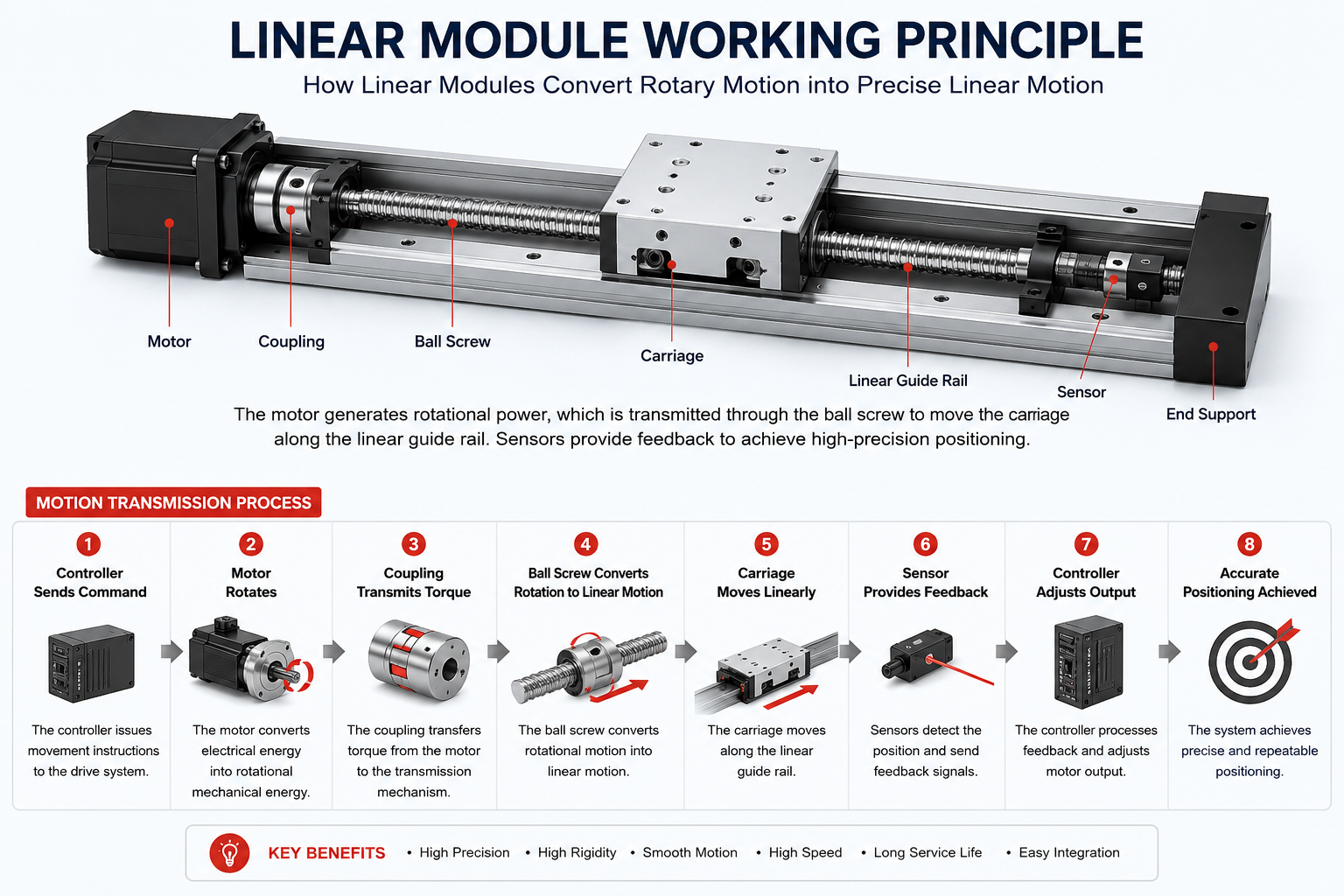
The working principle of a linear module is the controlled conversion of rotational or electromagnetic energy into precise linear motion. The system integrates a drive source, transmission mechanism, linear guide, carriage, sensors, and control electronics into a compact assembly that delivers accurate movement along a fixed axis.
Unlike traditional mechanical slides that rely on manual movement, a linear module performs programmed positioning automatically. The motor generates mechanical power, which is transferred through a transmission mechanism such as a ball screw or timing belt. The carriage moves along precision guide rails while maintaining rigidity and minimizing friction. Feedback devices continuously monitor the carriage position so the controller can correct any deviation in real time.
This closed-loop motion system enables modern automation equipment to achieve high repeatability, stable speed, and accurate positioning under varying loads.
Main Components Involved in the Working Principle
Although different manufacturers offer various designs, nearly every linear module consists of several essential components that work together during motion.
- Servo motor or stepper motor
- Motor coupling
- Transmission mechanism
- Linear guide rail
- Bearing carriage
- Limit sensors and home sensors
- Controller and motion driver
- Protective housing
Each component contributes to the overall motion performance. Removing or reducing the quality of any one component directly affects positioning accuracy, vibration, rigidity, and service life.
Motion Transmission Process
A linear module follows a sequential motion transmission process. Every movement begins with electrical power and ends with accurate linear displacement of the carriage.
- The controller sends movement commands.
- The servo or stepper driver energizes the motor.
- The motor generates rotational torque.
- The coupling transfers torque to the transmission mechanism.
- The transmission mechanism converts rotation into linear motion.
- The carriage travels along precision guide rails.
- Position sensors provide continuous feedback.
- The controller adjusts motor output for accurate positioning.
This complete process typically occurs within milliseconds, allowing modern automation systems to perform thousands of positioning cycles every hour.
Step 1: Motor Generates Mechanical Power
The motor serves as the primary power source of the linear module. Most industrial systems use either servo motors or stepper motors depending on the application's performance requirements.
Servo motors provide closed-loop control with encoder feedback, making them ideal for high-speed, high-precision applications. Stepper motors are commonly selected for lower-cost systems where moderate positioning accuracy is acceptable.
Once energized, the motor produces rotational motion that becomes the initial energy source for the entire linear motion system.
Servo Motor Advantages
- High positioning accuracy
- Closed-loop feedback
- High acceleration capability
- Stable high-speed operation
- Automatic error correction
Stepper Motor Advantages
- Simple control
- Lower cost
- Easy installation
- Suitable for light-duty automation
- Reliable operation under moderate loads
Step 2: Coupling Transfers Torque
The motor shaft connects to the transmission mechanism through a flexible or rigid coupling. Although relatively small, the coupling plays a critical role in maintaining transmission accuracy.
A properly selected coupling compensates for minor shaft misalignment, reduces vibration, absorbs shock loads, and protects bearings from excessive stress. Poor coupling selection often introduces positioning errors and premature mechanical wear.
High-precision automation equipment generally employs zero-backlash couplings to maximize positioning accuracy.
Step 3: Transmission Mechanism Converts Rotation into Linear Motion
The transmission mechanism is the core element of the linear module working principle. Its purpose is to transform rotational movement into straight-line motion while maintaining efficiency, rigidity, and repeatability.
Different transmission technologies are optimized for different operating conditions, making drive selection one of the most important engineering decisions.
Ball Screw Working Principle
A ball screw linear module converts rotary motion into linear movement using a precision-ground screw shaft and a recirculating ball nut. Steel balls roll between the screw and nut instead of sliding, dramatically reducing friction while increasing transmission efficiency.
As the screw rotates, the ball nut moves axially. Since the carriage is attached to the ball nut, the carriage moves smoothly along the guide rails with exceptional positioning accuracy.
Ball screw systems are widely used in CNC machine tools, inspection equipment, semiconductor manufacturing, laboratory automation, and precision assembly applications.
Advantages of Ball Screw Drive
- High positioning accuracy
- Excellent repeatability
- High thrust force
- Minimal backlash
- Long service life
The primary limitation is speed. Long ball screws may experience critical speed limitations and screw whip at high rotational speeds.
Timing Belt Working Principle
A timing belt linear module uses a toothed belt that meshes with a drive pulley connected to the motor. As the pulley rotates, the belt moves continuously, carrying the carriage along the guide rails.
Unlike ball screw systems, timing belts do not convert rotation through a threaded interface. Instead, motion is transmitted directly through the belt, allowing much higher travel speeds and longer stroke lengths.
Timing belt modules are commonly selected for packaging equipment, logistics systems, pick-and-place robots, material handling lines, and general factory automation.
Advantages of Timing Belt Drive
- High travel speed
- Long stroke capability
- Low moving mass
- Quiet operation
- Cost-effective for long travel distances
The trade-off is lower positioning accuracy compared with ball screw systems because the belt introduces a small amount of elastic deformation under heavy loads.
Linear Motor Working Principle
A linear motor module eliminates traditional mechanical transmission components entirely. Instead of rotating a screw or pulley, electromagnetic force directly drives the carriage along the guide rails.
The stator contains permanent magnets, while the moving coil generates electromagnetic force under the control of the servo amplifier. Since no mechanical contact exists between the driving components, backlash and transmission wear are virtually eliminated.
Linear motors provide outstanding acceleration, extremely high positioning accuracy, and excellent dynamic response, making them the preferred solution for semiconductor manufacturing, precision inspection, laser processing, and high-speed electronics production.
Advantages of Linear Motor Drive
- No mechanical backlash
- Ultra-high acceleration
- Excellent positioning accuracy
- Minimal maintenance
- Outstanding dynamic response
However, linear motor systems generally require higher investment costs and more advanced control technology than screw-driven or belt-driven modules.
Step 4: Linear Guide System Maintains Motion Accuracy
While the transmission mechanism generates movement, the linear guide system ensures that movement remains stable, accurate, and repeatable. Precision guide rails constrain the carriage to a single axis, preventing unwanted lateral displacement, rotation, or vibration.
Most industrial linear modules use recirculating ball-type linear guides. Rolling elements significantly reduce friction while supporting substantial loads and maintaining consistent motion throughout the stroke.
Guide system quality directly influences repeatability, rigidity, load capacity, vibration resistance, and overall machine reliability.
Functions of the Guide System
- Maintain straight-line motion
- Support external loads
- Reduce friction
- Improve rigidity
- Enhance positioning repeatability
Step 5: Servo Control Ensures Precise Positioning
Mechanical components alone cannot achieve modern automation accuracy. Precision motion also depends on advanced servo control systems that continuously monitor and adjust the carriage position.
A closed-loop control system compares the commanded position with the actual encoder feedback. If any deviation occurs due to load changes, vibration, or inertia, the controller immediately adjusts motor output to eliminate positioning errors.
This continuous correction process enables linear modules to maintain micron-level repeatability even during rapid acceleration and deceleration.
Complete Motion Cycle of a Linear Module
To better understand the linear module working principle, it is helpful to examine the complete motion cycle from the moment a movement command is issued until the carriage reaches its target position. Although different drive technologies use different transmission mechanisms, the overall control logic remains largely the same.
- Themotion controllerreceives a positioning command from the PLC, industrial PC, CNC system, or robot controller.
- The controller calculates the target position, acceleration, deceleration, travel speed, and movement direction.
- The servo drive or stepper driver supplies electrical power to the motor.
- The motor produces rotational torque or electromagnetic force depending on the drive technology.
- The transmission mechanism converts the driving force into linear movement.
- The carriage moves along precision linear guide rails.
- The encoder continuously measures the actual position, speed, and movement direction.
- The controller compares the actual position with the target position.
- If any positioning error is detected, the servo system immediately compensates for the deviation.
- Once the carriage reaches the programmed location, the controller stops the motor and maintains position if required.
This closed-loop process may repeat hundreds or even thousands of times every hour in automated production equipment while maintaining consistent positioning accuracy.
Comparison of Different Linear Module Drive Principles
Choosing the correct transmission mechanism is one of the most important engineering decisions when designing an automation system. Each drive technology offers different advantages in terms of accuracy, speed, load capacity, maintenance requirements, and overall cost.
| Drive Type | Working Principle | Main Advantages | Typical Applications |
|---|---|---|---|
| Ball Screw | Rotating screw drives a recirculating ball nut to produce linear motion. | High precision, high thrust, excellent repeatability. | CNC machines, semiconductor equipment, precision assembly. |
| Timing Belt | Motor rotates a pulley that drives a toothed timing belt. | High speed, long stroke, economical. | Packaging, logistics, pick-and-place systems. |
| Linear Motor | Electromagnetic force directly moves the carriage without mechanical transmission. | Ultra-high speed, no backlash, exceptional accuracy. | Electronics manufacturing, laser processing, wafer handling. |
There is no universally "best" drive mechanism. The optimal choice depends on the application's required positioning accuracy, travel distance, payload, operating speed, environmental conditions, and budget.
Factors Affecting the Working Performance of a Linear Module
Although all linear modules follow similar operating principles, their actual performance varies depending on mechanical design, manufacturing quality, installation accuracy, and operating conditions.
Transmission Mechanism
The selected transmission mechanism directly determines positioning accuracy, maximum speed, thrust capability, and service life. Ball screw systems generally prioritize precision, while timing belt systems emphasize speed and long travel. Linear motors excel in high-dynamic applications.
Guide Rail Precision
The straightness and manufacturing accuracy of the guide rails significantly influence positioning repeatability. High-quality guide rails reduce friction, vibration, and carriage deflection under load.
Motor Selection
Motor torque must match the moving load and required acceleration. Undersized motors may lose steps or fail to reach programmed speeds, while oversized motors increase system cost unnecessarily.
Servo Control Parameters
Proper tuning of servo gain, acceleration, deceleration, velocity limits, and filtering allows the system to achieve smooth movement without oscillation or excessive vibration.
Installation Accuracy
Improper mounting introduces alignment errors that increase friction and reduce positioning accuracy. Even high-quality linear modules cannot achieve their rated performance if installed incorrectly.
Lubrication and Maintenance
Regular lubrication minimizes wear between moving components. Proper maintenance extends service life, reduces operating noise, and maintains positioning accuracy over millions of operating cycles.
Advantages of Understanding the Linear Module Working Principle
A thorough understanding of how linear modules operate enables engineers to design more reliable automation systems and select components more efficiently.
- Select the most suitable drive mechanism.
- Improve machine positioning accuracy.
- Reduce maintenance costs.
- Increase equipment reliability.
- Optimize production efficiency.
- Extend service life.
- Reduce mechanical vibration.
- Improve motion stability.
- Simplify troubleshooting.
- Lower overall operating costs.
Typical Industrial Applications
Linear modules are used throughout modern manufacturing because they provide precise, repeatable, and programmable linear motion.
CNC Machine Tools
Ball screw linear modules provide accurate positioning for machining centers, drilling machines, milling equipment, and automated tool changers.
Semiconductor Manufacturing
Linear motor modules deliver ultra-fast acceleration and micron-level positioning accuracy for wafer handling, chip inspection, and precision assembly.
Packaging Equipment
Timing belt modules move products rapidly through filling, labeling, sealing, and sorting processes while maintaining consistent production speeds.
Electronic Assembly
Surface-mount production lines rely on high-speed linear modules for pick-and-place operations and precision component positioning.
Automated Inspection Systems
Vision inspection equipment requires highly repeatable linear motion to ensure accurate image acquisition and dimensional measurement.
Medical Equipment
Laboratory automation and diagnostic instruments use compact linear modules to perform precise sample handling and automated testing procedures.
Frequently Asked Questions
What is the working principle of a linear module?
A linear module converts rotary motion or electromagnetic force into controlled linear movement through a transmission mechanism, guide system, and motion controller.
How does a ball screw linear module work?
The motor rotates a precision screw. A recirculating ball nut travels along the screw, moving the carriage in a straight line with high positioning accuracy.
How does a timing belt linear module work?
The motor drives a toothed pulley that moves a reinforced timing belt. The carriage is fixed to the belt and travels along precision guide rails.
How does a linear motor module work?
Electromagnetic force directly moves the carriage without screws or belts, providing extremely fast acceleration and excellent positioning accuracy.
Which drive mechanism offers the highest accuracy?
For most industrial applications, ball screw systems provide outstanding positioning accuracy. For ultra-high dynamic precision, linear motor systems generally offer the best overall performance.
Why are linear guides necessary?
Linear guides support the moving load, reduce friction, maintain straight-line motion, and prevent unwanted movement in other directions.
Can linear modules operate at high speeds?
Yes. Timing belt modules and linear motor modules are specifically designed for high-speed applications, whileball screw modulesprioritize precision and thrust.
What determines positioning accuracy?
Positioning accuracy depends on the transmission mechanism, guide rail quality, encoder resolution, servo tuning, installation accuracy, and overall mechanical rigidity.
Do linear modules require regular maintenance?
Yes. Periodic lubrication, cleaning, inspection of moving components, and proper alignment help maintain accuracy and maximize service life.
How do I choose the right linear module?
Consider stroke length, payload, positioning accuracy, travel speed, operating environment, duty cycle, and available installation space before selecting a linear module.
Conclusion
The working principle of a linear module is based on the efficient conversion of electrical energy into controlled linear motion through a coordinated system of motors, transmission mechanisms, guide rails, and intelligent motion control. Whether using a ball screw, timing belt, or linear motor, every linear module is designed to achieve precise, repeatable, and reliable movement for industrial automation.
Understanding how these systems operate allows engineers to select the most appropriate drive technology, improve machine performance, reduce maintenance requirements, and maximize production efficiency. As automation continues to advance across manufacturing industries, linear modules will remain one of the most important building blocks for precision motion control.
Why Choose QRXQ Linear Modules?
QRXQ specializes in the design and manufacture of high-performance linear motion systems for industrial automation. Our product portfolio includes ball screw linear modules,timing belt linear modules, linear motor modules, electric cylinders, and custom multi-axis motion systems.
With advanced manufacturing equipment, rigorous quality control, and extensive application experience, QRXQ provides reliable motion solutions for CNC machining, semiconductor manufacturing, electronics assembly, packaging automation, robotics, and many other industries worldwide.
Whether you require a standard linear module or a fully customized motion system, our engineering team can help you select the most suitable solution based on your application requirements.
Contact QRXQ today to discuss your project and discover the right linear motion solution for your automation needs.