 English

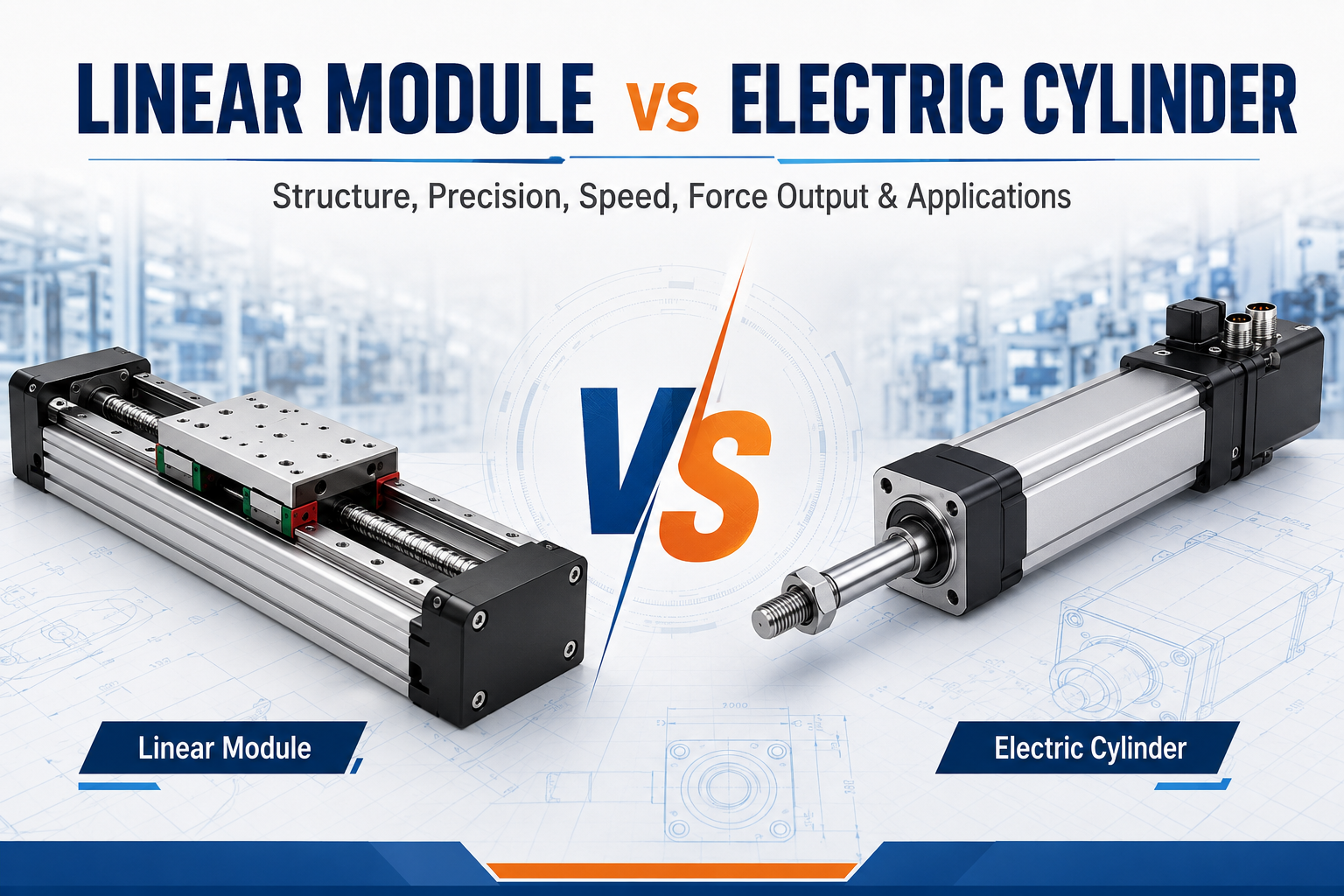
Alinear moduleand anelectric cylinderare both widely used to generate controlled linear motion in industrial automation. They can be driven by servo motors or stepper motors, connected to motion controllers, and integrated into automated equipment for positioning, lifting, pushing, pressing, transferring, and assembly operations.
Although both products belong to the broader category of linear actuators, their structures and primary functions are different. Alinear moduleis generally designed to move a carriage along an exposed or enclosed guide system. It is especially suitable for positioning loads over a defined travel path and for building single-axis or multi-axis motion platforms.
An electric cylinder is designed to extend and retract a rod or guided output assembly. It focuses on generating controlled axial force within a compact cylindrical or rectangular actuator structure. Electric cylinders are commonly used to replace pneumatic or hydraulic cylinders when higher positioning accuracy, programmable motion, cleaner operation, and better process control are required.
The correct choice depends on more than stroke and payload. Engineers must compare positioning accuracy, repeatability, speed, acceleration, thrust, side-load capacity, moment resistance, mounting orientation, protection level, environmental conditions, duty cycle, service life, control requirements, and total system cost.
This guide provides a detailedlinear module vs electric cylindercomparison to help automation engineers, equipment manufacturers, system integrators, and purchasing teams select the most suitable linear actuator.
What Is a Linear Module?
Alinear moduleis an integrated linear motion unit that combines a structural base, guide system, moving carriage, drive mechanism, motor interface, and optional sensors into a complete assembly.
The drive system may use a ball screw, timing belt, rack and pinion, linear motor, lead screw, or another transmission method. The carriage moves along one or more linear guides while supporting the payload, tooling, fixture, sensor, robot end effector, or processing head.
The motor is normally mounted at one end of the module or connected through a parallel drive arrangement. Motor rotation is converted into linear movement by the drive mechanism. The linear guides support the load and resist forces that would otherwise cause the carriage to rotate or move away from the intended path.
Linear modules are commonly used as independent axes or combined into XY, XZ, XYZ, gantry, Cartesian robot, and multi-axis automation systems.
Main Characteristics of Linear Modules
- Integrated guide and drive structure
- Moving carriage for mounting payloads and tooling
- Suitable for horizontal, vertical, side-mounted, and inverted installation
- Available in short, medium, and long strokes
- Supports multi-axis system construction
- Can provide high speed or high precision depending on drive type
- Can resist payload moments through the guide system
- Suitable for point-to-point positioning and continuous path motion
What Is an Electric Cylinder?
Anelectric cylinder, also called a servo electric cylinder, electric linear actuator, or electromechanical cylinder, is an actuator that converts motor rotation into controlled extension and retraction of a rod or guided output structure.
Most electric cylinders use a ball screw, roller screw, or lead screw as the internal transmission mechanism. The motor drives the screw through a coupling, gearbox, timing belt, or integrated direct-drive structure. As the screw rotates, the nut and output rod move axially.
Electric cylinders are designed to perform linear pushing, pulling, lifting, pressing, clamping, inserting, tensioning, and positioning operations. They provide an electrically controlled alternative to pneumatic and hydraulic cylinders.
Some electric cylinders have a simple rod output and require external guides when side loads are present. Others use dual guide rods, linear guide rails, or guided tables to improve load support and prevent the rod from rotating.
Main Characteristics of Electric Cylinders
- Rod-style or guided output
- High axial force capability
- Programmable stroke, speed, acceleration, and force
- Suitable for pressing, lifting, clamping, and insertion
- Compact actuator structure
- Can replace pneumatic or hydraulic cylinders
- Available with brakes, gearboxes, force sensors, and encoders
- Often available with higher protection levels
Linear Module vs Electric Cylinder: Quick Comparison
| Comparison Factor | Linear Module | Electric Cylinder |
|---|---|---|
| Primary Function | Position and transport a carriage along a guide path | Generate controlled axial extension, retraction, pushing, or pulling |
| Output Structure | Moving carriage or sliding table | Output rod or guided rod assembly |
| Guide System | Normally integrated | May be integrated or may require external guides |
| Force Output | Moderate to high, depending on drive type | Generally optimized for high axial thrust |
| Moment Load Capacity | Usually better because of integrated linear guides | Limited on rod types unless a guided structure is used |
| Speed | Can be very high, especially with belt or linear motor drive | Usually moderate, depending on screw lead and motor power |
| Stroke Length | Suitable for medium and long strokes | Commonly used for short and medium strokes |
| Positioning Accuracy | High with ball screw or linear motor systems | High with ball screw or roller screw systems |
| Protection Level | Open, semi-enclosed, or fully enclosed designs | Often easier to seal against dust, moisture, and contaminants |
| Multi-Axis Integration | Well suited for XY, XZ, XYZ, and gantry systems | Mainly used as an individual pushing or lifting axis |
| Typical Applications | Transfer, positioning, dispensing, inspection, and robotics | Pressing, clamping, lifting, insertion, and cylinder replacement |
The Fundamental Difference: Carriage Motion vs Rod Motion
The most visible difference between a linear module and an electric cylinder is the output form.
A linear module moves a carriage along a profile or base. The payload is mounted directly on the carriage, and the guide system supports the load throughout the complete stroke.
An electric cylinder normally extends and retracts an output rod. The rod transfers axial force to the load. In simple rod-style designs, the rod should not be exposed to excessive radial force or bending moment.
This difference strongly influences application selection. A linear module is generally more suitable when the load must travel along a guided path while carrying tooling or equipment. An electric cylinder is usually better when the main task is to push, pull, press, lift, clamp, or insert along a single axis.
Structural Differences
Linear Module Structure
A typical linear module contains a long structural profile or machined base. One or more guide rails are installed along the axis, and a carriage moves on the guide blocks.
The drive mechanism is positioned inside or beside the profile. In aball screw module, the carriage is connected to a ball nut. In a belt driven module, the carriage is fixed to a timing belt. In a linear motor module, electromagnetic force directly moves the carriage.
The module structure is designed to support payload weight and resist pitch, yaw, and roll moments. The carriage usually provides multiple threaded holes for mounting tooling, fixtures, sensors, or another motion axis.
Electric Cylinder Structure
A typical electric cylinder contains a motor, screw transmission, bearing support, actuator housing, anti-rotation structure, output rod, and front mounting interface.
When the motor rotates, the internal screw moves the nut and rod assembly forward or backward. The actuator housing protects the screw and supports the bearing system.
Rod-style electric cylinders are compact, but the output rod may not provide sufficient resistance to side loads. Guided electric cylinders add parallel guide rods or a table structure to improve lateral stability and moment capacity.
Drive Mechanism Comparison
Linear modules are available with several drive methods, while most electric cylinders rely on screw transmission.
Common Linear Module Drive Types
- Ball screw drive
- Timing belt drive
- Rack and pinion drive
- Linear motor drive
- Lead screw drive
Common Electric Cylinder Drive Types
- Ball screw drive
- Roller screw drive
- Lead screw drive
- Gearbox-assisted screw drive
- Parallel timing-belt motor transmission
Ball screw electric cylinders provide a good balance of force, speed, efficiency, and positioning accuracy. Roller screw electric cylinders provide higher force density and longer life in demanding applications, but they are usually more expensive.
The broader range of linear module drive technologies allows engineers to select a system optimized for speed, stroke, accuracy, or cost. Electric cylinders are more specifically optimized for axial force and compact extension-retraction motion.
Positioning Accuracy Comparison
Both linear modules and electric cylinders can provide accurate positioning when they use ball screws, suitable bearings, servo motors, and encoder feedback.
The final accuracy depends on screw lead accuracy, backlash, preload, structural rigidity, motor encoder resolution, controller performance, thermal expansion, mounting conditions, and load deformation.
Linear Module Accuracy
Ball screw linear modules are commonly selected for precision positioning. Preloaded ball nuts can reduce axial backlash, while integrated guide rails maintain carriage alignment.
Linear motor modules can provide excellent positioning performance because they eliminate the screw, coupling, belt, and other mechanical transmission components. Their accuracy depends strongly on the linear encoder and control system.
Belt driven linear modules generally provide lower axial rigidity and lower absolute positioning accuracy, but they may still offer sufficient repeatability for packaging, handling, and transfer operations.
Electric Cylinder Accuracy
Servo electric cylinders can achieve precise extension and retraction because the controller tracks motor position through an encoder. Ball screw preload and rigid bearing supports help reduce lost motion.
However, the output rod, mounting brackets, connected tooling, gearbox, and external load can introduce deflection or clearance. A precise actuator does not guarantee a precise process unless the complete machine structure is also rigid.
Which One Is More Accurate?
Neither product type is automatically more accurate in every application. A precision ball screw linear module and a precisionball screw electric cylindermay provide similar repeatability when they use comparable screw grades, bearings, motors, and feedback systems.
The more important difference is how the load is guided. A linear module normally controls the position and orientation of the moving carriage. A rod-style electric cylinder mainly controls axial extension and may require an external guide to maintain load orientation.
Repeatability and Resolution
Repeatability describes the ability of the actuator to return to the same commanded position repeatedly. Resolution describes the smallest movement the control system can command or detect.
Servo motors generally provide better closed-loop position control than open-loop stepper systems. However, high encoder resolution does not automatically create high mechanical accuracy.
Mechanical backlash, screw lead variation, bearing clearance, belt elasticity, rod deflection, coupling compliance, structural deformation, and temperature changes can all affect final performance.
For demanding positioning applications, engineers should distinguish between motor resolution, actuator repeatability, absolute positioning accuracy, and complete machine accuracy.
Speed Comparison
Linear modules generally offer a wider speed range because they can use different transmission technologies.
Timingbelt linear modulesare suitable for high-speed, long-stroke movement. Linear motor modules can provide even higher acceleration and rapid response. Ball screw modules offer precision and thrust but may be limited by screw critical speed.
Electric cylinders normally use ball screws or roller screws, so their maximum speed is influenced by screw lead, screw diameter, stroke, rotational speed, bearing capacity, motor power, and thermal conditions.
For short-stroke pushing, pressing, clamping, or lifting, an electric cylinder may provide sufficient speed. For repeated high-speed travel over a long distance, a belt driven or linear motor module is usually more suitable.
Maximum Speed vs Cycle Time
Maximum travel speed is only one part of machine productivity. Actual cycle time also depends on acceleration, deceleration, settling time, process time, payload, stroke, and motion profile.
An electric cylinder performing a short pressing stroke may complete the process faster than a long-travel module, even if its rated maximum speed is lower. The correct comparison must be based on the complete motion cycle.
Acceleration Comparison
Belt driven and linear motor modules can achieve high acceleration because their moving systems can be relatively lightweight.
Ball screw linear modules and electric cylinders must accelerate the motor rotor, screw, coupling, and moving load. High acceleration increases required torque, bearing load, screw stress, and heat generation.
Electric cylinders designed for high thrust may use larger screws, gearboxes, or powerful motors, which can increase inertia and reduce dynamic response.
When rapid acceleration is required, engineers should calculate peak motor torque, RMS torque, reflected inertia, screw critical speed, and structural vibration rather than relying only on catalog maximum values.
Force Output Comparison
Force output is one of the most important differences in alinear module vs electric cylindercomparison.
Electric cylinders are generally optimized for axial force. Their compact screw transmission can generate high pushing and pulling force, especially when combined with a gearbox or roller screw.
Linear modules can also generate significant thrust, particularly ball screw and rack driven modules. However, many linear modules are primarily optimized for positioning and transport rather than high-force pressing.
Electric Cylinder Force Advantages
- High axial force within a compact structure
- Suitable for pressing, clamping, and insertion
- Programmable force and position control
- Can maintain controlled force during a process
- Available with load cells or force feedback
- Can replace pneumatic or hydraulic cylinders
Linear Module Force Characteristics
- Ball screw modules provide strong axial thrust
- Rack driven modules are suitable for heavy long-stroke movement
- Belt driven modules are better for transport than high-force pressing
- Linear motor modules provide fast response but require thermal management
- Force capability must be checked together with guide and profile rigidity
Payload and Thrust Are Different
Payload refers to the mass supported by the moving carriage or output mechanism. Thrust refers to the axial force required to move, accelerate, lift, push, pull, clamp, or press the load.
A linear module may support a large payload on its carriage but provide only moderate process force. An electric cylinder may generate high axial thrust while supporting very little side load on its rod.
Selection should therefore include both payload and force calculations. Engineers should not use the payload rating of a module as a substitute for thrust capacity, or use the thrust rating of an electric cylinder as a substitute for side-load capacity.
Side Load and Moment Capacity
Linear modules normally have a clear advantage when the moving load produces side forces or moments.
The integrated guide rails and carriage support radial loads and resist pitch, yaw, and roll moments. The allowable moment depends on rail size, number of guide blocks, block spacing, carriage dimensions, profile rigidity, and load position.
A standard rod-style electric cylinder is mainly designed for axial force. Excessive side load can cause rod bending, seal wear, bearing damage, increased friction, and reduced service life.
When an electric cylinder is used to move a load that is not independently guided, a guided electric cylinder or external linear guide system should be used.
Use External Guides with an Electric Cylinder When:
- The load creates significant side force
- The load center is offset from the rod axis
- The actuator must resist rotation
- The tooling must maintain precise orientation
- The application involves a wide platform
- The stroke is long and the rod is exposed to bending
Stroke Length Comparison
Linear modules are available for a wide range of strokes. Belt driven, rack driven, and linear motor modules are particularly suitable for long travel.
Ball screw modules are normally used for short and medium strokes, although long-stroke versions can be designed with larger screws and suitable support structures.
Electric cylinders are commonly used for short and medium strokes. As the stroke increases, rod length, screw length, buckling risk, housing length, speed limitation, and installation space become more important.
For long-distance transfer, a linear module is usually more practical. For short-stroke pressing, clamping, lifting, or insertion, an electric cylinder is often more compact.
Rigidity Comparison
A linear module provides rigidity through its profile, guide rails, carriage, drive mechanism, and mounting structure. Ball screw modules typically provide good axial rigidity, while belt driven modules have more elastic deformation.
An electric cylinder provides strong axial rigidity when using a ball screw or roller screw with appropriate bearing support. However, a long output rod may bend under side load or compression.
For pressing and insertion operations, electric cylinder axial rigidity can provide stable force transmission. For carrying a large fixture or resisting overturning moments, a linear module or guided electric cylinder is usually more suitable.
Vertical Installation Comparison
Both linear modules and electric cylinders can be used vertically, but the safety design must account for gravity and power loss.
A vertical linear module may require a brake motor, counterbalance, gas spring, pneumatic balancing cylinder, or mechanical fall-prevention device.
An electric cylinder used for vertical lifting may also require a brake, self-locking mechanism, safety nut, mechanical lock, or load-holding device.
Ball screws are generally not completely self-locking. A vertical load can drive the screw backward when motor torque is removed. Engineers should never assume that a ball screw actuator will safely hold a suspended load without additional protection.
Protection Level Comparison
Protection level is often an important advantage of electric cylinders.
The screw and internal transmission components of an electric cylinder are enclosed within the housing. Seals, rod scrapers, gaskets, protective boots, and corrosion-resistant materials can be used to improve resistance to dust, moisture, oil, and contamination.
Linear modules may have open, semi-enclosed, or fully enclosed structures. Open modules provide easy access and heat dissipation but offer limited environmental protection. Semi-enclosed and fully enclosed modules use cover plates, steel strips, sealing belts, or protective bellows.
A catalog protection rating should only be accepted when the complete actuator, motor connection, cable interface, sensor installation, and moving seals are included in the rating.
Electric Cylinders Are Often Better Suited For:
- Dusty production areas
- Moist or splash-prone environments
- Food and packaging equipment with cleaning requirements
- Outdoor or semi-outdoor machinery
- Applications requiring sealed actuator housings
Linear Modules Are Often Better Suited For:
- Clean indoor automation
- Precision assembly systems
- Semiconductor and electronics equipment
- Multi-axis Cartesian motion
- Applications requiring easy carriage access
Cleanroom and Vacuum Applications
Both linear modules and electric cylinders can be designed for cleanroom use, but standard industrial products should not automatically be considered cleanroom compatible.
Cleanroom versions may require low-particle seals, clean lubricants, corrosion-resistant materials, vacuum extraction, covered guide systems, and special cable management.
Linear motor modules are often used in semiconductor equipment because they eliminate screw contact and can provide precise, high-speed motion. However, guide lubrication, cable movement, and magnetic components still require careful control.
Electric cylinders can provide an enclosed structure, but rod seals, internal lubrication, and air displacement during extension and retraction must be evaluated for cleanroom and vacuum conditions.
Control System Comparison
Both actuator types can be controlled with servo motors, stepper motors, motion controllers, programmable logic controllers, and industrial networks.
A linear module may perform point-to-point motion, continuous path motion, coordinated interpolation, electronic gearing, and multi-axis synchronization.
An electric cylinder may perform position control, speed control, force control, pressure replacement, press-fit monitoring, and programmable push-pull cycles.
Typical Linear Module Control Functions
- Absolute or incremental positioning
- Multi-position transfer
- XY or XYZ interpolation
- Speed and acceleration profiling
- Electronic cam motion
- Gantry synchronization
- Scanning and dispensing paths
Typical Electric Cylinder Control Functions
- Programmable extension and retraction
- Force-limited pressing
- Position-controlled clamping
- Multi-stage speed profiles
- Press-fit force and position monitoring
- Soft landing and controlled contact
- Load holding with brake control
Force Control and Process Monitoring
Electric cylinders are especially suitable for processes that require force monitoring. A servo motor can estimate force from motor torque, while a load cell can provide direct force feedback.
This makes electric cylinders useful for pressing, riveting, insertion, testing, forming, clamping, and assembly verification.
A force-position curve can be recorded during each cycle. The controller can compare actual results against acceptable limits to identify missing parts, incorrect assembly, excessive resistance, or process defects.
Linear modules can also perform force-sensitive operations, but an additional force sensor and suitable mechanical structure are usually required. Their primary design focus is normally motion positioning rather than force application.
Duty Cycle and Continuous Operation
Duty cycle describes how frequently and how long the actuator operates. It affects motor temperature, screw temperature, bearing life, lubrication interval, gearbox wear, and controller sizing.
Linear modules used in transfer and inspection equipment may operate continuously for long periods with repeated motion cycles.
Electric cylinders performing pressing or clamping may experience short periods of high force followed by rest periods. Some applications require the cylinder to hold force continuously, which can generate motor and screw heat.
The actuator should be selected according to the complete motion and force profile rather than peak force alone. Engineers should calculate peak load, average load, RMS motor torque, travel frequency, holding time, and expected annual cycles.
Service Life Comparison
The service life of both actuator types depends on load, speed, acceleration, screw type, guide capacity, lubrication, contamination, alignment, operating temperature, and duty cycle.
Ball screw life can be estimated using dynamic load ratings, but actual service life may be reduced by shock load, insufficient lubrication, misalignment, contamination, excessive preload, or operation beyond critical speed.
Electric cylinders used for high-force pressing may experience significant screw and bearing loads. Roller screw designs can provide longer life under demanding load cycles.
Linear modules may experience guide block wear, belt fatigue, screw wear, profile deformation, bearing damage, or carriage looseness depending on the design and application.
Noise and Vibration Comparison
Noise depends on drive type, speed, screw condition, motor control, bearing quality, lubrication, and machine resonance.
Belt driven linear modules are often quiet during high-speed movement. Ball screw modules may generate noise from recirculating balls and support bearings.
Electric cylinders may produce screw, gearbox, motor, and rod-seal noise. A gearbox can increase sound level, while a direct-drive design may operate more quietly.
For noise-sensitive applications, engineers should compare operating noise under actual load and speed rather than relying only on unloaded measurements.
Maintenance Comparison
Linear Module Maintenance
- Lubricate ball screws and linear guides
- Inspect belt tension and wear
- Check carriage looseness and guide preload
- Inspect couplings, pulleys, and bearings
- Clean protective strips and exposed surfaces
- Check sensors and cable carriers
- Monitor backlash, noise, vibration, and temperature
Electric Cylinder Maintenance
- Inspect rod surface and rod seals
- Check screw lubrication
- Inspect gearbox and coupling condition
- Check mounting pins and brackets
- Monitor axial backlash and thrust performance
- Inspect brake operation
- Check force sensor calibration
- Monitor motor temperature and abnormal noise
Fully enclosed electric cylinders may require less frequent cleaning, but internal components can be more difficult to access. Linear modules may be easier to inspect visually, especially when the guide and drive components are exposed.
Installation Differences
Linear modules are normally mounted along their base using bolts, clamps, or support brackets. The mounting surface must be flat, rigid, and capable of supporting the complete module length.
Electric cylinders can be mounted through front flanges, rear flanges, trunnions, clevis brackets, side mounts, or foot mounts. Their mounting arrangement may allow limited pivoting in applications similar to pneumatic cylinders.
However, an electric cylinder must be installed so that the output rod remains aligned with the load. Misalignment can create side forces, rod bending, seal wear, and screw damage.
A linear module also requires correct alignment, but its integrated guides maintain carriage direction once the base is mounted properly.
Space Requirement Comparison
A linear module occupies space along the complete travel path because the carriage moves on a fixed base. The motor may extend from one end or side of the profile.
An electric cylinder has a retracted body length plus an extending rod. In some installations, its body may be more compact than a full module, but the extended rod requires clear space.
The total installed length of an electric cylinder can be significantly greater than its usable stroke, especially with long strokes or inline motors.
Space should be evaluated using the complete actuator dimensions, motor position, cable bending radius, mounting brackets, safety clearance, and maintenance access.
Cost Comparison
The cost difference depends on size, stroke, force, accuracy, protection level, motor, control system, and accessories.
A standard belt driven linear module may provide a cost-effective solution for high-speed transport. A high-precision ball screw module or linear motor module may be more expensive.
An electric cylinder with a ball screw can be economical when replacing a pneumatic cylinder and providing programmable positioning. A high-force roller screw cylinder with force sensing and high protection may have a significantly higher purchase price.
The total cost should include more than the actuator price.
Total Cost of Ownership May Include
- Actuator purchase price
- Servo motor and drive
- Motion controller or PLC
- Mounting brackets and machine structure
- External guide system
- Sensors and force measurement
- Installation and commissioning
- Lubrication and maintenance
- Replacement belts, screws, bearings, seals, or rods
- Energy consumption
- Production downtime
- Product quality and rejection risk
Typical Linear Module Applications
- Pick-and-place systems
- Electronic component assembly
- Automatic dispensing
- Vision inspection
- Laser processing
- Packaging machinery
- Sorting and material transfer
- Cartesian robots
- Gantry automation
- Semiconductor handling
- Battery manufacturing equipment
- Laboratory automation
- Printing and labeling equipment
- Long-stroke loading and unloading
Typical Electric Cylinder Applications
- Servo pressing systems
- Press-fit assembly
- Clamping and positioning fixtures
- Vertical lifting
- Valve and gate control
- Riveting and forming
- Component insertion
- Tension control
- Opening and closing mechanisms
- Material testing equipment
- Packaging compression
- Welding gun actuation
- Automotive assembly
- Pneumatic cylinder replacement
When Should You Choose a Linear Module?
- The load must travel along a guided path
- The application requires a moving platform or carriage
- The load creates pitch, yaw, or roll moments
- The system requires medium or long stroke
- High travel speed is important
- The axis will be combined into an XY, XZ, XYZ, or gantry system
- The application involves dispensing, scanning, inspection, or transfer
- The tooling must maintain accurate orientation
- The machine requires multiple positioning points
- The actuator must support payload weight throughout the stroke
When Should You Choose an Electric Cylinder?
- The main requirement is pushing or pulling force
- The application involves pressing, clamping, insertion, or lifting
- The actuator must replace a pneumatic or hydraulic cylinder
- Programmable force and position control are required
- The stroke is short or moderate
- A compact rod-style output is preferred
- The environment requires a sealed actuator structure
- The process requires force-position monitoring
- The actuator must maintain controlled contact force
- The load is primarily aligned with the actuator axis
Application Selection Examples
High-Speed Product Transfer
A packaging line must move lightweight products over a long stroke at high speed. The load is mounted on a carriage and must remain stable during acceleration. A belt driven linear module is generally more suitable.
Precision Press-Fit Assembly
An assembly station must insert a bearing into a housing while monitoring force and position. A servo electric cylinder with a load cell is usually the better option.
Vision Inspection Platform
A camera must move between multiple inspection positions while maintaining accurate orientation. A ball screw or linear motor module is generally more appropriate.
Vertical Lifting Mechanism
A fixture must be lifted vertically and held at several positions. Either actuator may be suitable. A linear module is better when the fixture creates significant moments, while an electric cylinder may be better when axial lifting force and compact installation are the main requirements.
Clamping Station
A fixture must apply controlled clamping force to a component. An electric cylinder is usually more suitable because it can control position, speed, and force during the clamping cycle.
XYZ Dispensing System
A dispensing head must follow a programmed three-dimensional path. Linear modules are the natural choice because they can be combined into coordinated multi-axis systems.
Common Selection Mistakes
Using an Electric Cylinder to Carry Large Side Loads
A rod-style electric cylinder should not be used as a structural guide unless it is specifically designed for side-load capacity. External guides may be necessary.
Selecting a Linear Module Only by Payload
Payload capacity does not describe process thrust. Pressing and insertion applications require a separate force calculation.
Ignoring Moment Loads
A load may be within the stated weight limit but still exceed the allowable pitch, yaw, or roll moment.
Assuming Ball Screws Are Self-Locking
Vertical ball screw actuators may back-drive under load. A brake or mechanical safety system may be required.
Comparing Only Maximum Speed
Actual cycle time depends on acceleration, deceleration, settling, process duration, stroke, and load.
Ignoring Protection Requirements
An open linear module may fail prematurely in dusty or wet environments. A sealed electric cylinder or fully enclosed module may be necessary.
Using Motor Torque as Direct Force Measurement
Motor torque estimation can be affected by friction, temperature, gearbox efficiency, acceleration, and mechanical losses. Critical force-control processes may require a dedicated load cell.
Comparing Only Purchase Price
External guides, mounting structures, force sensors, downtime, maintenance, and product quality can significantly affect total cost.
Important Parameters to Confirm Before Selection
- Motion function:Determine whether the application needs carriage travel or rod extension.
- Effective stroke:Confirm the required working travel.
- Payload:Include tooling, fixtures, products, cables, and accessories.
- Axial force:Calculate pushing, pulling, lifting, clamping, and process forces.
- Side load:Confirm radial forces acting on the carriage or rod.
- Moment load:Calculate pitch, yaw, and roll moments.
- Speed:Define normal and maximum operating speeds.
- Acceleration:Confirm acceleration, deceleration, and jerk requirements.
- Accuracy:Distinguish between repeatability, absolute accuracy, and resolution.
- Mounting orientation:Specify horizontal, vertical, side-mounted, inverted, or inclined installation.
- Duty cycle:Confirm cycles per minute, operating hours, travel distance, and holding time.
- Protection level:Identify dust, water, oil, chips, cleaning, and outdoor exposure.
- Environment:Confirm temperature, humidity, cleanroom, vacuum, and chemical conditions.
- Safety:Include brakes, mechanical locks, fall protection, limit switches, and emergency stops.
- Control mode:Define position, speed, force, torque, or synchronized motion requirements.
- Service life:Define expected cycles, maintenance intervals, and replacement strategy.
- Installation space:Check actuator length, motor position, rod extension, and cable clearance.
- Total cost:Compare complete system and lifetime cost.
Frequently Asked Questions
Is an electric cylinder a type of linear actuator?
Yes. An electric cylinder is an electromechanical linear actuator that converts motor rotation into controlled rod extension and retraction.
Can a linear module replace an electric cylinder?
It can replace an electric cylinder in some positioning or lifting applications, but it may not be the best choice for compact high-force pressing, clamping, or insertion.
Can an electric cylinder replace a linear module?
It can perform simple axial movement, but a rod-style electric cylinder may require external guides when the load must maintain orientation or resist moment forces.
Which actuator provides more force?
Electric cylinders are generally optimized for higher axial force, especially roller screw and gearbox-assisted models. Ball screw and rack driven linear modules can also provide high thrust.
Which actuator is faster?
Belt driven and linear motor modules usually provide higher travel speed and acceleration. Electric cylinders are normally optimized for controlled axial motion rather than maximum long-stroke speed.
Which actuator is more accurate?
Both can provide high accuracy when using precision ball screws, servo motors, suitable feedback, and rigid structures. The final result depends on the complete system design.
Which actuator is better for vertical lifting?
Either may be suitable. A linear module is often better when the load creates moments or requires guided carriage motion. An electric cylinder is often better when axial lifting force and compact installation are the main requirements.
Which actuator has better environmental protection?
Electric cylinders often provide better sealing because their screw transmission is enclosed. Fully enclosed linear modules can also provide good protection when correctly specified.
Does an electric cylinder require a linear guide?
A simple axial load may not require an external guide. Side loads, off-center loads, long tooling, or moment forces normally require a guided cylinder or separate linear guide system.
Which actuator is better for multi-axis automation?
Linear modules are generally better for XY, XZ, XYZ, and gantry systems because their carriages and mounting interfaces are designed for multi-axis integration.
Conclusion
The main difference in thelinear module vs electric cylindercomparison is the type of motion and load each product is designed to handle.
A linear module moves a guided carriage along a defined path. It is suitable for positioning, transfer, inspection, dispensing, robotics, long-stroke motion, and multi-axis automation. Its integrated guide system allows it to support payload weight and resist moment loads.
An electric cylinder extends and retracts a rod or guided output assembly. It is suitable for pushing, pulling, pressing, clamping, lifting, insertion, and force-controlled processes. Its enclosed structure and high axial force capability make it an effective replacement for pneumatic and hydraulic cylinders.
Choose a linear module when carriage guidance, long travel, high speed, moment resistance, and multi-axis integration are the main priorities. Choose an electric cylinder when axial thrust, compact extension-retraction motion, force control, environmental sealing, and cylinder replacement are more important.
The final selection should be based on stroke, payload, thrust, side load, moment load, speed, acceleration, accuracy, protection level, duty cycle, mounting orientation, control method, safety, service life, and total system cost.
By evaluating these requirements as a complete system, engineers can avoid actuator overload, rod bending, insufficient force, unstable positioning, premature wear, and unnecessary equipment cost while creating a reliable and efficient automation solution.