 English

Aball screw linear moduleis one of the most widely used precision linear motion systems in modern industrial automation. By combining a ball screw drive mechanism, linear guide rails, carriage, aluminum base, motor interface, and control components into a single integrated assembly, it converts rotary motion from a motor into smooth, highly accurate linear movement.
Compared with conventional linear motion mechanisms assembled from separate ball screws and guide rails, a standardizedball screw linear moduleprovides higher positioning accuracy, greater rigidity, easier installation, lower maintenance requirements, and significantly shorter machine development time.
Because of its outstanding precision and repeatability, theball screw linear modulehas become the preferred solution for semiconductor equipment, CNC machinery, electronics manufacturing, laboratory automation, lithium battery production, vision inspection systems, medical devices, and countless other industrial applications where accurate positioning is essential.
This guide explains everything you need to know about aball screw linear module, including its definition, working principle, internal structure, major components, performance characteristics, and typical industrial applications.
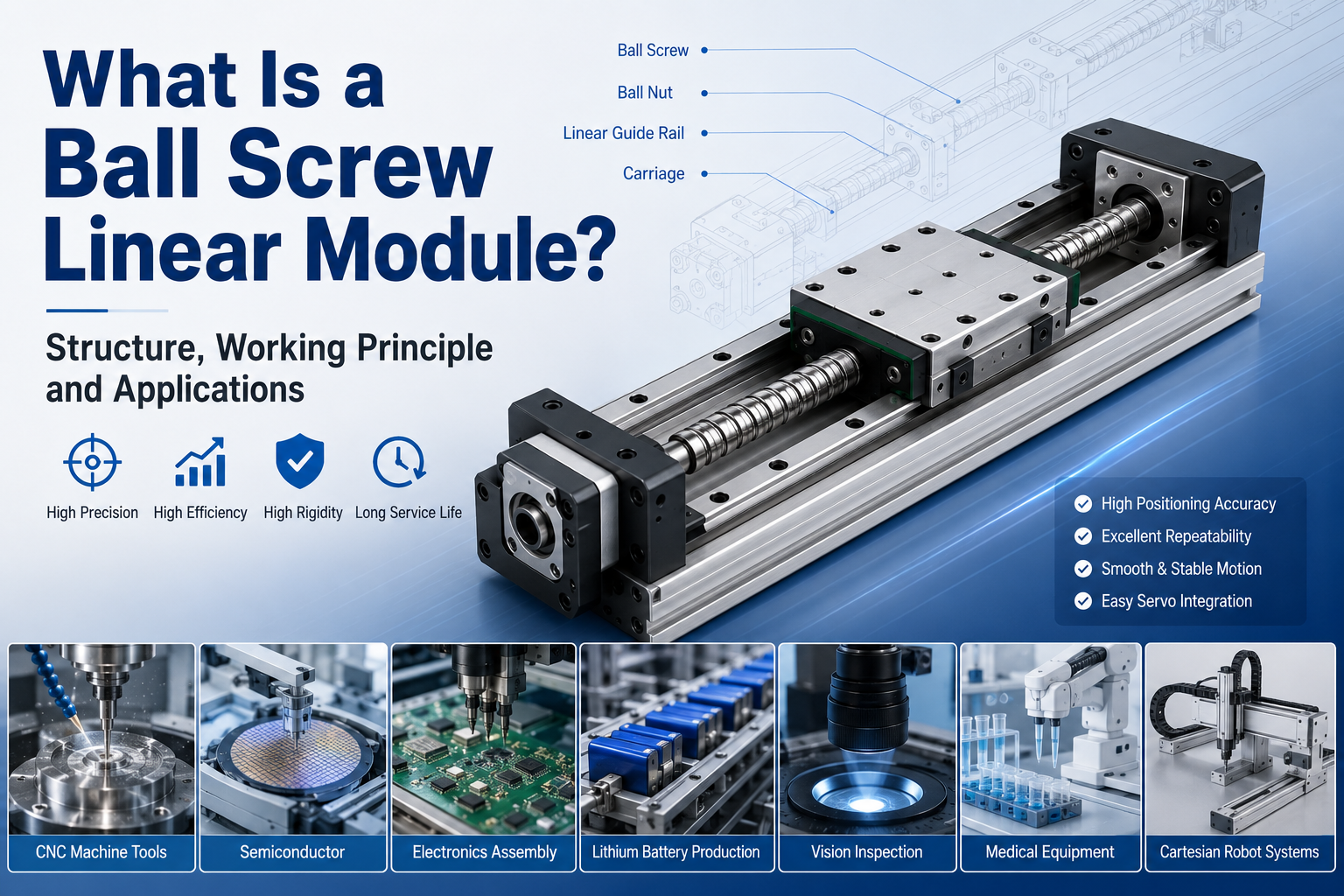
What Is a Ball Screw Linear Module?
A ball screw linear module is a precisionlinear motion platformthat uses a rotatingball screwto drive a moving carriage along linear guide rails. The rolling balls circulating inside the ball nut dramatically reduce friction compared with conventional lead screws, allowing the module to achieve high positioning accuracy, excellent transmission efficiency, long service life, and smooth motion.
Unlike pneumatic cylinders or hydraulic actuators that rely on fluid pressure, a ball screw linear module is driven mechanically by an electric motor. This makes it suitable for applications requiring programmable positioning, repeatable motion, servo control, and precise speed regulation.
In modern automation equipment, a ball screw linear module often serves as a single-axis positioning system. Multiple modules can also be combined into XY tables, XYZCartesian robots, gantry systems, and multi-axis automation platforms.
Understanding the Basic Concept
The fundamental purpose of every linear module is to transform rotary motion into controlled linear motion. In a ball screw linear module, this conversion is accomplished through the interaction between the rotating screw shaft and the ball nut assembly.
When the motor rotates the ball screw, dozens or even hundreds of precision steel balls continuously circulate inside the nut. Rather than sliding directly against the screw threads, these balls roll between the screw and nut, greatly reducing friction while transferring mechanical force efficiently.
As the ball nut moves along the rotating screw, the carriage attached to the nut travels along precision linear guide rails. Because the guide rails absorb lateral loads while the screw provides driving force, both motion accuracy and structural rigidity are maintained simultaneously.
This rolling-contact transmission principle is one of the primary reasons why ball screw driven systems are capable of micron-level positioning accuracy in many industrial applications.
Why Is It Called a Ball Screw Linear Module?
The name comes from its core transmission component—theball screw. Unlike traditional trapezoidal lead screws that generate sliding friction, a ball screw contains recirculating steel balls between the screw shaft and the nut.
These rolling balls continuously circulate through specially designed return channels, allowing rotary motion to be converted into linear motion with extremely high efficiency.
The term "linear module" refers to the complete integrated motion unit rather than the ball screw itself. Besides the ball screw, the module also includes:
- Precision aluminum base
- Linear guide rails
- Moving carriage
- Bearing support assemblies
- Motor mounting interface
- Limit sensors
- Cable management system
- Protective cover (optional)
By integrating all these components into one standardized product, manufacturers eliminate complicated alignment work during machine assembly while improving overall system reliability.
How Does a Ball Screw Linear Module Work?
The operating principle of a ball screw linear module can be divided into several continuous motion stages.
1. Motor Generates Rotary Motion
An AC servo motor, stepper motor, or other rotary actuator provides rotational power through a coupling or belt transmission connected to the ball screw.
2. Ball Screw Rotates
The screw shaft rotates while remaining axially fixed by bearing supports located at one or both ends of the module.
3. Steel Balls Roll Inside the Nut
Hundreds of precision steel balls circulate continuously inside the ball nut. Instead of sliding across the screw threads, these balls roll smoothly, dramatically reducing friction and mechanical wear.
4. Ball Nut Produces Linear Motion
As the screw rotates, the ball nut travels linearly along the screw axis. The direction of travel depends entirely on the motor's rotational direction.
5. Carriage Moves Along Guide Rails
Since the carriage is rigidly connected to the ball nut, it moves together with the nut while the linear guide rails maintain precise alignment and resist external loads.
6. Position Feedback Enables Precision Control
Servo systems equipped with encoders continuously monitor motor position, allowing highly accurate positioning, synchronized multi-axis motion, interpolation, and closed-loop motion control.
This combination of efficient rolling transmission and precision servo control makes ball screw linear modules ideal for applications requiring high repeatability and accurate positioning.
Main Advantages of Ball Screw Drive Technology
High Positioning Accuracy
Ball screw transmission offers significantly higher positioning accuracy than many other mechanical transmission methods. Combined with precision guide rails and servo motors, positioning errors can be minimized for demanding automation tasks.
Excellent Repeatability
Because backlash is minimized through preload design, repeated positioning remains highly consistent over long production cycles.
High Mechanical Efficiency
Rolling friction enables transmission efficiencies commonly reaching around 90%, substantially reducing energy loss compared with sliding screw mechanisms.
High Rigidity
The combination of precision screw support bearings, rigid aluminum structure, and linear guides provides excellent structural stiffness suitable for machining, dispensing, inspection, and assembly equipment.
Long Service Life
Proper lubrication significantly reduces wear between rolling elements, allowing ball screw modules to achieve long operating lifetimes even under continuous industrial use.
Accurate Speed Control
Since movement is directly proportional to motor rotation, motion speed can be precisely programmed using servo controllers or motion control systems.
Ball Screw Linear Module Structure Overview
Although different manufacturers offer various designs, most ball screw linear modules share a highly similar mechanical architecture. Every structural component contributes to positioning accuracy, rigidity, load capacity, service life, and maintenance performance.
A typical ball screw linear module consists of the following assemblies:
- Aluminum base frame
- Ball screw assembly
- Ball nut
- Linear guide rails
- Carriage (slider)
- Bearing support units
- Motor mounting flange
- Limit sensors
- Lubrication system
- Protective cover
Each component performs a dedicated function while working together as an integrated precision motion platform.
Main Components of a Ball Screw Linear Module
Aluminum Base Frame
The aluminum profile forms the structural backbone of the module. It supports all mechanical components while maintaining rigidity, dimensional stability, and installation accuracy.
High-quality modules typically use precision-machined aluminum alloy bases that minimize deformation during long-term operation.
Ball Screw Assembly
The ball screw is the primary transmission component responsible for converting rotary motion into linear movement. Its lead directly determines travel distance per revolution, influencing both speed and thrust.
Different lead options allow engineers to optimize the balance between positioning accuracy, maximum speed, and load capacity according to application requirements.
Ball Nut
The ball nut contains precisely manufactured recirculating steel balls that roll smoothly between the nut and screw shaft. This rolling contact minimizes friction while maintaining highly efficient power transmission.
Many industrial-grade modules employ preloaded ball nuts to eliminate backlash and further improve positioning accuracy.
Linear Guide Rails
While the ball screw provides the driving force, thelinear guide railsare responsible for guiding the carriage accurately throughout its travel. Precision linear guides maintain straight-line motion, absorb radial and moment loads, and prevent unwanted deflection during operation.
Modern ball screw linear modules generally use profile linear guide rails with recirculating ball bearings. These guides offer high rigidity, low friction, and excellent load-carrying capacity, making them suitable for precision automation equipment.
The quality of the guide rails directly influences positioning accuracy, repeatability, vibration performance, and overall service life.
Carriage (Slider)
The carriage, also known as the slider or moving table, is the platform that carries the payload. It is mechanically connected to the ball nut so that linear motion generated by the screw is transferred directly to the workpiece or tooling mounted on the carriage.
Depending on the application, the carriage may support fixtures, robotic grippers, vision cameras, dispensing valves, laser heads, machining tools, or inspection equipment.
To ensure stable operation under varying loads, the carriage is designed with optimized rigidity and multiple mounting holes for flexible installation.
Bearing Support Units
Both ends of the ball screw are supported by precision bearing units. These supports maintain screw alignment, minimize axial movement, and absorb rotational loads generated during high-speed operation.
High-quality support bearings also reduce vibration and improve transmission stability, especially in applications involving rapid acceleration and deceleration.
Motor Mounting Interface
The motor mounting interface connects the ball screw to a servo motor, stepper motor, or other drive source. Standardized mounting dimensions simplify motor installation and allow users to select motors according to application requirements.
Some modules incorporate direct coupling designs, while others use timing belts to achieve speed reduction or increase installation flexibility.
Limit Sensors
Photoelectric or magnetic limit sensors detect carriage position near both ends of the stroke. These sensors prevent overtravel, protect equipment from collision, and establish reference positions during system initialization.
Modern automation systems also use sensors for homing procedures, positioning verification, and production monitoring.
Lubrication System
Proper lubrication is essential for maintaining long-term performance. Lubricants reduce friction between the screw, ball nut, and guide rails while minimizing wear and preventing corrosion.
Many industrial modules provide dedicated lubrication ports that simplify routine maintenance without requiring complete machine disassembly.
Protective Cover
Optional protective covers shield internal moving components from dust, metal chips, coolant, and other contaminants. Depending on the working environment, covers may consist of stainless steel strips, telescopic covers, bellows, or enclosed aluminum housings.
Effective protection significantly extends component life and improves reliability in harsh industrial environments.
Performance Characteristics of Ball Screw Linear Modules
Compared with many other linear transmission technologies, ball screw linear modules offer an excellent combination of precision, rigidity, efficiency, and controllability. These characteristics explain why they are widely used in demanding industrial automation applications.
Excellent Positioning Accuracy
Ball screw transmission enables highly accurate positioning because rolling contact minimizes backlash and mechanical error. Combined with servo control and precision guide rails, the system can repeatedly reach programmed positions with exceptional consistency.
Outstanding Repeatability
Repeatability is often even more important than absolute positioning accuracy in automated production. Ball screw modules maintain highly consistent positioning over thousands or millions of operating cycles, making them ideal for repetitive manufacturing processes.
High Load Capacity
The combination of a rigid ball screw, robust linear guides, and reinforced aluminum structure allows these modules to support significant payloads while maintaining precise motion.
High Rigidity
Minimal structural deformation under load ensures stable machining, inspection, dispensing, and assembly operations. High rigidity also reduces vibration during acceleration and improves overall system stability.
Smooth Motion
Rolling-contact transmission produces smooth and stable movement with very low friction, reducing noise while improving motion quality.
Long Service Life
When properly lubricated and maintained, ball screw linear modules can operate reliably for many years under continuous industrial conditions, providing excellent long-term value.
Easy Servo Integration
Ball screw linear modules are fully compatible with modern motion control systems, including servo drives, PLCs, industrial PCs, and multi-axis controllers. This enables precise interpolation, synchronized motion, and complex automation sequences.
Typical Applications of Ball Screw Linear Modules
Because of their high precision and excellent repeatability, ball screw linear modules are widely used across numerous industries where accurate linear positioning is required.
CNC Machine Tools
CNC machining centers use ball screw linear modules to position cutting tools and workpieces with high precision, ensuring dimensional accuracy and surface quality.
Semiconductor Manufacturing
Semiconductor production equipment requires micron-level positioning accuracy for wafer handling, inspection, lithography, and packaging. Ball screw modules provide the stability necessary for these demanding processes.
Electronics Assembly
Automated PCB assembly, screw fastening, soldering, dispensing, and testing systems rely on accurate linear positioning to improve production efficiency and product quality.
Lithium Battery Production
Battery manufacturing equipment uses ball screw modules for electrode stacking, welding, inspection, and precision assembly throughout the production process.
Vision Inspection Systems
Machine vision equipment frequently requires precise movement of cameras or workpieces to ensure accurate image acquisition and automated inspection.
Medical Equipment
Laboratory automation, diagnostic instruments, sample handling systems, and medical manufacturing equipment often utilize ball screw linear modules for reliable and repeatable positioning.
Precision Assembly Automation
Robotic assembly stations use ball screw modules to position components accurately during fastening, insertion, alignment, and quality inspection operations.
Cartesian Robot Systems
Multiple ball screw linear modules can be combined into XY, XZ, XYZ, or gantry robot configurations to create flexible multi-axis automation systems capable of handling complex production tasks.
Why Choose a Ball Screw Linear Module?
Selecting the appropriate linear motion solution depends on application requirements such as positioning accuracy, load capacity, travel distance, speed, and operating environment.
For applications that prioritize precision over extremely high travel speeds, ball screw linear modules remain one of the most effective mechanical transmission solutions available. Their excellent repeatability, high rigidity, mature technology, and broad compatibility with servo systems make them suitable for both standard industrial equipment and highly customized automation projects.
Compared with manually assembled motion systems, integrated ball screw linear modules also reduce engineering complexity, shorten machine development cycles, simplify installation, and improve long-term reliability.
Frequently Asked Questions
What is a ball screw linear module?
A ball screw linear module is an integrated precision linear motion system that converts motor rotation into accurate linear movement using a ball screw and ball nut assembly.
How does a ball screw linear module work?
The motor rotates the ball screw, causing recirculating balls inside the ball nut to roll along the screw threads. The moving nut drives the carriage along precision guide rails to produce smooth linear motion.
What are the advantages of a ball screw linear module?
Key advantages include high positioning accuracy, excellent repeatability, high rigidity, high transmission efficiency, long service life, and compatibility with servo motion control systems.
What industries use ball screw linear modules?
They are widely used in CNC machining, semiconductor manufacturing, electronics assembly, lithium battery production, machine vision, medical equipment, laboratory automation, and robotic systems.
What is the difference between a ball screw linear module and a belt-driven linear module?
Ball screw linear modules prioritize positioning accuracy, thrust, and rigidity, while belt-driven linear modules generally provide higher travel speeds and longer stroke lengths. The best choice depends on the application's motion requirements.
Conclusion
Aball screw linear moduleis one of the most important precision motion components used in industrial automation. By integrating a ball screw transmission system, precision linear guides, carriage, motor interface, and supporting mechanical structures into a standardized platform, it delivers accurate, smooth, and repeatable linear motion for a wide range of manufacturing applications.
Its combination of high positioning accuracy, excellent rigidity, efficient power transmission, and reliable long-term performance makes it an ideal solution for industries ranging from semiconductor manufacturing and CNC machining to electronics assembly, medical equipment, and intelligent automation.
As manufacturing continues to demand greater precision, higher productivity, and smarter motion control, ball screw linear modules will remain a core technology supporting the next generation of automated equipment.