 English

Proper maintenance is essential for maximizing the performance, reliability, and service life of alinear module. Even the highest-quality linear modules require regular inspection, lubrication, cleaning, and preventive maintenance to maintain positioning accuracy, reduce wear, and minimize unexpected downtime.
Linear modules are widely used in industrial automation systems such as CNC machine tools, semiconductor equipment, electronics manufacturing, lithium battery production, packaging machinery, robotics, medical devices, and laboratory automation. These applications often involve continuous operation under varying loads, speeds, and environmental conditions, making routine maintenance a critical part of equipment management.
Without proper maintenance, contamination, insufficient lubrication, loose fasteners, and normal mechanical wear can gradually reduce motion accuracy, increase operating resistance, shorten bearing life, and eventually lead to costly equipment failures.
This guide explains how to maintain linear modules through daily inspections, lubrication, cleaning, guide rail maintenance, ball screw maintenance, timing belt inspection, preventive maintenance planning, and maintenance scheduling. Following these best practices helps engineers improve equipment reliability while significantly extending component service life.
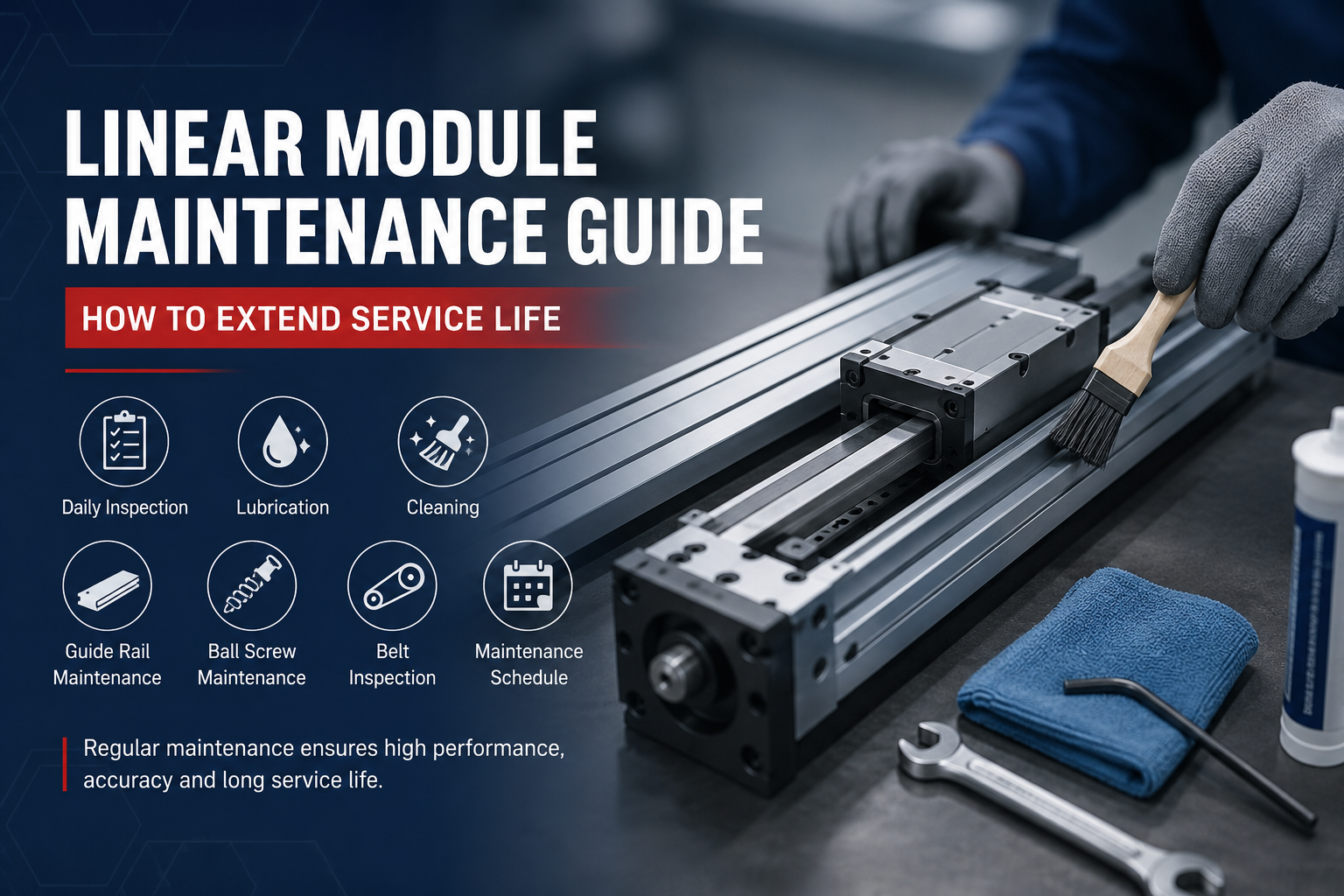
Why Linear Module Maintenance Is Important
Every moving mechanical system experiences wear during operation. Although modern linear modules are designed for high durability and long service life, proper maintenance is required to preserve their original performance.
Regular maintenance provides numerous benefits:
- Longer service life
- Higher positioning accuracy
- Improved repeatability
- Reduced operating friction
- Lower maintenance costs
- Improved machine reliability
- Reduced unplanned downtime
- Lower replacement costs
Conversely, neglected maintenance can result in:
- Guide rail wear
- Bearing damage
- Ball screw failure
- Timing belt wear
- Positioning errors
- Servo overload alarms
- Abnormal vibration
- Unexpected production stoppages
A preventive maintenance program is therefore far more cost-effective than repairing equipment after a failure occurs.
Understanding Linear Module Wear
Linear modules operate under repeated motion cycles that subject mechanical components to continuous rolling contact, friction, vibration, and dynamic loading. Over time, these factors gradually affect the performance of guide rails, bearings, drive systems, and supporting components.
Normal wear is unavoidable; however, proper lubrication, regular inspection, and timely replacement of wear components can greatly slow the deterioration process.
Main Causes of Wear
- Insufficient lubrication
- Dust contamination
- Metal particles
- Improper installation
- Overloading
- Excessive acceleration
- Poor alignment
- Corrosive environments
Understanding these wear mechanisms allows maintenance personnel to identify potential problems before they become major failures.
Daily Inspection
Daily inspection is the simplest yet one of the most effective maintenance practices. A brief visual and functional inspection before production begins can identify abnormalities early and prevent unexpected machine downtime.
Recommended Daily Inspection Items
- Check for abnormal noise.
- Observe smooth carriage movement.
- Inspect guide rail cleanliness.
- Look for lubricant leakage.
- Check protective covers.
- Inspect cables and drag chains.
- Verify sensor operation.
- Observe motor temperature.
- Monitor vibration.
- Check emergency stop function.
Operators should report any unusual conditions immediately rather than continuing production with a suspected mechanical problem.
Cleaning the Linear Module
Keeping a linear module clean is one of the most important maintenance tasks. Dust, chips, cutting fluid, and other contaminants can enter guide rails or drive mechanisms, accelerating wear and reducing positioning accuracy.
Recommended Cleaning Procedure
- Power off the equipment.
- Remove loose dust using compressed air where appropriate.
- Wipe exposed guide rails using a lint-free cloth.
- Remove accumulated grease and debris.
- Inspect protective covers.
- Reapply lubricant if necessary.
Cleaning frequency depends on the operating environment. Equipment used in dusty or contaminated environments requires more frequent cleaning than equipment operating in clean rooms.
Cleaning Tools
- Lint-free cloth
- Industrial alcohol
- Soft nylon brush
- Compressed air (where appropriate)
- Manufacturer-approved cleaning agents
Avoid using aggressive solvents that may damage seals, protective coatings, or plastic components.
Lubrication Fundamentals
Lubrication is the single most important maintenance activity for most linear modules. Proper lubrication reduces friction between moving components, minimizes wear, protects against corrosion, and improves motion smoothness.
Insufficient lubrication is one of the leading causes of premature guide rail and ball screw failure.
Benefits of Proper Lubrication
- Reduced friction
- Lower operating temperature
- Longer bearing life
- Improved positioning accuracy
- Reduced wear
- Corrosion protection
- Lower maintenance costs
Common Lubricant Types
| Lubricant | Typical Application |
|---|---|
| Grease | General industrial automation |
| Oil | High-speed systems |
| Automatic lubrication systems | Continuous production equipment |
Always follow the lubricant type and maintenance interval recommended by the linear module manufacturer.
How Often Should a Linear Module Be Lubricated?
Lubrication intervals vary depending on operating conditions, travel speed, environmental contamination, load, and duty cycle.
| Operating Condition | Recommended Lubrication Interval |
|---|---|
| Light-duty operation | Every 6 months |
| Normal industrial operation | Every 3 months |
| Heavy-duty continuous operation | Monthly |
| Dusty environments | Inspect weekly |
| Cleanroom applications | According to manufacturer recommendations |
These intervals are general recommendations. Actual maintenance schedules should always be adjusted according to operating conditions and the manufacturer's specifications.
Guide Rail Maintenance
Linear guide rails are among the most important components of a linear module. They provide precise guidance for the moving carriage while supporting radial, axial, and moment loads. Proper guide rail maintenance is essential for preserving positioning accuracy, ensuring smooth motion, and maximizing service life.
Although guide rails are manufactured from hardened steel and designed for long-term durability, they remain vulnerable to contamination, insufficient lubrication, corrosion, and excessive loading. Regular inspection allows potential issues to be identified before permanent damage occurs.
Guide Rail Inspection Checklist
- Inspect rail surfaces for scratches or dents.
- Check for corrosion or rust.
- Verify smooth carriage movement.
- Listen for abnormal operating noise.
- Inspect lubrication condition.
- Check protective covers and seals.
- Look for signs of uneven wear.
Minor contamination can usually be removed during routine cleaning, while significant surface damage may require guide rail replacement.
Common Guide Rail Problems
| Problem | Possible Cause |
|---|---|
| Abnormal noise | Insufficient lubrication or contamination |
| High running resistance | Guide rail contamination or misalignment |
| Uneven movement | Bearing wear or damaged guide rail |
| Corrosion | Moisture or chemical exposure |
| Reduced accuracy | Guide rail wear |
Ball Screw Maintenance
Ball screw-driven linear modules require additional maintenance because the ball screw assembly converts rotary motion into precise linear movement through rolling contact between the screw shaft and circulating balls.
Proper lubrication and cleanliness are especially important because contamination inside the ball nut can rapidly accelerate wear and reduce positioning accuracy.
Routine Ball Screw Inspection
- Check screw surface cleanliness.
- Inspect for rust or corrosion.
- Verify lubrication condition.
- Observe smooth screw rotation.
- Listen for abnormal noise.
- Check axial backlash.
- Inspect support bearings.
Any increase in backlash or unusual operating noise should be investigated promptly to prevent further damage.
Ball Screw Lubrication
Ball screws typically require more frequent lubrication than timing belt systems because rolling contact occurs under relatively high contact pressure.
During lubrication:
- Clean the screw before applying lubricant.
- Use only compatible lubricants.
- Apply lubricant evenly.
- Operate the module through the full stroke after lubrication.
- Remove excess lubricant.
Timing Belt Inspection and Maintenance
Timingbelt linear modulesrequire regular inspection to maintain accurate motion transmission and prevent unexpected belt failure. Although timing belts generally require less lubrication than ball screw systems, they should be inspected periodically for wear and tension.
Inspection Items
- Inspect belt teeth.
- Check belt tension.
- Inspect for cracks.
- Check belt edges.
- Inspect pulleys for wear.
- Listen for abnormal belt noise.
- Verify smooth belt tracking.
Signs That a Timing Belt Should Be Replaced
- Visible cracks.
- Missing belt teeth.
- Frayed belt edges.
- Permanent belt stretching.
- Excessive vibration.
- Abnormal operating noise.
Timing belts should always be replaced as complete assemblies rather than repairing individual damaged sections.
Fastener Inspection
Continuous machine vibration may gradually loosen mounting bolts and other fasteners over time. Loose fasteners can reduce positioning accuracy, increase vibration, and eventually damage surrounding components.
Recommended Inspection Points
- Module mounting bolts.
- Motor mounting bolts.
- Coupling clamping screws.
- Sensor mounting screws.
- Protective cover fasteners.
- Drag chain brackets.
Torque should always be verified using calibrated tools rather than relying solely on visual inspection.
Motor and Coupling Inspection
The motor and coupling transmit power from the drive system to the linear module. Their condition directly affects positioning accuracy, motion stability, and transmission efficiency.
Motor Inspection
- Check motor temperature.
- Inspect electrical connectors.
- Monitor vibration.
- Listen for unusual sounds.
- Verify encoder operation.
- Inspect cooling fans where applicable.
Coupling Inspection
- Inspect for wear.
- Verify shaft alignment.
- Check clamping screws.
- Look for cracks.
- Inspect for excessive backlash.
Any noticeable increase in vibration or backlash may indicate coupling wear or alignment problems that require corrective action.
Protective Covers and Seals
Protective covers, bellows, and sealing components help prevent dust, coolant, chips, and other contaminants from entering guide rails and transmission systems. Damaged protective components significantly increase the risk of premature wear.
Inspection Checklist
- Inspect bellows for tears.
- Check scraper condition.
- Inspect dust seals.
- Verify cover movement.
- Remove accumulated debris.
Protective components showing excessive wear should be replaced promptly to prevent contamination from reaching critical motion components.
Environmental Maintenance
The operating environment has a major influence on maintenance requirements. Equipment operating in dusty factories, high-humidity facilities, or corrosive environments generally requires shorter maintenance intervals than equipment used in clean production areas.
Dusty Environments
- Increase cleaning frequency.
- Inspect guide rails weekly.
- Replace worn seals promptly.
- Monitor lubrication contamination.
High-Humidity Environments
- Inspect for corrosion.
- Use anti-corrosion lubricants.
- Maintain protective coatings.
Cleanroom Applications
- Use approved lubricants.
- Avoid particle generation.
- Inspect sealing systems regularly.
- Follow cleanroom maintenance procedures.
Preventive Maintenance Program
Rather than waiting for components to fail, most modern manufacturers implement preventive maintenance programs based on operating hours, travel distance, or production cycles.
A preventive maintenance strategy reduces unexpected downtime while improving equipment availability and lowering overall maintenance costs.
Typical Preventive Maintenance Tasks
- Scheduled lubrication.
- Routine cleaning.
- Guide rail inspection.
- Ball screw inspection.
- Timing belt inspection.
- Fastener verification.
- Sensor testing.
- Motor inspection.
- Positioning accuracy verification.
Maintenance intervals should be adjusted according to actual operating conditions rather than relying solely on fixed calendar schedules.
Recommended Maintenance Schedule
A structured maintenance schedule helps ensure that every critical component of a linear module is inspected at the appropriate interval. While maintenance frequency depends on operating conditions, a standardized schedule provides an excellent foundation for preventive maintenance.
The following schedule is intended as a general guideline. Actual maintenance intervals should always be adjusted according to operating hours, environmental conditions, load, travel speed, and the manufacturer's recommendations.
| Interval | Recommended Maintenance Tasks |
|---|---|
| Daily | Visual inspection, abnormal noise check, guide rail cleanliness, cable inspection, sensor verification |
| Weekly | Clean exposed surfaces, inspect lubrication condition, inspect protective covers, inspect drag chains |
| Monthly | Lubricate moving components if required, inspect fasteners, inspect couplings, verify smooth motion |
| Quarterly | Check positioning accuracy, inspect ball screws or timing belts, inspect bearings, inspect motor mounting |
| Annually | Comprehensive inspection, replace worn components if necessary, recalibrate motion system, review maintenance records |
Machines operating under heavy loads, continuous duty cycles, or harsh environments should be maintained more frequently than systems operating under normal industrial conditions.
Linear Module Maintenance Checklist
The following checklist can be used during routine maintenance to ensure that no important inspection items are overlooked.
| Inspection Item | Status |
|---|---|
| Guide rails cleaned | □ |
| Guide rails lubricated | □ |
| Ball screw inspected | □ |
| Timing belt inspected | □ |
| Motor inspected | □ |
| Coupling inspected | □ |
| Fasteners tightened | □ |
| Sensors tested | □ |
| Cables inspected | □ |
| Drag chain inspected | □ |
| Protective covers inspected | □ |
| Lubrication system inspected | □ |
| Positioning accuracy verified | □ |
| Repeatability verified | □ |
| Maintenance record updated | □ |
Maintenance Records
Keeping detailed maintenance records allows engineers to monitor equipment condition over time and identify recurring problems before they lead to unexpected failures.
A maintenance log should include:
- Maintenance date.
- Operating hours.
- Performed maintenance tasks.
- Lubricant type used.
- Replacement parts installed.
- Inspection results.
- Observed abnormalities.
- Technician name.
Historical maintenance records are valuable for identifying wear trends, optimizing maintenance intervals, and improving long-term equipment reliability.
Predictive Maintenance
Many modern automation systems are moving beyond traditional preventive maintenance by adopting predictive maintenance strategies. Instead of servicing equipment at fixed intervals, predictive maintenance uses condition monitoring and operational data to determine when maintenance is actually required.
This approach minimizes unnecessary maintenance while reducing the risk of unexpected failures.
Common Predictive Maintenance Methods
- Vibration analysis.
- Motor current monitoring.
- Temperature monitoring.
- Noise analysis.
- Positioning accuracy monitoring.
- Servo load monitoring.
- Operating hour tracking.
Predictive maintenance is especially beneficial for high-value automation equipment where unplanned downtime can result in significant production losses.
Common Linear Module Maintenance Mistakes
Many maintenance-related failures result not from component defects but from incorrect maintenance practices. Avoiding the following common mistakes can significantly improve equipment reliability and extend service life.
- Skipping routine inspections.
- Using incorrect lubricants.
- Applying excessive lubricant.
- Operating with insufficient lubrication.
- Ignoring abnormal noise.
- Ignoring increasing vibration.
- Cleaning with aggressive chemicals.
- Mixing incompatible lubricants.
- Failing to inspect fasteners.
- Ignoring timing belt wear.
- Operating with damaged protective covers.
- Allowing contamination to accumulate.
- Ignoring positioning accuracy changes.
- Continuing operation after abnormal alarms.
- Replacing only part of a damaged belt assembly.
- Neglecting maintenance documentation.
- Using non-approved replacement parts.
- Ignoring environmental influences.
- Waiting for failure before performing maintenance.
- Not following manufacturer maintenance recommendations.
Consistent maintenance procedures and proper technician training help eliminate many of these avoidable problems.
Best Practices for Linear Module Maintenance
Successful maintenance programs focus on consistency rather than reacting to failures. The following best practices are widely adopted by manufacturers of high-performance automation equipment.
- Inspect equipment before every production shift.
- Keep guide rails clean at all times.
- Lubricate according to operating conditions.
- Replace worn components before failure occurs.
- Use only manufacturer-approved lubricants.
- Maintain detailed service records.
- Train maintenance personnel regularly.
- Monitor positioning accuracy over time.
- Implement preventive or predictive maintenance strategies.
Following these practices reduces unplanned downtime while improving machine availability and lowering total ownership costs.
Frequently Asked Questions
How often should a linear module be maintained?
Inspection should be performed daily, while lubrication and more detailed maintenance should follow operating conditions and the manufacturer's maintenance schedule.
Can different lubricants be mixed?
No. Mixing incompatible lubricants may reduce lubrication effectiveness and damage bearings or seals. Always use the lubricant recommended by the manufacturer.
How can I tell if a guide rail needs replacement?
Excessive wear, corrosion, permanent surface damage, abnormal noise, or reduced positioning accuracy may indicate that the guide rail should be replaced.
Do timing belt modules require lubrication?
The timing belt itself generally does not require lubrication, but guide rails, bearings, and other moving components still require routine maintenance according to manufacturer recommendations.
Why does positioning accuracy decrease over time?
Possible causes include guide rail wear, insufficient lubrication, loose fasteners, ball screw backlash, belt stretching, contamination, or improper maintenance.
What is the difference between preventive and predictive maintenance?
Preventive maintenance is performed at scheduled intervals, while predictive maintenance relies on equipment condition monitoring to determine when maintenance is actually required.
Can maintenance intervals be extended?
Maintenance intervals may be adjusted based on actual operating conditions, but they should never exceed the manufacturer's recommended limits without proper engineering evaluation.
Conclusion
Proper maintenance is essential for preserving the accuracy, reliability, and service life of a linear module. Regular cleaning, appropriate lubrication, systematic inspections, and preventive maintenance all contribute to smoother motion, reduced wear, and lower operating costs.
Whether maintaining timing belt linear modules,ball screw linear modules, rack and pinion systems, or linear motor stages, following a structured maintenance program helps maximize equipment availability while minimizing unexpected downtime and costly repairs.
By combining routine inspections with preventive and predictive maintenance strategies, manufacturers can significantly improve production efficiency, extend component life, and achieve more reliable long-term performance from their automation systems.