 English

Linear modules are used in everything from compact pick-and-place equipment to multi-axis automation systems, but choosing the right unit is rarely as simple as matching stroke and payload. Drive type, mounting direction, speed, acceleration, repeatability, duty cycle, environment and motor selection all affect whether a module will perform reliably in the real machine.
This FAQ brings together the questions engineers and buyers most often ask when evaluating, installing and maintaining alinear motion module. The answers focus on practical decision-making rather than product-specific claims, so they can be used as a starting point before detailed sizing.
Start Here: What Exactly Is a Linear Module?
What is a linear module?
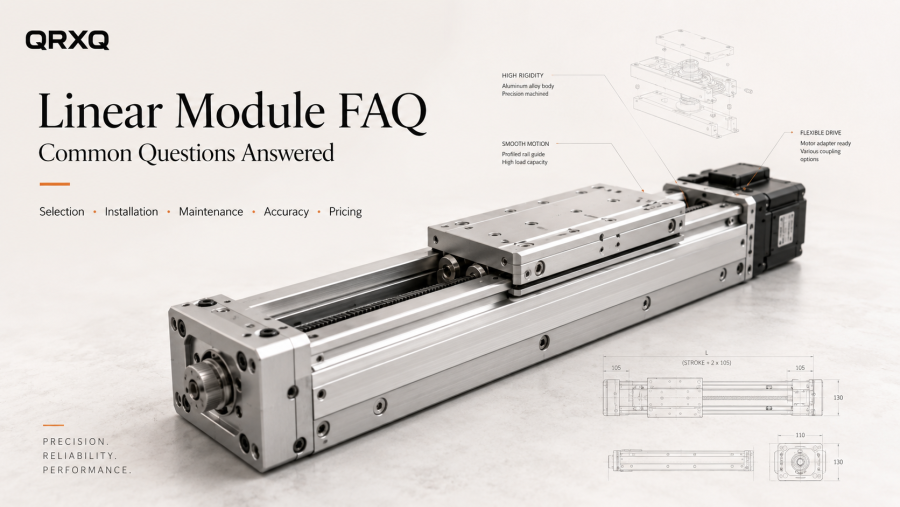
Alinear moduleis a pre-engineered linear motion assembly that combines a guiding system with a drive mechanism in one structure. Depending on the design, the drive may use a ball screw, timing belt, rack and pinion or direct-drive linear motor.
Compared with building an axis from separate rails, bearings, transmission parts and a fabricated base, a complete module simplifies mechanical integration because the main motion components are already aligned inside a standardized housing or beam.
Is a linear module the same as a linear guide?
No. A linear guide mainly supports and guides straight-line motion. It normally consists of a rail and one or more bearing blocks, but it does not create motion by itself.
A linear module is a more complete axis. It usually includes the guide, transmission, carriage, base or profile, end supports and motor interface. In other words, the guide controls the path of motion, while the module provides a ready-to-drive linear axis.
What is the difference between a linear module and a linear actuator?
The terms overlap, but they are not always used in exactly the same way.Linear actuatoris a broad category covering devices that create linear movement, including electric cylinders, lead-screw actuators, lifting columns and linear modules.
In industrial automation, the termlinear moduleoften refers to a guided stage or axis with a moving carriage, while anelectric cylinderusually uses an extendable rod.
Practical distinction:if the application needs a carriage to travel along a beam and carry tooling, a linear module is usually the more relevant product category.
Which Linear Module Type Should I Choose?
The drive technology should be selected from the motion requirement, not from one specification in isolation. The following comparison gives a useful first filter.
| Drive Type | Typical Strength | Common Trade-Off | Often Used For |
|---|---|---|---|
| Ball screw | High positioning performance, stiffness and thrust capability | Stroke and maximum speed are constrained by screw dynamics | Precision positioning, assembly, inspection, machining support |
| Timing belt | Long stroke and high travel speed | Lower stiffness than a screw drive and more sensitivity to belt tension | Pick and place, packaging, transfer, gantry systems |
| Rack and pinion | Very long travel with scalable axis length | Backlash control and gear quality become important for precision | Large gantries, handling systems, long-distance automation |
| Linear motor | Direct drive, high acceleration and no mechanical transmission backlash | Higher system cost and greater dependence on feedback, controls and thermal design | High-dynamic, high-precision automation and semiconductor equipment |
When is a ball screw linear module a better choice?
Aball screw moduleis often preferred when positioning accuracy, repeatability, thrust, rigidity and controlled low-speed motion matter more than extremely long stroke or very high travel speed. It is a common choice for precision assembly, measuring, dispensing, machine tending and positioning tasks.
When is a timing belt linear module a better choice?
Atiming belt moduleis usually attractive when the application needs longer travel, rapid movement and relatively low moving mass. It is widely used in transfer systems, packaging machines, sorting equipment and multi-axis gantries.
The trade-off is that belt elasticity and tension affect stiffness and dynamic behavior, so a belt-driven module should not be selected only by maximum speed.
When should I consider a linear motor module?
Direct-drive linear motor modules are worth considering when the machine requires high acceleration, frequent reversing, very smooth motion or high positioning performance without a screw or belt transmission. They are especially useful when mechanical backlash and transmission wear need to be minimized.
The Sizing Questions That Matter Most
Can I select a linear module only by payload?
No. Payload is one of the most commonly misused specifications.
A module that can support a 20 kg load under one test condition may not be suitable for the same 20 kg load when the center of gravity is offset, the axis is mounted vertically, acceleration is high or an overhung fixture creates a large moment.
At minimum, sizing should consider:
- Moving mass and process load
- Mounting orientation
- Center-of-gravity position
- Pitch, yaw and roll moments
- Stroke
- Maximum and average speed
- Acceleration and deceleration
- Duty cycle
- Required positioning accuracy and repeatability
- External forces and process loads
What information should I provide for linear module sizing?
The fastest way to get a useful recommendation is to provide the complete motion profile rather than a short statement such as “I need a 500 mm module for 30 kg.”
A practical sizing request should include stroke, payload, mounting direction, required speed, acceleration or cycle time, expected positioning performance, working environment, motor preference and any external force acting on the carriage.
Buying tip:if the tooling extends far away from the carriage, provide the center-of-gravity distance or a drawing. Moment load can become more important than the payload itself.
How do I determine the correct stroke?
Required stroke is the usable distance the carriage must travel between working positions. Do not confuse stroke with the total physical length of the module.
The overall axis length will be longer because the carriage, end blocks, motor arrangement and internal transmission need additional space. Allow margin for homing, overtravel and machine clearances where necessary.
How fast can a linear module move?
Maximum speed depends heavily on the drive mechanism, stroke and module size. Timing belt modules can generally support longer high-speed travel than ball screw modules, while linear motor systems can achieve high speed and acceleration without a mechanical transmission.
For screw-driven axes, critical speed and screw whip become increasingly important as stroke increases. For belt-driven axes, belt dynamics, pulley size, carriage load and acceleration can become the limiting factors.
Why is acceleration important if I already know the maximum speed?
Because acceleration determines how quickly the axis reaches that speed and how much dynamic force the drive system must produce. In short-cycle automation, a module may spend very little time at its theoretical maximum velocity.
High acceleration increases motor torque demand, bearing load, structural deflection and moment loading. For this reason, a cycle-time target is often more useful for sizing than a maximum-speed value alone.
Accuracy, Repeatability and Backlash
What is the difference between accuracy and repeatability?
Positioning accuracydescribes how close the actual position is to the commanded position.Repeatabilitydescribes how consistently the axis returns to the same position when the same command is repeated.
A system can be highly repeatable without being equally accurate. For example, it may return to almost the same point every cycle but retain a consistent offset from the commanded coordinate.
What determines linear module accuracy?
Accuracy is influenced by more than the drive mechanism. Important factors include screw lead error or belt behavior, guide accuracy, bearing clearance or preload, structural stiffness, assembly tolerances, encoder resolution, control tuning, thermal expansion and mounting quality.
When very tight positioning is required, ask whether the specification refers to repeatability, absolute positioning accuracy or straightness. These values describe different aspects of performance.
Does a ball screw automatically mean higher accuracy?
Not automatically. Ball screws are well suited to precision motion, but the final axis performance depends on the screw grade, support arrangement, preload, guide system, manufacturing quality, feedback method and installation.
A poorly mounted precision screw can perform worse than a correctly integrated system built around a less expensive transmission.
What is backlash, and when does it matter?
Backlash is lost motion that appears when the direction of travel reverses. It can come from mechanical clearances in screws, gears, couplings or other drive elements.
Backlash matters most in applications that reverse direction frequently or require accurate bidirectional positioning. Preloaded ball nuts, precision gear arrangements or direct-drive systems can reduce or eliminate specific sources of backlash.
Installation Questions Engineers Often Discover Too Late
Does the mounting surface need to be machined?
For precision applications, the mounting surface should be sufficiently flat, rigid and clean to support the module without twisting it. The required flatness depends on the axis design and accuracy target.
Bolting a precision module to a distorted frame can introduce binding, uneven bearing load, premature wear and positioning error even when the module itself was manufactured correctly.
Can a linear module be mounted vertically?
Yes, many linear modules can operate vertically, but vertical motion changes the sizing requirements because the motor must work against gravity.
The design should consider holding torque, braking, uncontrolled descent, counterbalance if required and the additional load on the transmission. A motor holding brake should not automatically be assumed to provide personnel safety unless the complete system is designed and rated for that purpose.
Can I mount the payload directly on one carriage?
Often yes, but only when the load and moment remain within the module’s allowable ratings. Large plates, robots, grippers or offset tooling can create significant pitch, yaw or roll moments.
If the tooling is wide or the center of gravity is far from the carriage, a dual-guide arrangement, two synchronized modules or an additional external guide may be more appropriate.
Do two parallel linear modules need to be perfectly aligned?
They need to be aligned closely enough that they do not fight each other. Misalignment between parallel axes can create internal stress, increased drive torque and premature bearing wear.
For mechanically coupled or synchronized dual-axis systems, both the machine frame and the installation method should allow the modules to be referenced accurately before final tightening.
What is the most common installation mistake?
One of the most common mistakes is treating the module as if its rated performance is independent of the machine structure. Poor base flatness, incorrect fastener sequence, cable drag, side loading, misaligned couplings and inadequate lubrication can all reduce performance.
Motors, Controls and Multi-Axis Systems
Should I use a servo motor or a stepper motor?
A servo motor is generally preferred when the axis requires high dynamic performance, closed-loop feedback, wide speed range, frequent acceleration changes or reliable operation near the limits of the motion profile.
A stepper motor can be suitable for simpler positioning tasks where speed and load are predictable and the risk of losing steps is properly controlled.
Can I choose the motor after choosing the module?
You can select the mechanical platform first, but final module and motor selection should be checked together. Screw lead, pulley ratio, payload, speed and acceleration all affect required motor torque and speed.
An oversized motor is not always beneficial. Excess rotor inertia can make tuning more difficult and increase cost, while an undersized motor may overheat or fail to meet acceleration requirements.
Can linear modules be combined into XY or XYZ systems?
Yes. Linear modules are commonly assembled into XY tables, XZ cantilever systems, XYZCartesian robotsand gantry structures.
In a multi-axis system, the lower axis must carry the mass of the upper axes in addition to the payload. This means each axis cannot be sized independently from the same payload number.
Multi-axis sizing rule:size from the tool outward. The X axis may need to carry the Y axis, Z axis, end effector, cables and workpiece—not just the final payload.
Maintenance, Lubrication and Service Life
How often should a linear module be lubricated?
There is no universal interval. Lubrication frequency depends on the guide and screw design, lubricant type, travel distance, speed, duty cycle, temperature and contamination level.
Follow the maintenance interval specified for the actual model. High-cycle, dusty or washdown environments may require a different maintenance plan from a clean, intermittent application.
What happens if a linear module is not lubricated properly?
Insufficient lubrication can increase friction, noise, temperature and wear. Excessive or incompatible lubricant can also create problems, including drag, contamination or seal damage.
Use the lubricant type and quantity recommended for the guide and transmission system rather than selecting grease only by general-purpose availability.
How long does a linear module last?
Service life cannot be expressed as one fixed number for every application. Bearing and screw life are load-dependent, while belts, pulleys, seals and lubrication introduce additional maintenance factors.
Real life is strongly affected by load spectrum, moment load, acceleration, contamination, alignment, shock and lubrication. A correctly sized module operating below its limits can last far longer than an axis selected only from nominal payload.
What are common signs that a linear module needs inspection?
- New or increasing mechanical noise
- Higher motor current or drive torque
- Loss of positioning consistency
- Vibration during acceleration or direction reversal
- Visible belt damage or abnormal belt tracking
- Contamination around seals or guide surfaces
- Loosened fasteners, couplings or motor mounts
Changes should be investigated early because the first symptom may come from installation, lubrication, cable drag or tooling rather than from the module itself.
Environment and Application Limits
Can a standard linear module be used in a dusty environment?
It may be possible, but the sealing and protection level must match the contamination. Fine dust, abrasive particles and chips can damage guides, screws and belts if they enter the motion system.
Bellows, covers, positive pressure, special seals or a different module construction may be needed for harsh environments.
Can linear modules be used in cleanrooms?
Yes, specially configured modules can be used in clean manufacturing, electronics and semiconductor applications. However, particle generation depends on the complete design, including lubricants, seals, cable systems, materials and operating speed.
Cleanroom suitability should be confirmed for the specific module configuration rather than assumed from the drive type alone.
Can a linear module work outdoors?
Standard industrial modules are usually intended for controlled indoor environments. Outdoor use can introduce rain, condensation, ultraviolet exposure, dust and large temperature variation.
If outdoor operation is required, material selection, corrosion protection, sealing, lubrication and motor or sensor protection must all be reviewed.
Buying and Pricing FAQs
How much does a linear module cost?
There is no meaningful single price because a linear module is a configured motion product. Cost varies with drive type, profile size, stroke, accuracy class, guide arrangement, motor, brake, sensors, covers, cable management and customization.
A short standard belt axis and a long precision ball screw axis may both be described as “linear modules” but have very different material and manufacturing costs.
What affects linear module pricing the most?
The main cost drivers usually include module size, stroke, transmission type, precision requirement, guide capacity, motor and drive package, protection options, sensors, machining changes and production quantity.
Tighter specifications can also increase cost indirectly. For example, requesting higher accuracy than the process actually needs may require a higher-grade screw, more careful assembly and more detailed inspection.
What should I ask a linear module supplier before ordering?
Do not evaluate only the catalog load rating. Ask for the specification that relates to your actual application.
- What drive and guide structure does the module use?
- What are the allowable load and moment ratings for my mounting direction?
- How are accuracy and repeatability specified?
- What is the recommended maximum speed for my stroke?
- What motor size and transmission ratio are recommended?
- What lubrication and maintenance are required?
- Are limit sensors, home sensors, brakes or covers included?
- Can the supplier provide dimensional drawings or 3D models?
- What inspection or test data is available before shipment?
- Which items are standard and which are customized?
When is a custom linear module necessary?
Customization is useful when the standard product cannot satisfy stroke, mounting geometry, motor orientation, environmental protection, carriage size, sensor arrangement or interface requirements.
However, unnecessary customization increases engineering time and can make future replacement more difficult. A good supplier should first determine whether a standard configuration can meet the requirement.
Common Misconceptions About Linear Modules
“Higher precision is always better.” Is that true?
No. Precision should match the process. Specifying substantially tighter accuracy than the application requires can increase cost without improving product quality or machine output.
It is usually more useful to separate the actual requirements for repeatability, absolute accuracy, straightness and rigidity instead of asking for the “most precise” module.
“The highest rated load means the strongest module.” Is that a safe comparison?
Not by itself. Manufacturers may publish load data under different assumptions, and a static load rating does not describe the complete dynamic application.
Compare allowable moments, dynamic loading, speed limits, mounting orientation and life calculation—not just one maximum-load number.
“A larger motor will solve an undersized axis.” Is that correct?
No. A larger motor cannot correct insufficient guide capacity, excessive moment load, critical screw speed, poor structural stiffness or an undersized belt. The mechanical axis and drive system must be selected as one system.
What Should You Send for a Linear Module Recommendation?
If you are preparing an inquiry, the following information is usually enough to begin a meaningful engineering evaluation:
- Required stroke
- Payload and tooling mass
- Horizontal, vertical or side mounting orientation
- Maximum speed or target cycle time
- Acceleration if known
- Required repeatability or positioning accuracy
- Center-of-gravity offset or application drawing
- External push, pull or process force
- Motor and control preference
- Working environment and protection requirements
- Expected daily operating time or cycle count
Need help with a linear module selection?Send QRXQ your stroke, load, speed, mounting direction and application drawing. A complete motion profile makes it much easier to compare ball screw, timing belt, rack-and-pinion and linear motor options accurately.