 English

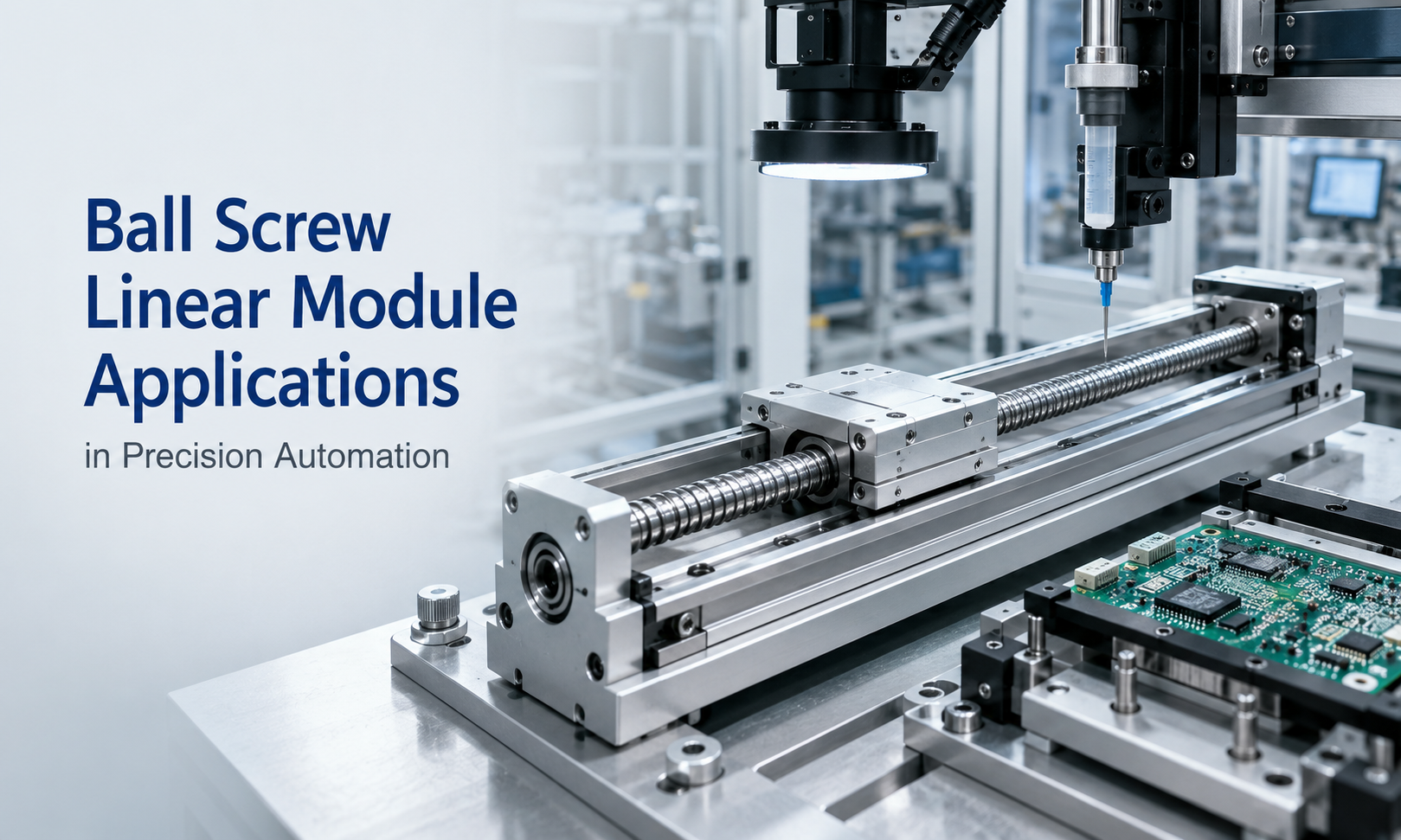
Ball screw linear modules are widely used in precision automation systems that require accurate positioning, high repeatability, strong axial thrust and stable linear motion. By combining a precision ball screw, linear guide, carriage, support bearings and servo or stepper motor, the module converts rotary motion into controlled linear travel.
Compared with belt-driven axes, ball screw linear modules are generally better suited to applications where positioning accuracy, rigidity and controlled feed motion are more important than extremely long stroke or maximum travel speed. Typical applications include electronics assembly, semiconductor equipment, vision inspection, precision dispensing, laser processing, CNC machine loading, medical equipment, measurement systems and multi-axis automation.
Why Ball Screw Linear Modules Are Used in Precision Automation
A ball screw actuator uses recirculating steel balls between the screw shaft and ball nut to reduce sliding friction. This transmission principle allows the module to provide smooth movement, efficient power transmission and precise control of the carriage position.
Important application advantages include:
- High positioning accuracy for controlled assembly and processing operations
- High repeatability during continuous production cycles
- Strong axial thrust for pushing, pressing and feeding operations
- High structural rigidity under changing loads
- Low mechanical backlash when a preloaded ball nut is used
- Smooth motion at low and medium operating speeds
- Easy integration with servo motors, stepper motors and motion controllers
- Flexible construction of single-axis, XY, XZ and XYZ motion systems
The actual performance of a ball screwlinear moduledepends on the screw lead, screw diameter, guide structure, bearing arrangement, motor selection, preload level, installation accuracy and control parameters.
1. Electronics Assembly
Electronics manufacturing requires precise, repeatable movement when handling small components, printed circuit boards, connectors and electronic assemblies. A ball screw linear module can provide controlled linear positioning for automated assembly stations where movement accuracy directly affects product quality.
Common electronics assembly applications include:
- PCB loading and unloading
- Component insertion and alignment
- Connector assembly
- Automatic screw fastening
- Soldering and welding positioning
- Adhesive or thermal paste dispensing
- Mobile phone and consumer electronics assembly
- Battery cell and electronic module positioning
In an automatic screwdriving station, for example, a ball screw axis can move the screwdriver to a controlled position while maintaining sufficient rigidity during the fastening process. In connector insertion systems, accurate axis control helps maintain alignment and reduces the risk of component damage.
For compact electronics machinery, an enclosed or embedded ball screw module can reduce installation space and protect the transmission components from dust, solder particles and assembly debris.
2. Semiconductor Equipment
Semiconductor manufacturing and inspection equipment often requires precise motion, low vibration and stable repeatability. Ball screw linear modules can be used in wafer handling, chip inspection, packaging, bonding and auxiliary positioning systems.
Typical semiconductor applications include:
- Wafer transfer mechanisms
- Wafer inspection positioning
- Chip sorting equipment
- Die bonding and wire bonding systems
- Semiconductor packaging equipment
- Optical alignment mechanisms
- Tray loading and unloading
- Testing and measurement stations
In these applications, the module may need to perform small incremental movements while maintaining consistent positioning over thousands of cycles. A precision-ground or high-accuracy rolled ball screw, preloaded nut and rigid linear guide can help improve repeatability and reduce lost motion.
Standardball screw modulesare not automatically suitable for every cleanroom environment. Semiconductor equipment may require low-particle lubrication, corrosion-resistant components, cleanroom-compatible covers, special seals and controlled material selection. Cleanliness requirements should therefore be confirmed during the design stage.
3. Vision Inspection
Machine vision systems use cameras, lenses, lighting and image-processing software to inspect dimensions, surfaces, labels, defects and assembly conditions. The quality of the inspection result depends not only on the camera but also on the stability of the motion platform.
A ball screw linear stage can move the camera, product or inspection fixture at a controlled speed and position. Common vision inspection applications include:
- Electronic component inspection
- PCB defect detection
- Product dimension measurement
- Surface scratch and defect inspection
- Label and barcode verification
- Optical character recognition
- Battery and connector inspection
- Automated microscope positioning
For line-scan camera systems, the axis must often maintain a stable scanning speed so that image pixels correspond consistently to the physical travel distance. For area-scan inspection, the module must stop accurately at each inspection position and remain stable while the image is captured.
Low vibration, sufficient guide rigidity and properly tuned acceleration are important. Excessive acceleration or an unsupported overhanging load can cause image blur, settling delay or inconsistent measurement results.
4. Precision Dispensing
Precision dispensing equipment applies adhesives, sealants, solder paste, lubricants, resins and other materials along a controlled path. Ball screw linear modules are commonly used because they can provide accurate starting positions, stable feed speed and repeatable dispensing trajectories.
Typical dispensing applications include:
- Electronic adhesive dispensing
- PCB conformal coating
- Battery sealing
- Lens and camera module bonding
- Medical device adhesive application
- LED encapsulation
- Thermal paste dispensing
- Precision fluid filling
A single ball screw axis can be used for straight-line dispensing, while XY or XYZ systems can follow more complex two-dimensional or three-dimensional paths. The Z axis controls the dispensing height, while the X and Y axes control the path and travel speed.
Dispensing quality is influenced by more than positioning accuracy. Motion smoothness, velocity stability, corner transitions, acceleration settings, nozzle height and controller interpolation all affect the final bead width and material distribution.
5. Laser Processing
Ball screw linear modules are used in laser equipment that requires accurate workpiece positioning or controlled movement of the laser head. Suitable processes include laser marking, engraving, welding, drilling, cutting and surface treatment.
Common laser processing applications include:
- Laser marking positioning
- Small-format laser cutting
- Precision laser welding
- Laser drilling
- Optical component adjustment
- Laser focus positioning
- Battery tab processing
- Electronic component processing
For small and medium work areas, ball screw modules provide a useful combination of accuracy, rigidity and thrust. In an XY laser platform, two linear modules move the workpiece or laser head along programmed coordinates. A Z-axis module can adjust the focus distance or processing height.
For very long travel or extremely high-speed laser cutting, a belt-driven, rack-and-pinion or linear motor system may be more suitable. Ball screw critical speed, screw whip and thermal elongation must be evaluated when the required stroke and rotational speed increase.
6. CNC Machine Loading and Unloading
Automated CNC loading systems transfer raw parts, fixtures and finished components between conveyors, trays and machine tools. Ball screw linear modules can be used in compact machine-tending systems where controlled positioning, rigidity and thrust are required.
Typical uses include:
- Workpiece feeding
- Chuck loading and unloading
- Fixture positioning
- Tool or tray transfer
- Part orientation adjustment
- Inspection station transfer
- Small gantry loading systems
In a loading mechanism, the module must withstand the payload as well as acceleration forces, offset forces and moment loads created by the gripper and workpiece. The allowable dynamic load and moment capacity of the linear guide should therefore be checked instead of considering only the nominal axial load.
For vertical lifting axes, the motor must provide enough torque to raise the load and control it during deceleration. A brake motor, counterbalance mechanism or anti-drop device may be required to prevent uncontrolled movement when power is removed.
7. Medical Equipment
Medical and laboratory equipment often requires compact construction, controlled motion, low operating noise and reliable repeatability. Ball screw linear modules can be integrated into diagnostic instruments, laboratory automation and medical device manufacturing equipment.
Possible applications include:
- Sample handling systems
- Laboratory analyzers
- Reagent dispensing equipment
- Microscope stages
- Medical imaging positioning
- Automated testing equipment
- Medical device assembly
- Pharmaceutical packaging equipment
In sample handling equipment, the module may move tubes, trays or pipetting mechanisms between processing stations. In automated microscopy, a compact XY stage can position samples under the optical system for scanning and image acquisition.
Medical applications may require special attention to noise, lubrication, corrosion resistance, cleaning methods and material compatibility. The module should be selected according to the actual equipment environment rather than relying only on standard industrial specifications.
8. Measurement Systems
Precision measurement equipment requires stable motion so that sensor readings correspond accurately to the physical position of the inspected object. Ball screw linear modules can serve as positioning axes in dimensional inspection, scanning and calibration systems.
Typical measurement applications include:
- Optical measurement machines
- Laser displacement measurement
- Surface profile inspection
- Coordinate measurement systems
- Gauge calibration equipment
- Automated microscope stages
- Sensor scanning platforms
- Laboratory testing systems
In these systems, repeatability is often as important as absolute positioning accuracy. A module may repeatedly return to the same measurement point even when the complete system has a separate calibration process for compensating pitch error, thermal error and assembly error.
For high-precision measurement, the designer should also consider encoder resolution, screw accuracy grade, guide straightness, mounting surface flatness, thermal stability, structural deformation and vibration isolation.
9. Multi-Axis Automation
Ball screw linear modules can be combined to create coordinated multi-axis motion systems. Standard configurations include XY cross tables, XZ cantilever systems, XYZ Cartesian systems and compact gantry structures.
Common multi-axis applications include:
- Pick-and-place systems
- Automatic assembly machines
- Dispensing robots
- Vision inspection platforms
- Laser processing equipment
- Testing and measurement systems
- Sorting and positioning equipment
- SmallCartesian robots
In an XYZ system, the X axis normally provides the main horizontal travel, the Y axis provides lateral positioning and the Z axis controls vertical movement. The axis arrangement should be designed so that each module can support the mass of the modules, motor, cables, tooling and payload installed above it.
The lower axis usually carries the greatest combined load. Its guide size, screw diameter, support structure and motor capacity should therefore be calculated according to the total moving mass rather than only the final workpiece weight.
Application Comparison
| Application | Main Motion Requirement | Important Selection Factors |
|---|---|---|
| Electronics assembly | Accurate repetitive positioning | Repeatability, compact size, rigidity and cycle time |
| Semiconductor equipment | Low-vibration precision motion | Cleanliness, preload, lubrication and particle control |
| Vision inspection | Stable scanning and positioning | Velocity stability, settling time and guide rigidity |
| Precision dispensing | Smooth path control | Interpolation, speed consistency and Z-axis control |
| Laser processing | Accurate programmed movement | Stroke, speed, thermal stability and positioning accuracy |
| CNC loading | Rigid payload transfer | Load, moment capacity, acceleration and safety devices |
| Medical equipment | Quiet and reliable movement | Noise, cleanliness, material and lubrication requirements |
| Measurement systems | Stable repeatable scanning | Screw grade, straightness, encoder and thermal control |
| Multi-axis automation | Coordinated linear movement | Combined moving mass, structural rigidity and controller capability |
How to Select a Ball Screw Linear Module for an Application
Define the Load
Calculate the workpiece, fixture, gripper, motor, cable carrier and any other moving components. Also evaluate dynamic forces generated during acceleration and deceleration.
Confirm the Required Stroke
The effective travel should include the process distance, loading clearance, safety distance and homing allowance. For long strokes, verify the allowable screw speed and support arrangement.
Determine Speed and Acceleration
Calculate the target cycle time and required travel profile. A larger screw lead can increase linear speed for the same motor speed, while a smaller lead can provide greater mechanical advantage and finer positioning increments.
Define Accuracy Requirements
Positioning accuracy, repeatability and resolution are different parameters. The required screw grade, encoder and control strategy should be selected according to the actual process tolerance.
Evaluate Moment Loads
An offset payload creates pitch, yaw and roll moments on the carriage. Check the allowable static and dynamic moment ratings of the guide system, especially when using long tooling or cantilever-mounted loads.
Choose the Motor and Control System
Servo motors are commonly selected for high-speed, high-response and closed-loop positioning. Stepper motors may be suitable for lower-cost systems with moderate speed and predictable load conditions.
Consider the Operating Environment
Dust, liquid, metal chips, chemicals, temperature changes and cleanroom requirements can affect module selection. Protective covers, seals, stainless-steel components or special lubrication may be necessary.
Limitations to Consider
Although ball screw linear modules are suitable for many precision applications, they are not the best choice for every motion system.
- Very long strokes may be limited by screw critical speed and deflection.
- Extremely high-speed applications may be better suited to belt drives or linear motors.
- Ball screws require regular lubrication and contamination protection.
- Thermal expansion can affect positioning accuracy during continuous high-speed operation.
- Vertical axes may require a motor brake or anti-drop mechanism.
- Improper alignment can increase noise, friction and premature wear.
These limitations should be evaluated together with load, speed, accuracy, maintenance and total system cost.
Conclusion
Ball screw linear modules provide accurate positioning, high repeatability, strong thrust and rigid motion control for a wide range of precision automation applications. They are commonly used in electronics assembly, semiconductor equipment, vision inspection, dispensing systems, laser processing, CNC loading, medical equipment, measurement systems and multi-axis machinery.
Successful application depends on selecting the correct screw lead, guide size, motor, stroke, accuracy grade, protection method and installation configuration. By matching the module specifications to the actual load, speed, moment, environment and process requirements, designers can build a reliable and efficient precision motion system.