 English

Atiming belt linear moduleis a high-speed linear motion unit that uses a toothed timing belt and pulley system to convert motor rotation into controlled linear movement. Because of its fast travel speed, long stroke capability, low moving mass and relatively simple mechanical structure, it is widely used in industrial automation equipment that requires rapid positioning, frequent reciprocating motion and efficient material transfer.
Compared with ball screw driven systems, timing beltlinear modulesare generally more suitable for long-distance movement and high-speed cycles where extremely high positioning accuracy is not the primary requirement. They can be integrated as a single linear axis or combined into XY, XZ, XYZ and gantry configurations to support packaging, pick and place, electronics assembly, vision inspection, logistics and many other automated processes.
This article explains the most commontiming belt linear module applications, the performance requirements of each application and the key factors engineers should consider when selecting a belt driven linear actuator for industrial automation.
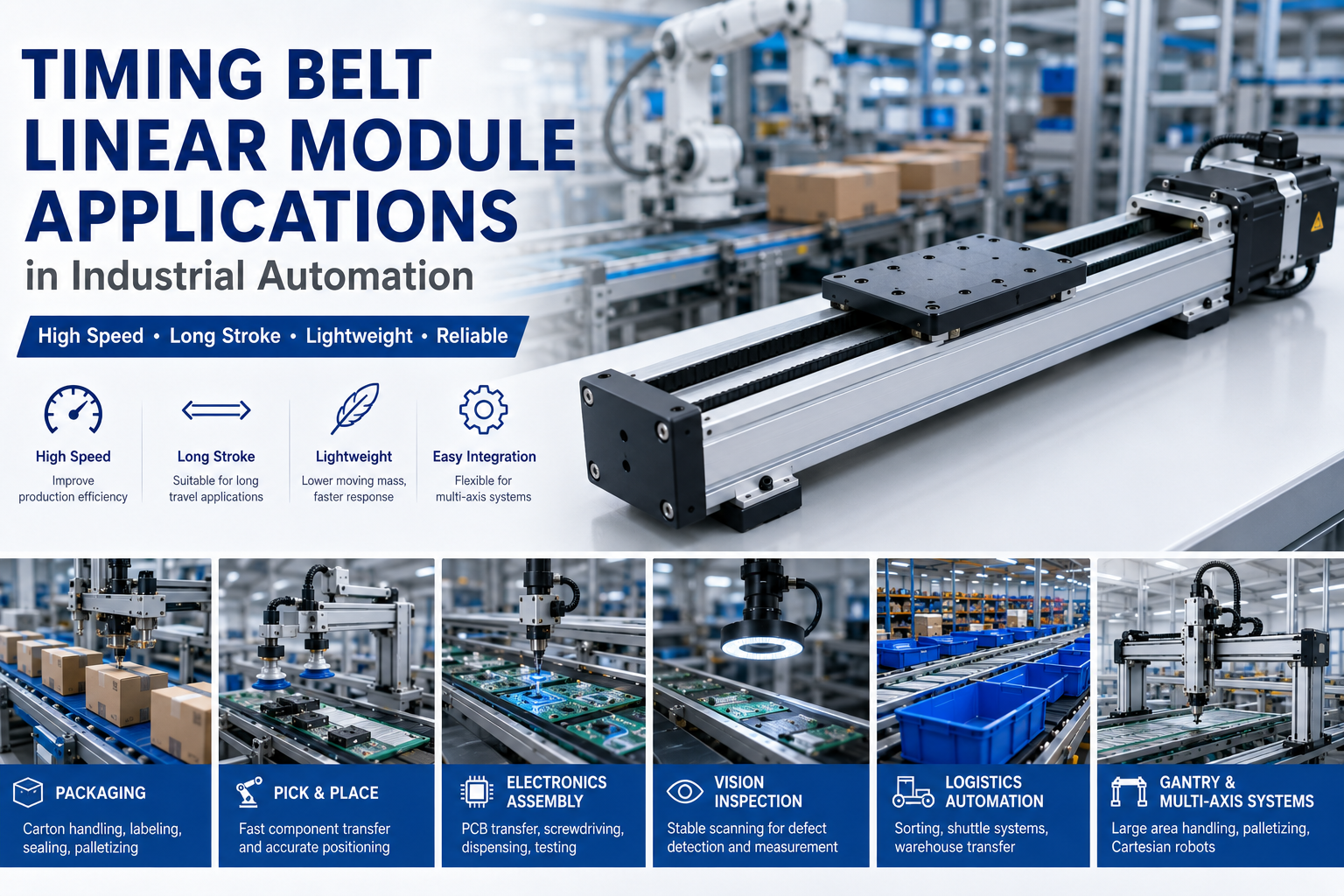
Why Timing Belt Linear Modules Are Widely Used in Automation
Modern automated production lines often require components to move quickly between multiple stations. The motion system must complete repeated cycles reliably while maintaining sufficient positioning consistency, speed and mechanical stability.
A timing belt linear module provides several characteristics that make it especially suitable for these requirements:
- High linear travel speed
- Fast acceleration and deceleration
- Long available stroke
- Low moving mass
- Relatively quiet operation
- Simple drive structure
- Low maintenance requirements
- Flexible motor mounting options
- Easy integration into multi-axis systems
- Cost-effective construction for long-distance motion
The toothed belt engages with the drive pulley without the continuous sliding associated with conventional flat belts. This positive engagement helps maintain repeatable movement while reducing the risk of transmission slip under normal operating conditions.
For many handling and transfer processes, the positioning accuracy of a properly designed belt driven linear module is sufficient, while its speed and stroke advantages can significantly improve machine productivity.
Packaging Machinery
Packaging equipment is one of the most common areas forbelt driven linear actuator applications. Packaging lines normally operate at high cycle rates and require products, containers, labels, cartons or sealing tools to move rapidly between different processing positions.
Timing belt linear modules can be used in:
- Carton loading systems
- Case packing equipment
- Product sorting mechanisms
- Labeling machines
- Sealing and cutting stations
- Tray loading systems
- Automatic palletizing equipment
- Flexible packaging machinery
In a carton packing machine, for example, a timing belt module may move a gripping mechanism horizontally between a conveyor and an open carton. The low moving mass allows the axis to accelerate quickly, pick up the product and return to the loading position within a short cycle time.
Packaging machinery also benefits from the relatively low noise of belt transmission. This is especially valuable in facilities containing many continuously operating machines.
When selecting abelt driven actuator for packaging machines, engineers should consider cycle frequency, payload, travel distance, acceleration, environmental contamination and the number of operating hours per day. Protective covers may be required where dust, cardboard fibers, food particles or packaging debris could enter the module.
Pick and Place Systems
Pick and place automation requires a motion system to collect a component from one position and transfer it accurately to another. These movements are repeated continuously and often involve short positioning times.
Atiming belt module for pick and placeis commonly used as the horizontal axis in:
- Component transfer systems
- Robotic loading equipment
- Assembly line handling stations
- Sorting machines
- Tray loading and unloading equipment
- Product orientation systems
The belt driven axis can be combined with a vertical ball screw module, pneumatic cylinder orservo electric cylinder. In this arrangement, the timing belt module provides fast horizontal travel, while the vertical axis performs lifting, pressing or insertion movements.
Vacuum cups, pneumatic grippers, electric grippers and custom end effectors can be mounted on the carriage. Sensors or machine vision systems are normally used to confirm the position and orientation of the workpiece before it is picked.
For high-speed pick and place equipment, the module must have sufficient belt tension, carriage rigidity and guide rail capacity. Excessive acceleration with an undersized payload can cause vibration, belt oscillation or positioning instability.
Material Handling and Machine Loading
Timing belt linear modules are frequently used for material handling because they can move products across relatively long distances without the rotating speed limitations associated with long ball screws.
Typical material handling applications include:
- CNC machine loading and unloading
- Part transfer between processing stations
- Workpiece feeding systems
- Conveyor-to-machine transfer
- Tray movement
- Fixture positioning
- Warehouse material transfer
In an automated machine tending system, a belt driven linear stage may move a robotic gripper between a parts tray and a machine tool. The module can be mounted horizontally above the equipment, beside the machine or as part of an XZ handling unit.
Long stroke movement is particularly important when one handling unit serves multiple machines. A single timing belt axis may travel across several processing stations, reducing the need for separate robots or transfer mechanisms.
The payload calculation should include the weight of the carriage tooling, cables, gripper, sensors and workpiece. Engineers must also calculate overturning moments created when the load is mounted away from the center of the carriage.
Electronics Assembly
Electronics manufacturing requires fast, clean and repeatable component movement. Timing belt linear modules are used in production equipment for consumer electronics, printed circuit boards, connectors, batteries and small electromechanical products.
Common applications include:
- PCB transfer systems
- Connector assembly
- Electronic component feeding
- Screwdriving platforms
- Dispensing equipment
- Testing and inspection stations
- Battery cell handling
- Product sorting and classification
In a multi-station electronics assembly line, the timing belt module can move fixtures or products between dispensing, fastening, inspection and testing stations. Its long stroke capability allows multiple work areas to be arranged along one motion axis.
For applications involving lightweight components, the module can operate at high acceleration and significantly reduce non-processing time. However, the motion profile must be optimized to prevent sudden stops from disturbing delicate components.
Where static electricity is a concern, grounding measures, antistatic materials and suitable cable management should be incorporated into the machine design.
Vision Inspection Systems
Machine vision equipment depends on stable and repeatable motion to position cameras, lighting systems or workpieces. A timing belt linear module can provide the required scanning movement for many inspection processes.
Typical vision inspection applications include:
- Surface defect inspection
- Dimensional measurement
- Barcode and character recognition
- Product presence detection
- Assembly verification
- Large panel scanning
- Electronic component inspection
In one configuration, the workpiece remains stationary while the camera moves along the timing belt module. In another configuration, the camera is fixed and the module transports the product through the inspection area.
The most suitable arrangement depends on the size, mass and sensitivity of the workpiece. Moving a lightweight camera is generally easier than moving a large product, but camera cables and lighting connections must be managed carefully.
Consistent velocity is important during continuous scanning. Variation in carriage speed can affect image capture intervals and measurement quality. Servo control, encoder feedback and a properly programmed motion profile help maintain stable scanning performance.
Laser Processing Equipment
Timing belt linear modules can be used in selected laser processing applications where high travel speed and long working range are more important than ultra-precision positioning.
Possible applications include:
- Laser marking
- Product identification
- Non-precision laser cutting
- Laser scanning
- Large workpiece positioning
- Loading and unloading of laser equipment
For example, a belt linear stage may move a laser marking head over a row of products or transport products beneath a fixed laser source. This configuration allows one laser system to process multiple workpieces arranged across a long fixture.
Laser processing may generate smoke, fine particles and heat. The module should therefore be positioned away from the direct processing area where possible. Protective covers, extraction systems and sealed components may be necessary to prevent contamination of the belt and guide rails.
For high-precision laser cutting, engraving or micro-machining, a ball screw or linear motor system may provide better positioning performance. The application requirements should always be evaluated before choosing the drive method.
Logistics and Warehouse Automation
Logistics systems often involve long-distance movement, high operating frequency and continuous product flow. These conditions match the strengths of timing belt driven motion systems.
Typical logistics applications include:
- Automatic sorting equipment
- Warehouse transfer systems
- Parcel handling mechanisms
- Shuttle positioning
- Container transfer
- Pallet handling
- Conveyor distribution systems
- Order fulfillment equipment
Along stroke automation modulecan move a pusher, gripper, lifting mechanism or transfer carriage between different conveyor lines. Compared with a long ball screw, the belt system can achieve higher travel speed without the same concern about screw whip or critical rotational speed.
In warehouse automation, the module may operate for extended periods with a large number of daily cycles. Belt durability, bearing life, motor temperature and guide rail lubrication should therefore be considered during system design.
Preventive inspection of belt tension and pulley alignment helps maintain reliable performance and reduce unplanned downtime.
Gantry Systems
Timing belt linear modules are widely used in gantry systems because they can provide fast movement across long horizontal distances. A gantry normally consists of two parallel support axes, a crossbeam axis and one or more vertical axes.
Common gantry applications include:
- Large-area pick and place
- Palletizing and depalletizing
- Packaging line handling
- Machine tending
- Panel transfer
- Warehouse sorting
- Assembly automation
In a dual-axis gantry, two paralleltiming belt modulesmay support opposite ends of the crossbeam. These axes must move synchronously to prevent the beam from twisting or jamming.
Synchronization can be achieved mechanically through a connecting shaft or electronically through two servo motors controlled by a master-slave system. Electronic synchronization provides greater installation flexibility, while mechanical synchronization can simplify coordinated movement in some machines.
The gantry structure must be sufficiently rigid to resist bending, vibration and dynamic loads. The total moving mass includes the crossbeam, secondary axis, vertical axis, tooling and workpiece.
Multi-Axis Automation Systems
A timing belt linear module can be combined with other linear motion products to create multi-axis automation systems. Common configurations include:
- XY positioning platforms
- XZ handling units
- XYZCartesian robots
- Dual-drive gantry systems
- Multi-station transfer equipment
Different drive technologies can be selected for different axes. For example, a timing belt module may be used for a long horizontal X-axis, while a ball screw module provides precise vertical movement on the Z-axis. This hybrid design combines the speed and stroke advantages of belt drive with the accuracy and thrust capability of ball screw drive.
Multi-axis systems are commonly used for dispensing, assembly, screwdriving, inspection, palletizing, sorting and material transfer.
When designing a multi-axis system, engineers must consider structural rigidity, cable routing, controller capacity, servo synchronization, coordinate calibration and collision prevention.
Other Industrial Uses
In addition to the major applications above,timing belt module industrial usesinclude:
- Automatic door positioning
- Printing machinery
- Textile equipment
- Testing machines
- Laboratory automation
- Food processing equipment
- Pharmaceutical packaging
- Solar panel production
- Lithium battery manufacturing
- Automotive component assembly
The suitability of a timing belt module depends on the required payload, speed, stroke, positioning accuracy, environment and operating cycle. The same module design may perform well in one application but require significant modification in another.
How to Select a Timing Belt Linear Module for an Application
1. Determine the Required Stroke
The required stroke should include the actual working distance, acceleration and deceleration space, safety margin and installation allowance. Long stroke capability is one of the main advantages of timing belt modules, but the total module length must still fit within the machine structure.
2. Calculate the Total Moving Load
The moving load includes the workpiece, tooling, gripper, mounting plate, sensors, cable carrier and any secondary axis mounted on the carriage. The selected module must support both static weight and dynamic forces during acceleration.
3. Define Speed and Acceleration
Maximum speed alone does not determine cycle time. The available travel distance, motor torque, acceleration and deceleration profile must also be considered. A short stroke may not allow the module to reach its theoretical maximum speed.
4. Confirm Positioning Accuracy
Timing belt systems provide good repeatability for many industrial handling tasks, but they are generally not intended to replace precision ball screw or linear motor stages in ultra-high-accuracy applications.
Engineers should distinguish between positioning accuracy, repeatability and resolution. These parameters describe different aspects of motion performance.
5. Evaluate Load Moments
Loads positioned away from the center of the carriage create pitch, yaw and roll moments. These forces act on the linear guide system and can reduce service life if they exceed the module rating.
6. Consider the Operating Environment
Dust, oil, moisture, metal chips, food particles, chemicals and high temperatures may affect the belt, bearings, guide rails and lubrication. Protective bellows, covers, seals or corrosion-resistant materials may be required.
7. Select the Motor and Control System
Timing belt linear modules can be driven by servo motors or stepper motors. Servo motors are generally preferred for high-speed motion, rapid acceleration, closed-loop positioning and synchronized multi-axis systems.
The controller should support the required motion profiles, input and output signals, safety functions and communication protocol.
8. Plan Cable Management
Moving cables and pneumatic tubes should be routed through a suitable cable carrier. Incorrect cable selection or excessive bending can cause premature cable failure, increased drag and irregular axis movement.
Timing Belt Module Limitations
Although timing belt linear modules offer many advantages, they are not suitable for every application.
Potential limitations include:
- Lower rigidity than some ball screw systems
- Elastic deformation of the belt under heavy load
- Reduced suitability for ultra-precision positioning
- Possible belt wear or tension change over time
- Limited thrust compared with heavy-duty screw driven systems
- Sensitivity to contamination in exposed designs
For high thrust, heavy machining loads, extremely accurate positioning or very slow controlled feed, a ball screw linear module may be more appropriate. For extremely high precision and dynamic performance, a linear motor module may be considered.
Maintenance Requirements
Routine maintenance helps maintain the performance of a timing belt linear module. Recommended tasks include:
- Inspecting belt tension
- Checking the belt for wear or damaged teeth
- Verifying pulley alignment
- Lubricating the linear guide
- Tightening mounting fasteners
- Inspecting bearings and end blocks
- Checking sensor positions
- Cleaning dust and process debris
- Inspecting cables and cable carriers
Maintenance intervals should be determined according to operating speed, payload, cycle frequency, environment and the module manufacturer’s recommendations.
Frequently Asked Questions
What is a timing belt linear module mainly used for?
A timing belt linear module is mainly used for high-speed, long-stroke movement in packaging, pick and place, material handling, electronics assembly, inspection, logistics and multi-axis automation systems.
Is a timing belt module suitable for long stroke applications?
Yes. Long stroke movement is one of the main advantages of timing belt modules. They do not experience the same critical rotational speed limitation as long ball screws.
Can a timing belt module be used for vertical movement?
It can be used vertically when the payload, motor torque, brake system and safety requirements are properly evaluated. However,ball screw modulesor servo electric cylinders are often preferred for vertical axes that require high thrust or self-locking protection.
Can timing belt modules be combined into an XYZ system?
Yes. They can be combined into XY, XZ, XYZ and gantry configurations. Different drive methods may also be used on different axes according to speed, stroke, thrust and accuracy requirements.
Are timing belt modules accurate enough for vision inspection?
They are suitable for many vision inspection and scanning tasks, especially where repeatable movement and stable velocity are more important than micron-level absolute positioning. High-precision measurement applications may require a more accurate drive system or external encoder feedback.
What motor is commonly used with a timing belt linear module?
Servo motors are commonly used in high-speed industrial systems because they provide closed-loop control, strong acceleration performance and accurate multi-axis synchronization. Stepper motors may be suitable for simpler, lower-speed applications.
Conclusion
Timing belt linear module applicationscover a wide range of industrial automation processes, including packaging machinery, pick and place, material handling, electronics assembly, vision inspection, laser processing, logistics automation, gantry systems and multi-axis equipment.
The main advantages of timing belt modules are high speed, long stroke, low moving mass, quiet operation and flexible system integration. These characteristics make them particularly suitable for applications where productivity and travel distance are more important than ultra-high positioning accuracy.
Successful application depends on correct selection of stroke, payload, acceleration, guide capacity, belt tension, motor power, environmental protection and control strategy. By matching the module configuration to the actual operating conditions, manufacturers can build fast, reliable and cost-effective linear motion systems for modern automated production lines.