 English

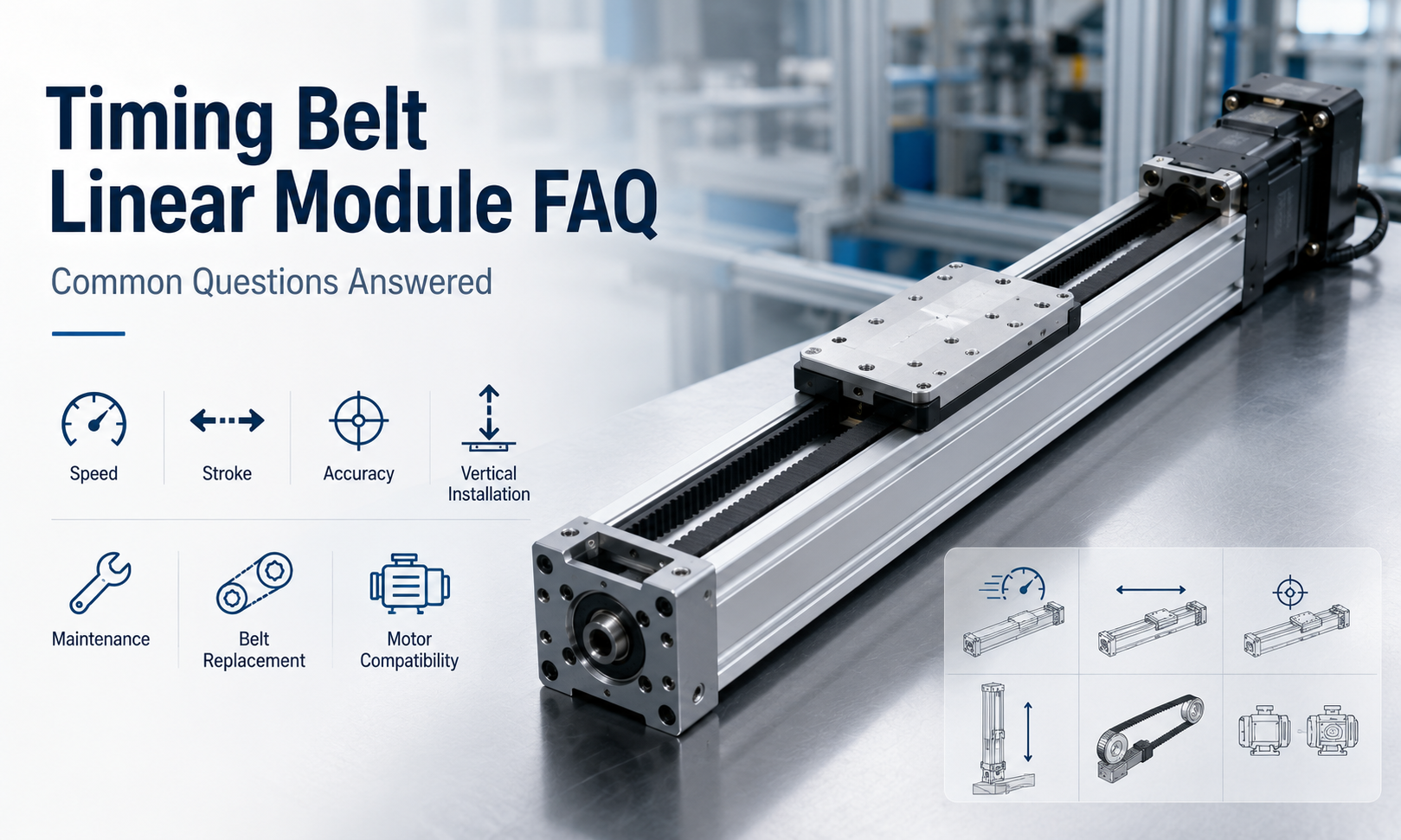
Timing belt linear modulesare widely used in industrial automation because they provide long travel, high-speed motion and flexible integration with servo or stepper motors. However, selecting and operating a belt-driven linear module involves more than checking its stroke and payload.
This FAQ answers common questions about maximum stroke, operating speed, positioning accuracy, vertical installation, timing belt replacement, maintenance frequency, motor compatibility and suitable applications.
1. What Is the Maximum Stroke of a Timing Belt Linear Module?
There is no single maximum stroke that applies to every timing belt linear module. The available travel depends on the module profile, guide structure, belt length, structural rigidity and installation conditions.
Timing belt modules are particularly suitable for long-stroke motion because the belt transmission is not limited by the critical rotational speed of a long ball screw. This allows belt-driven modules to achieve longer travel while maintaining relatively high operating speeds.
The practical stroke limit is influenced by several factors:
- Length and rigidity of the aluminum extrusion
- Timing belt width, pitch and allowable tension
- Linear guide capacity and carriage support
- Installation orientation and mounting support
- Payload and external moment loads
- Required speed, acceleration and positioning stability
For very long travel, the module base may require additional support points to prevent bending, vibration or guide misalignment. The cable carrier, sensor wiring and protective cover must also be designed for the complete travel distance.
When selecting the stroke, remember that the overall module length is greater than the effective travel. Space must be reserved for the carriage, end blocks, motor connection and mechanical safety allowance.
2. How Fast Can a Timing Belt Linear Module Move?
Timing belt linear modules are commonly selected for applications requiring high-speed reciprocating motion. Their lightweight transmission structure and low rotational inertia allow them to accelerate and decelerate more quickly than many screw-driven systems.
The maximum operating speed is determined by:
- Motor rated speed
- Driving pulley diameter
- Timing belt pitch and tooth profile
- Transmission ratio
- Carriage payload
- Guide rail capacity
- Belt tension
- Required acceleration and deceleration
- Stroke length and available travel time
A module should not be selected based only on its stated maximum speed. The actual production cycle also includes acceleration, constant-speed movement, deceleration, settling time and return motion.
For short strokes, the carriage may not have enough distance to reach the theoretical maximum speed. In this situation, acceleration capability often has a greater influence on cycle time than maximum speed.
Excessive speed may increase vibration, noise, belt wear and positioning fluctuation. The selected speed should therefore provide a reasonable balance between production efficiency, service life and motion stability.
3. How Accurate Is a Belt-Driven Linear Actuator?
The positioning performance of a timing belt linear module should be evaluated using both positioning accuracy and repeatability.
Positioning accuracydescribes how closely the carriage reaches the commanded coordinate across the complete travel. It can be affected by belt elasticity, belt pitch variation, pulley manufacturing accuracy, guide straightness, structural deformation and control calibration.
Repeatabilitydescribes how consistently the carriage returns to the same position under the same operating conditions. In many automated handling applications, repeatability is more important than absolute positioning accuracy.
Factors that influence positioning performance include:
- Timing belt material and tension
- Pulley machining quality
- Belt-to-pulley engagement
- Guide rail accuracy
- Carriage rigidity
- Load position and moment load
- Servo encoder resolution
- Controller tuning
- Operating temperature
- Acceleration and deceleration settings
Timing belt modules are well suited to packaging, material handling, sorting, loading and unloading, dispensing and other applications where high speed and reliable repeatability are required.
Applications requiring extremely high absolute accuracy, very low transmission elasticity or precision machining may be better suited to ball screw or linear motor systems.
4. Can Timing Belt Linear Modules Be Used Vertically?
Yes. A timing belt linear module can be installed vertically, but the system must be specifically selected and configured for vertical motion.
In a vertical installation, the motor must overcome both the payload and gravity. The required driving force during acceleration is higher than it is in a comparable horizontal application.
Important considerations include:
- Total moving mass
- Required upward acceleration
- Motor torque and transmission ratio
- Timing belt tensile capacity
- Holding brake requirement
- Counterbalance mechanism
- Emergency stop behavior
- Risk of the carriage falling during power loss
A servo motor with an electromagnetic brake is often used to help hold the vertical axis when power is removed. However, the brake should not be treated as the only safety device when an uncontrolled fall could injure personnel or damage equipment.
Depending on the load and stroke, the system may also require a counterweight, pneumatic balance cylinder, mechanical locking device or safety brake.
Vertical applications should use a sufficient safety factor for the belt, motor, brake, guide rail and connection components. The system should also be tested under maximum load and emergency-stop conditions before production use.
5. When Should the Timing Belt Be Replaced?
A timing belt does not always need to be replaced after a fixed number of operating hours. Its service life depends on load, speed, acceleration, operating frequency, belt tension, pulley alignment, environmental conditions and maintenance quality.
The belt should be inspected regularly and replaced when any of the following conditions are found:
- Visible cracks on the belt surface
- Missing, damaged or deformed belt teeth
- Frayed belt edges
- Abnormal belt elongation
- Reduced positioning repeatability
- Frequent tooth jumping or slipping
- Unusual vibration or impact noise
- Oil, chemicals or excessive dust contamination
- Loss of stable belt tension
Premature belt wear is often caused by incorrect tension, pulley misalignment, excessive acceleration, overload or contamination. Simply replacing the belt without correcting the original cause may result in repeated failure.
When installing a replacement belt, confirm that its tooth profile, pitch, width, material and length match the original system requirements. Belt tension should be adjusted according to the module design rather than by subjective feel.
After replacement, the axis should be moved slowly through the complete stroke. Pulley engagement, belt tracking, sensor positions and positioning repeatability should then be checked before normal operation resumes.
6. How Often Does a Timing Belt Linear Module Need Maintenance?
Maintenance frequency should be based on operating conditions rather than a single universal schedule. A module operating continuously at high speed in a dusty environment requires more frequent inspection than a lightly loaded module operating in a clean room.
A maintenance plan should consider:
- Daily operating hours
- Number of cycles
- Payload and moment load
- Speed and acceleration
- Ambient dust and humidity
- Operating temperature
- Presence of oil, coolant or chemicals
- Installation orientation
Routine inspections normally include checking:
- Belt tension and belt condition
- Pulley wear and alignment
- Linear guide lubrication
- Fastener tightness
- Motor coupling or gearbox connection
- Carriage movement and abnormal play
- Limit sensors and home sensors
- Cable carrier and electrical wiring
- Noise, vibration and operating temperature
The linear guide requires appropriate lubrication even though the timing belt itself normally does not require oil. Using the wrong lubricant, mixing incompatible greases or applying excessive grease can increase resistance and contaminate nearby components.
Maintenance records should document inspection dates, lubrication, belt adjustment, component replacement and any changes in noise or positioning performance. These records help identify gradual wear before it causes unexpected downtime.
7. What Motors Are Compatible with Timing Belt Linear Modules?
Timing belt linear modules can be driven by servo motors, stepper motors and other rotary actuators, provided that the motor output matches the mechanical and motion requirements of the axis.
Servo Motors
Servo motors are commonly used when the application requires high speed, rapid acceleration, closed-loop control, accurate positioning and frequent reciprocating motion. Encoder feedback also allows the controller to detect following errors and improve motion stability.
Stepper Motors
Stepper motors can be suitable for lower-speed applications with moderate loads and simpler positioning requirements. They can provide a cost-effective solution, but their torque decreases as rotational speed increases. An insufficiently sized stepper motor may lose steps during rapid acceleration or overload.
Motor Selection Factors
Motor compatibility should be evaluated based on:
- Maximum payload
- Required speed
- Acceleration and deceleration
- Pulley diameter
- Transmission ratio
- Mechanical efficiency
- External resistance
- Vertical or horizontal installation
- Required positioning performance
- Duty cycle
- Available power supply
The motor flange, shaft diameter, shaft length, keyway, mounting hole pattern and coupling type must also match the module interface. An adapter plate may be required when the selected motor frame differs from the standard motor mount.
The motor should be sized using the complete motion profile rather than only the static payload. Peak torque, continuous torque, motor inertia, load inertia and thermal capacity must all remain within acceptable limits.
8. What Applications Are Timing Belt Linear Modules Suitable For?
Timing belt linear modules are best suited to applications that require long travel, high speed, frequent reciprocating motion and flexible multi-axis integration.
Common applications include:
- Pick-and-place equipment
- Packaging machinery
- Product feeding and sorting systems
- Labeling and sealing equipment
- Machine loading and unloading
- Material handling systems
- Vision inspection platforms
- Dispensing and gluing equipment
- Light-dutygantry robots
- Warehouse transfer equipment
- Assembly automation
- Testing and measurement equipment
A timing belt module may not be the best choice when the application requires extremely high thrust, very high structural rigidity, heavy cutting forces or exceptionally high absolute positioning accuracy.
The final selection should consider the complete combination of stroke, payload, speed, acceleration, repeatability, installation direction, environmental conditions and required service life.
Timing Belt Linear Module Selection Summary
| Question | Key Consideration |
|---|---|
| Maximum stroke | Profile rigidity, support spacing, belt length and installation space |
| Maximum speed | Motor speed, pulley size, payload, acceleration and stroke length |
| Positioning accuracy | Belt elasticity, guide accuracy, pulley quality and control tuning |
| Vertical use | Motor torque, brake, fall protection and safety factor |
| Belt replacement | Cracks, tooth damage, elongation, slipping and reduced repeatability |
| Maintenance frequency | Operating hours, cycle count, load, speed and environment |
| Motor compatibility | Torque, speed, inertia, flange size, shaft and controller |
| Application suitability | Long travel, high speed, moderate load and frequent reciprocation |
Conclusion
Timing belt linear modules provide an effective solution for long-stroke, high-speed and repetitive positioning applications. Their performance depends on correct sizing, proper belt tension, suitable motor selection, stable installation and regular maintenance.
Before selecting a module, define the required stroke, payload, speed, acceleration, positioning performance, installation orientation, duty cycle and operating environment. Evaluating these conditions together helps ensure reliable operation and prevents premature belt wear, motor overload and positioning problems.