 English

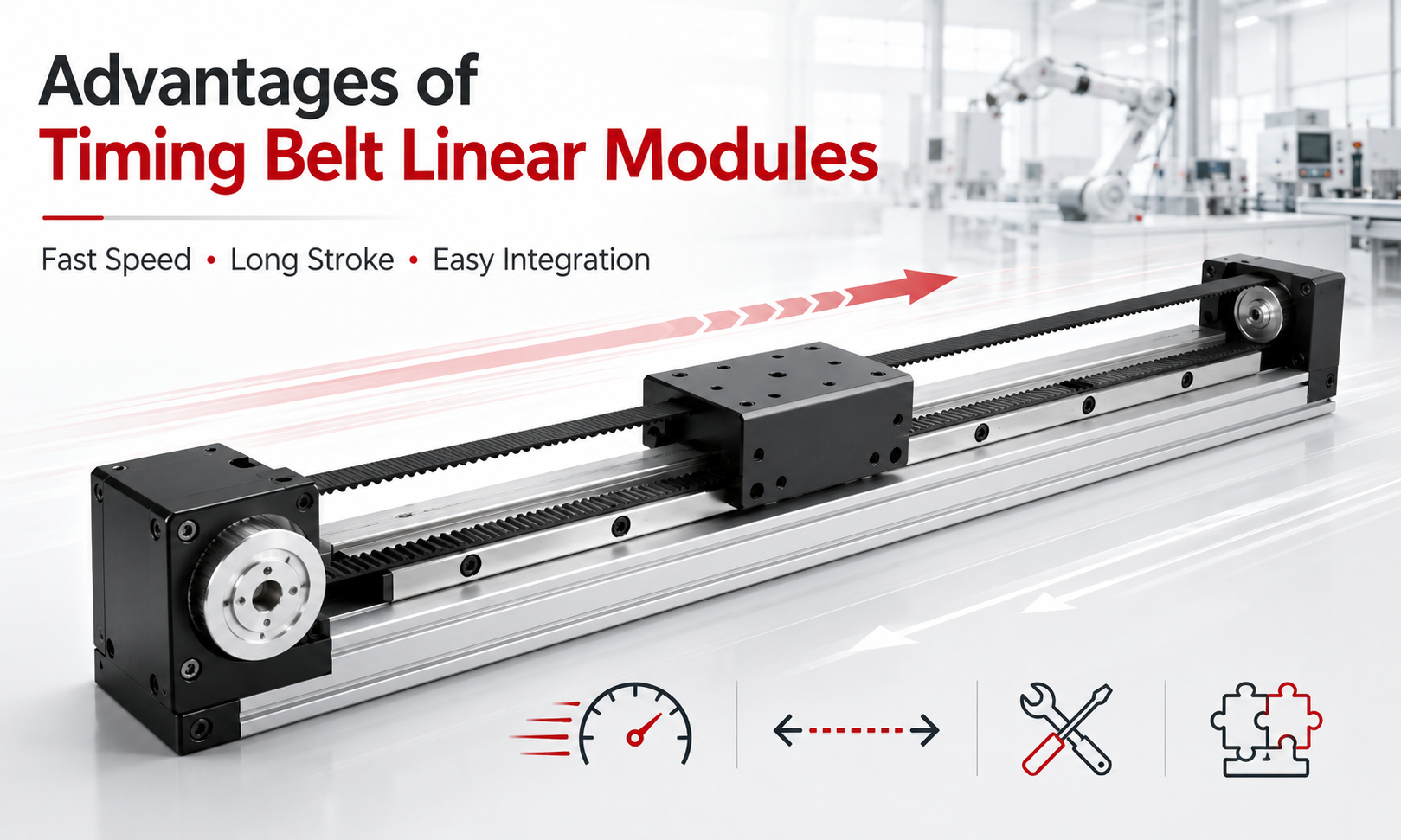
Atiming belt linear moduleis a linear motion system that uses a toothed timing belt and pulley mechanism to convert motor rotation into controlled linear movement. It typically integrates an aluminum base profile, timing belt, drive pulley, idler pulley, linear guide, carriage, bearings, tensioning mechanism and motor mounting interface into a compact automation unit.
Timing belt linear modules are widely used in industrial automation because they provide fast travel speed, long stroke capability, low moving mass and relatively simple mechanical construction. Compared with ball screw driven systems, they are particularly suitable for applications that require rapid reciprocating movement, long-distance transportation and frequent positioning cycles without demanding extremely high positioning accuracy.
This article explains the maintiming belt linear module advantages, including their performance, maintenance, cost, integration and customization benefits. It also discusses the applications in which belt driven linear modules provide the greatest value.
Why Timing Belt Linear Modules Are Popular in Automation
Modern automation equipment often needs to move products, tools, cameras, sensors or handling mechanisms over relatively long distances within a short cycle time. The motion system must therefore provide sufficient speed, acceleration, stroke length and reliability while remaining easy to install and maintain.
A timing beltlinear modulemeets these requirements by combining a lightweight belt transmission with a rigid guide system. The timing belt transfers motor torque to the moving carriage, while the linear guide supports the load and controls the direction of movement.
Because the drive mechanism does not rely on a long rotating screw, the module can achieve long travel ranges without being significantly restricted by the critical rotational speed of a ball screw. This makes belt driven linear modules especially valuable for packaging machinery, material handling equipment, logistics systems, pick-and-place devices and multi-axis automation platforms.
1. Fast Travel Speed
One of the most important advantages of timing belt linear modules is their ability to achieve high travel speeds. The timing belt has a low mass and can circulate rapidly between the drive pulley and idler pulley. This allows the carriage to move quickly along the linear guide.
In many industrial applications, cycle time directly affects production capacity. A faster linear axis can reduce the time required for transferring, positioning, loading and unloading workpieces. This is particularly important in high-volume production lines where the axis performs thousands of repetitive movements every day.
Timing belt linear modules are commonly selected for applications such as:
- High-speed pick-and-place systems
- Packaging and sealing equipment
- Automatic sorting systems
- Material transfer stations
- Vision inspection platforms
- Electronic assembly lines
- Logistics and warehouse automation
The actual achievable speed depends on the module size, belt type, pulley diameter, motor performance, load, stroke length and control parameters. Proper acceleration and deceleration settings are also necessary to prevent excessive vibration or belt oscillation.
2. Long Travel Range
Long stroke capability is another major benefit of belt driven linear modules. In a ball screw system, increasing the stroke length usually requires a longer screw shaft. When a long ball screw rotates at high speed, it may experience vibration, whipping or critical speed limitations.
A timing belt system does not have the same long rotating screw limitation. The belt moves around pulleys while the supporting profile remains stationary, making it easier to create linear axes with long travel ranges.
This characteristic makes timing belt linear modules suitable for:
- Long production lines
- Large gantry systems
- Warehouse transportation equipment
- Automatic loading and unloading systems
- Large-format inspection machines
- Packaging conveyor integration
- Long-distance material transfer
For extremely long travel distances, engineers must still consider profile rigidity, belt elongation, belt tension, guide alignment and support spacing. A properly designed long-stroke module should use a sufficiently rigid aluminum profile and an appropriate belt width to maintain stable movement.
3. High Acceleration and Rapid Response
Timing belt linear modules have relatively low transmission inertia. The lightweight belt, pulley and moving carriage allow the motor to accelerate and decelerate the axis quickly.
High acceleration is valuable in applications where the movement distance is short but the number of cycles is high. In these systems, the axis may spend more time accelerating and decelerating than traveling at maximum speed. Reducing the moving mass helps shorten each motion cycle.
Rapid response also improves the performance of synchronized production equipment. When controlled by a servo motor, the timing belt module can follow programmed motion profiles and coordinate with other axes, conveyors, robots or processing equipment.
However, acceleration should be configured according to the payload and mechanical structure. Excessive acceleration may produce vibration, belt deformation, carriage oscillation or reduced positioning stability.
4. Low Moving Mass
The transmission components of a timing belt linear module are generally lighter than those of many screw driven systems. The belt itself has a very low mass, and the moving carriage can often be designed as a compact aluminum component.
A lower moving mass provides several practical benefits:
- Reduced motor torque requirements
- Faster acceleration and deceleration
- Lower energy consumption during repeated movement
- Reduced dynamic load on the machine frame
- Improved responsiveness during rapid positioning
- Less mechanical stress during direction changes
This advantage is particularly important in multi-axis systems. For example, in an XYZ gantry system, the X-axis may need to move the entire Y-axis and Z-axis assembly. Reducing the mass of each upper-level axis can significantly reduce the load on the lower supporting axis.
5. Simple Mechanical Structure
A typical timing belt linear module uses a straightforward transmission system consisting of a drive pulley, an idler pulley and a toothed belt. Compared with more complex transmission mechanisms, this structure contains relatively few drive components.
The simple construction makes the operating principle easy to understand and simplifies installation, adjustment and troubleshooting. The toothed profile of the belt engages with the matching pulley teeth, allowing motion to be transmitted without the continuous sliding associated with conventional flat belts.
The modular structure usually combines the following components:
- Aluminum base profile
- Linear guide rail and guide blocks
- Timing belt
- Drive and idler pulleys
- Moving carriage
- End blocks
- Belt tensioning mechanism
- Motor mount
- Sensor mounting positions
Because these components are integrated into one assembly, machine builders do not need to design and align every transmission component separately. This can shorten equipment development and assembly time.
6. Low Maintenance Requirements
Timing belt linear modules generally require relatively simple routine maintenance. The belt transmission does not require the same lubrication method as a ball screw and nut assembly. This reduces the number of lubrication points within the drive system.
Routine maintenance normally focuses on:
- Checking belt tension
- Inspecting belt tooth condition
- Checking pulley alignment
- Lubricating the linear guide when required
- Inspecting fasteners and mounting bolts
- Cleaning dust and debris from the module
- Checking sensors and limit switches
In a correctly selected and properly installed system, the timing belt can provide reliable operation over many repeated cycles. When replacement is eventually required, the belt can usually be removed and replaced without changing the complete module.
The actual maintenance interval depends on operating speed, payload, acceleration, environmental contamination, duty cycle and belt material. Applications involving abrasive dust, oil, high temperatures or chemical exposure may require additional protection and more frequent inspections.
7. Cost-Effective Linear Motion Solution
Cost efficiency is an important reason why many equipment manufacturers choose timing belt linear modules. Their relatively simple drive structure can provide a practical balance between performance and system cost.
For applications that require long strokes and high speeds but do not need extremely high positioning accuracy, a belt driven module may be more economical than a precision ball screw system or linear motor system.
Cost advantages may include:
- Lower initial transmission component cost
- Reduced assembly and alignment work
- Lower maintenance complexity
- Simple replacement of wear components
- Reduced motor size in lightweight applications
- Lower system integration cost
- Shorter equipment development time
The lowest purchase price should not be the only selection factor. Engineers should consider total operating cost, including motor size, maintenance frequency, expected belt life, downtime, replacement parts and production requirements.
8. Easy Integration into Automation Equipment
Timing belt linear modules are designed as standardized motion units. They can be mounted directly onto machine frames, aluminum profile structures, steel bases or custom automation equipment.
Motor interfaces can be configured for servo motors or stepper motors. Depending on the design, the motor may be installed directly, mounted in parallel through a belt reduction mechanism or connected through a gearbox.
Standardized mounting surfaces make it easier to install:
- Grippers
- Vacuum suction cups
- Dispensing heads
- Inspection cameras
- Laser sensors
- Welding tools
- Marking heads
- Material handling fixtures
Sensors, limit switches and cable management components can also be integrated into the module. This reduces the amount of additional mechanical design required during machine construction.
9. Flexible Multi-Axis Configuration
A single timing belt module can operate as an independent linear axis, but multiple modules can also be combined into more complex motion systems.
Common configurations include:
- XY cross-slide platforms
- XZ cantilever systems
- XYZCartesian robots
- Single-drive gantry systems
- Dual-drive gantry systems
- Linear transfer systems
- Multi-station handling equipment
The long stroke and high-speed characteristics of belt driven modules make them especially suitable for horizontal X-axis and Y-axis movement. Aball screw moduleorelectric cylindermay be used for the vertical Z-axis when higher thrust, rigidity or vertical load-holding capability is required.
In a dual-drive gantry system, two parallel timing belt axes can be electronically synchronized through servo control. Proper mechanical alignment and control tuning are essential to prevent gantry twisting or uneven loading.
10. Flexible Customization
Timing belt linear modules can be customized to meet different equipment requirements. Manufacturers can adjust the module dimensions, stroke, belt width, guide size, motor interface and carriage structure according to the application.
Common customization options include:
- Custom travel length
- Different aluminum profile sizes
- Single or dual linear guide rails
- Wider or longer carriages
- Different timing belt materials
- Alternative belt widths and tooth profiles
- Servo or stepper motor interfaces
- Motor mounting direction
- Custom sensor positions
- Protective covers and dust protection
- Special mounting holes
- Multi-carriage configurations
This flexibility allows the same basic module technology to support compact electronic assembly equipment, medium-sized packaging machinery and large industrial gantry systems.
11. Quiet and Smooth Operation
A properly tensioned timing belt module can operate with relatively low mechanical noise. The belt engages smoothly with the pulley teeth, and there is no continuous metal-to-metal rolling contact within the belt transmission.
Low noise is beneficial in laboratories, electronics production areas, inspection equipment and other environments where machine noise must be controlled.
Smooth operation depends on correct belt tension, pulley alignment, guide lubrication, structural rigidity and servo tuning. Excessive belt tension can increase bearing load and noise, while insufficient tension can cause vibration, tooth jumping or unstable positioning.
12. Clean Transmission Design
The timing belt drive itself does not require grease lubrication. This can help reduce the risk of lubricant contamination around the transmission mechanism.
This characteristic is useful in electronics assembly, packaging, laboratory automation and certain clean production environments. However, the linear guide still normally requires suitable lubrication, and standard belt modules should not automatically be considered cleanroom rated.
For cleanroom or low-particle applications, engineers should select compatible belt materials, low-volatility lubricants, sealed guide systems and appropriate protective structures.
13. Efficient Replacement and Repair
The modular construction of a timing belt linear module makes many service operations relatively straightforward. Components such as belts, sensors, bearings or pulleys can often be inspected and replaced separately.
If a belt becomes worn or damaged, technicians can replace the belt without replacing the entire guide system or aluminum base. This can reduce repair cost and equipment downtime.
To simplify future maintenance, machine designers should provide sufficient access to end blocks, tensioning components, motor mounts and sensor connections.
Timing Belt Linear Module Advantages Compared with Ball Screw Modules
Timing belt and ball screw linear modules are designed for different performance priorities. Neither system is universally better for every application.
| Comparison Item | Timing Belt Linear Module | Ball Screw Linear Module |
|---|---|---|
| Travel Speed | Generally suitable for higher-speed movement | Speed may be limited by screw length and critical rotational speed |
| Stroke Length | Well suited to long travel ranges | Long strokes require careful screw design and support |
| Moving Mass | Relatively low | Generally higher transmission inertia |
| Positioning Accuracy | Suitable for general automation positioning | Usually better for high-precision positioning |
| Rigidity | Lower transmission rigidity due to belt elasticity | Higher axial rigidity |
| Maintenance | Simple belt inspection and guide lubrication | Requires screw and guide lubrication |
| Cost | Often cost-effective for high-speed, long-stroke applications | Often preferred when precision and thrust are more important |
A timing belt module is usually the better choice when speed, stroke length, cycle time and cost are the main priorities. A ball screw module is generally more appropriate when the application requires higher positioning accuracy, greater rigidity, controlled thrust or resistance to external process forces.
Typical Applications That Benefit from Timing Belt Modules
Packaging Machinery
Packaging systems often require rapid product transfer, carton handling, sealing, labeling and sorting.Timing belt modulesprovide the speed and stroke needed for these repeated operations.
Pick-and-Place Equipment
The low moving mass and high acceleration capability of a belt driven axis help reduce cycle time in pick-and-place systems. The module can carry grippers, vacuum tools or compact robotic mechanisms.
Material Handling
Timing belt modules are suitable for transferring components between conveyors, workstations and processing equipment. Long-stroke modules can cover multiple production stations with a single axis.
Vision Inspection
A belt driven module can move cameras, sensors or products through different inspection positions. It is useful when the system requires fast scanning over a relatively long distance.
Electronics Assembly
Electronic manufacturing equipment uses timing belt modules for component transfer, fixture positioning, tray handling and inspection processes where rapid movement is more important than ultra-high precision.
Logistics Automation
Warehouse and logistics systems use belt driven axes for sorting, pallet handling, package transfer and automated storage equipment. Their long travel capability is well suited to large material flow systems.
Gantry and Cartesian Robots
Timing belt modules can form the horizontal axes of Cartesian robots and gantry systems. They provide large working areas and can be combined with vertical screw modules or electric cylinders.
Limitations to Consider
Although timing belt linear modules offer many advantages, they also have limitations that must be considered during selection.
- Belt elasticity can reduce positioning rigidity.
- Positioning accuracy is generally lower than precision ball screw or linear motor systems.
- Belt tension must be correctly adjusted.
- Heavy process forces may cause elastic displacement.
- Vertical applications require appropriate braking or load-holding measures.
- Temperature changes can affect belt length and tension.
- Long strokes require sufficient profile rigidity and installation support.
These limitations do not make belt driven systems unsuitable. They simply mean that the module must be matched to the actual accuracy, load, force, speed and environmental requirements.
How to Select a Timing Belt Linear Module
To obtain the full benefits of a timing belt linear module, engineers should evaluate the following parameters:
- Required effective stroke
- Maximum payload
- Horizontal, vertical or inclined installation
- Required travel speed
- Acceleration and deceleration
- Positioning accuracy
- Repeatability
- Allowable moment load
- Duty cycle
- Motor type and power
- Environmental conditions
- Expected service life
- Available installation space
- Multi-axis integration requirements
The selection should be based on dynamic operating conditions rather than static load alone. A module that supports a load at rest may not provide stable motion when the same load is accelerated rapidly or mounted with a large overhanging offset.
Frequently Asked Questions
What is the main advantage of a timing belt linear module?
The main advantage is its ability to provide fast, long-stroke linear movement with relatively low moving mass and simple mechanical construction. It is especially suitable for high-cycle automation applications.
Are timing belt linear modules accurate?
Timing belt modules provide sufficient repeatability and positioning performance for many industrial automation tasks. However, their transmission rigidity and absolute positioning accuracy are generally lower than those of precision ball screw or linear motor systems.
Can a timing belt module be used for vertical movement?
Yes, but the design must consider gravity, motor brake requirements, counterbalance mechanisms, belt loading and emergency load-holding measures. Ball screw modules or electric cylinders may be more suitable for some heavy vertical applications.
Are timing belt linear modules suitable for long strokes?
Yes. Long stroke capability is one of their most important advantages. The module does not use a long rotating screw, so it is less affected by screw critical speed limitations.
Do timing belt modules require lubrication?
The timing belt transmission itself generally does not require grease lubrication. The linear guide system normally requires periodic lubrication according to the guide manufacturer’s recommendations.
How often should the timing belt be replaced?
There is no universal replacement interval. Belt life depends on load, speed, acceleration, tension, pulley size, operating environment and duty cycle. Regular inspection is more reliable than replacement based only on calendar time.
When should a ball screw module be selected instead?
A ball screw module should be considered when the application requires higher positioning accuracy, greater axial rigidity, higher thrust, controlled pressing force or better resistance to external processing loads.
Conclusion
The mainadvantages of timing belt linear modulesinclude fast travel speed, long stroke capability, high acceleration, low moving mass, simple construction, low maintenance requirements, cost efficiency and flexible integration.
These characteristics make them an effective solution for packaging, material handling, pick-and-place, electronics assembly, inspection, logistics and multi-axis automation systems.
However, selecting the correct linear module requires balancing speed and stroke advantages against positioning accuracy, rigidity, load and environmental requirements. When the application prioritizes rapid movement, long travel and efficient automation integration, a properly designed timing belt linear module can provide reliable performance and strong overall value.