 English

Atiming belt linear moduleis a linear motion system that uses a toothed timing belt and pulley mechanism to convert motor rotation into controlled linear movement. It is widely used in industrial automation applications that require high travel speed, long stroke, rapid acceleration and frequent reciprocating motion.
Compared with ball screw driven systems, timing belt linear modules generally have a lighter moving structure and are not limited by the critical rotational speed of a long screw shaft. These characteristics make them especially suitable for packaging equipment, material handling systems, pick-and-place machines, visual inspection platforms, electronic assembly lines and multi-axis automation systems.
This article explains the maintiming belt linear module features, including high speed, long stroke, high acceleration, smooth movement, low operating noise, lightweight construction, flexible motor installation and multi-axis integration.
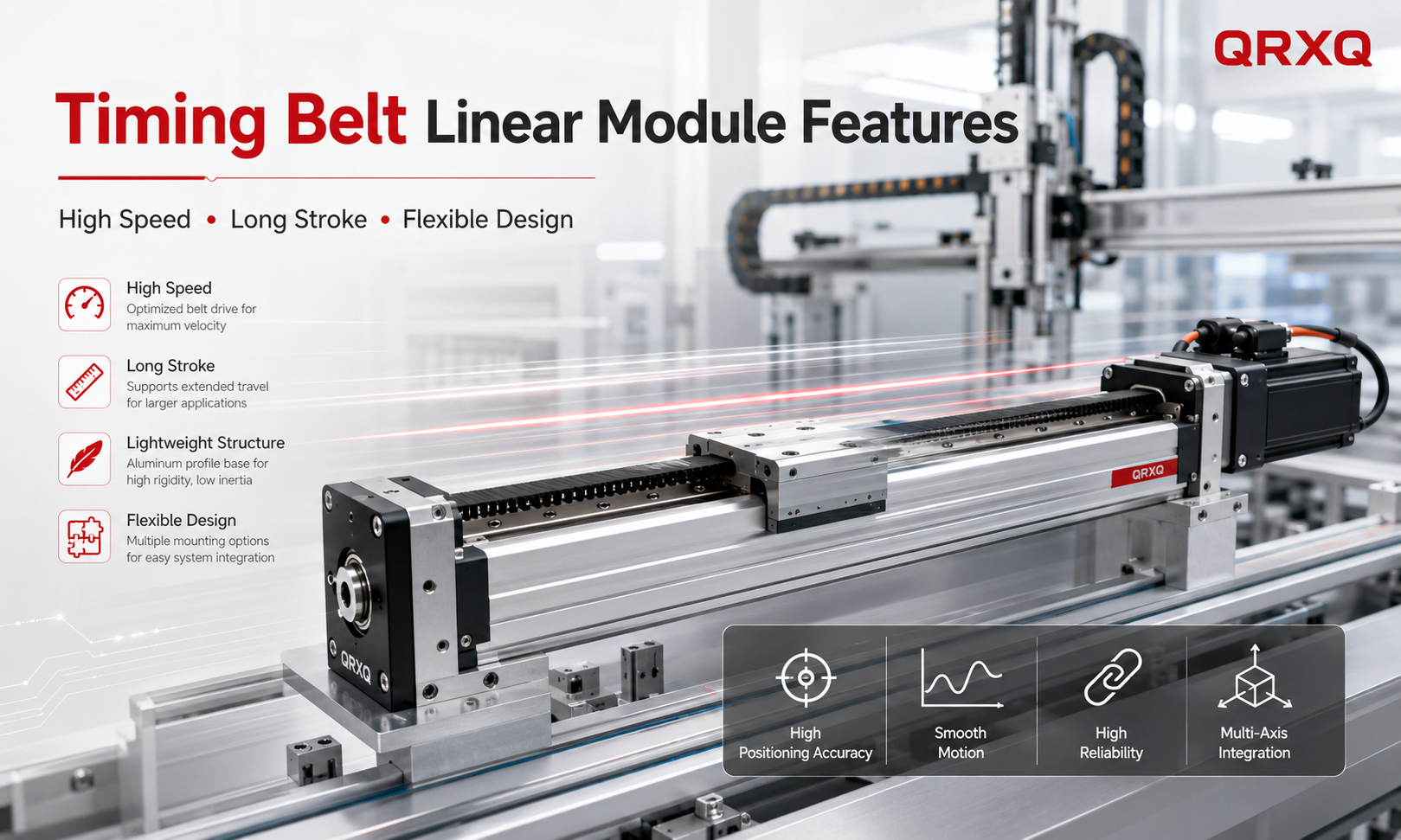
What Determines the Performance of a Timing Belt Linear Module?
The performance of a timing belt linear module depends on the coordinated operation of several mechanical and electrical components. These typically include the timing belt, drive pulley, idler pulley, linear guide, carriage, aluminum profile, tensioning mechanism, motor andmotion controller.
The motor rotates the drive pulley, while the teeth on the timing belt engage with the pulley grooves. The belt then moves continuously between the drive pulley and the idler pulley, carrying the carriage along the linear guide.
Because the timing belt provides synchronous transmission without the sliding contact found in ordinary flat belt systems, the module can achieve controlled positioning while maintaining high operating speed.
The actual performance of the module is influenced by:
- Timing belt material and width
- Pulley diameter and tooth profile
- Linear guide size and preload
- Carriage weight
- Stroke length
- Motor torque and rotational speed
- Load mass and load moment
- Acceleration and deceleration settings
- Belt tension
- Installation orientation
- Machine frame rigidity
- Motion control parameters
A properly selected and correctly installedtiming belt modulecan provide a stable balance between speed, stroke, positioning performance and operating life.
1. High Travel Speed
High travel speed is one of the most important features of a timing belt linear module. The lightweight timing belt can move quickly around the drive and idler pulleys, allowing the carriage to travel at a higher speed than many conventional screw-driven systems.
In aball screw module, the screw shaft must rotate continuously to move the nut and carriage. As the screw becomes longer and the rotational speed increases, vibration and critical speed limitations may become significant. A timing belt module does not rely on a long rotating screw shaft, so it is generally more suitable for high-speed movement over extended distances.
This high-speed capability is valuable in applications such as:
- High-speed product transfer
- Packaging and labeling machinery
- Automatic loading and unloading
- Sorting and distribution equipment
- Electronic component handling
- Visual inspection positioning
- Production line material transport
However, maximum speed should not be considered independently. The actual operating speed must also account for payload, stroke, acceleration, guide capacity, belt tension, motor output and duty cycle.
Operating continuously at the theoretical maximum speed may increase belt fatigue, pulley wear, vibration and heat generation. For reliable long-term operation, engineers should select a module with sufficient performance margin.
2. Long Stroke Capability
Another major characteristic of timing belt linear modules is their ability to provide long linear travel. Because the transmission system consists primarily of a belt circulating between two pulleys, the stroke can be extended without significantly increasing the rotational inertia of the drive system.
In long ball screw systems, increasing the stroke usually requires a longer screw shaft. A long screw can be affected by deflection, vibration and critical speed restrictions. In comparison, a belt-driven system can support longer travel more efficiently, especially when extreme positioning accuracy is not the primary requirement.
Long-stroke timing belt modules are commonly used for:
- Large workpiece transfer
- Long production line positioning
- Warehouse and logistics automation
- Gantry handling systems
- Packaging line transportation
- Laser processing equipment
- Large-format visual inspection
- Cartesian robot axes
The practical stroke length is still influenced by profile rigidity, guide rail configuration, belt elongation, load distribution and installation support.
For very long horizontal axes, the aluminum base may require additional support points to prevent bending. For vertical or cantilever installations, engineers must also evaluate structural deflection and load moments.
3. High Acceleration and Deceleration
Timing belt linear modules can achieve rapid acceleration because the moving components are relatively lightweight. The motor does not need to rotate a heavy, long screw shaft, which reduces rotational inertia and improves dynamic response.
High acceleration allows the carriage to reach the required travel speed within a shorter distance. This can reduce cycle time in automated equipment that performs frequent start-stop or reciprocating movements.
Typical applications that benefit from high acceleration include:
- Pick-and-place operations
- High-speed sorting
- Electronic assembly
- Packaging material transfer
- Vision inspection positioning
- Automatic feeding systems
- Rapid tool movement
Acceleration performance depends on more than motor power. Excessive acceleration can generate high inertial force and increase the load on the timing belt, belt clamp, carriage, guide blocks and machine frame.
The relationship between load mass and acceleration should therefore be evaluated carefully. A module that moves a light component can normally achieve higher acceleration than the same module carrying a heavy fixture or workpiece.
Acceleration and deceleration curves should also be configured smoothly. Sudden changes in speed can cause impact, belt vibration, motor alarms and positioning instability.
4. Smooth Linear Motion
A properly tensioned timing belt engages smoothly with the pulley teeth, allowing the carriage to move continuously along the linear guide. When the guide rail, belt system and motor control parameters are correctly matched, the module can provide stable motion with limited mechanical shock.
Smooth movement is particularly important in applications where products must be transported without tipping, shaking or shifting. Examples include:
- Handling electronic components
- Transporting bottles and containers
- Moving inspection cameras
- Positioning dispensing equipment
- Transferring lightweight workpieces
- Operating scanning and measuring devices
Motion smoothness is affected by belt tension, pulley concentricity, guide rail alignment, motor tuning and installation rigidity.
If the belt tension is too low, the system may experience vibration, belt tooth jumping or positioning lag. If the tension is too high, bearing load, motor resistance and belt wear may increase.
Correct assembly and commissioning are therefore essential for maintaining stable movement throughout the operating stroke.
5. Low Operating Noise
Timing belt modules generally produce less transmission noise than systems that rely on continuous metal-to-metal contact. The belt teeth engage with the pulleys without the rolling contact between a steel screw and ball nut found in ball screw systems.
This makes timing belt modules suitable for automation equipment installed in environments where lower operating noise is desirable, including:
- Electronics production areas
- Laboratory automation
- Medical equipment assembly
- Inspection equipment
- Light industrial production lines
- Office-adjacent automation areas
Although the belt transmission itself can be relatively quiet, the complete module may still generate noise from the guide blocks, motor, gearbox, bearings, cable carrier or machine frame.
Abnormal noise may indicate:
- Incorrect belt tension
- Pulley misalignment
- Worn pulley teeth
- Damaged belt teeth
- Insufficient guide lubrication
- Loose mounting bolts
- Excessive operating speed
- Unstable machine frame
Regular inspection and correct maintenance help preserve low-noise operation.
6. Lightweight Moving Structure
Timing belt linear modules usually have a relatively low moving mass. The carriage is driven directly by the belt, while the belt itself is lightweight compared with a long steel screw shaft.
A lower moving mass provides several advantages:
- Faster dynamic response
- Higher acceleration potential
- Reduced motor load
- Lower energy consumption during repeated movement
- Reduced mechanical impact during direction changes
- Easier integration into multi-axis systems
The module base is commonly manufactured from an aluminum alloy extrusion. Aluminum profiles offer a favorable balance between structural rigidity, weight, corrosion resistance and manufacturing efficiency.
However, lightweight construction does not mean unlimited load capacity. The module must still be selected according to payload, installation direction, acceleration, load center and allowable static and dynamic moments.
A heavy load positioned far away from the carriage center can create a large overturning moment even when the total mass is within the nominal payload range.
7. Flexible Motor Mounting
Timing belt linear modules can support several motor installation configurations, allowing engineers to adapt the module to different machine layouts.
Common motor mounting arrangements include:
- Direct motor connection
- Motor mounted on the left side
- Motor mounted on the right side
- Motor mounted above the module
- Motor mounted below the module
- Folded motor installation
- Parallel motor installation using an external belt
- Motor installation through a gearbox
A direct motor connection provides a simple transmission path and reduces the number of intermediate components. A folded or parallel motor arrangement can shorten the total machine length and help the module fit into limited installation space.
A gearbox may be added when the application requires increased output torque, improved load control or a different motor-to-pulley speed ratio.
When selecting the motor mounting direction, engineers should consider:
- Available installation space
- Maintenance accessibility
- Cable routing
- Motor cooling
- Interference with other machine components
- Required transmission ratio
- Machine center of gravity
Flexible motor mounting simplifies mechanical layout and allows the same basic linear module to be used in a wider range of equipment designs.
8. Easy Multi-Axis Integration
Timing belt linear modules can be combined with other linear axes to create multi-axis motion systems. Their lightweight structure, long travel and flexible mounting options make them particularly suitable for Cartesian automation.
Common configurations include:
- XY positioning platforms
- XZ cantilever systems
- XYZ Cartesian robots
- Dual-axis synchronized systems
- Gantry systems
- Pick-and-place units
- Material handling manipulators
In an XY system, one module provides movement along the X-axis while another module is mounted on the carriage to provide Y-axis movement. In an XYZ system, a vertical Z-axis is added for lifting, pressing, gripping or tool positioning.
Timing belt modules are often used for the long horizontal axis, while a ball screw module orelectric cylindermay be used for the vertical axis when higher thrust or vertical holding performance is required.
Multi-axis integration requires careful evaluation of the total moving mass. The lower axis must carry not only the workpiece but also the upper module, motor, cable carrier, tooling and mounting plates.
Engineers must calculate:
- Total moving weight
- Load center position
- Dynamic load moment
- Required acceleration
- Motor torque
- Frame deflection
- Synchronization accuracy
- Cable and air tube routing
9. Simple Mechanical Transmission
The transmission structure of a timing belt module is relatively straightforward. It typically consists of a drive pulley, idler pulley, timing belt, belt clamp and tensioning mechanism.
This simple structure can reduce the number of complex transmission components and make inspection or belt replacement more convenient.
Compared with some high-precision screw systems, timing belt modules may require less intensive lubrication of the transmission mechanism. The linear guide still requires proper lubrication, but the timing belt itself generally does not need oil or grease.
This feature can be beneficial in applications where excessive lubricant contamination should be avoided. However, a standard timing belt module is not automatically suitable for cleanroom or food processing environments. Belt material, lubrication type, sealing method and particle control must still be evaluated for the specific application.
10. Cost-Effective for Long-Stroke Automation
For long-distance, high-speed positioning applications, timing belt modules can provide a cost-effective motion solution. Extending the stroke of a belt-driven system may be more economical than using a very long precision ball screw.
The overall cost advantage may include:
- Lower transmission component cost for long strokes
- Simpler mechanical construction
- Reduced moving mass
- Smaller motor requirements in some applications
- Easier multi-axis integration
- Lower replacement cost for wear components
Purchase price should not be the only consideration. Engineers should compare the total lifecycle cost, including installation, maintenance, belt replacement, energy consumption, downtime and required positioning performance.
A timing belt module may be economical for high-speed material transfer, while a ball screw module may be more appropriate when high thrust, rigidity and precision are the main requirements.
Timing Belt Module Feature Summary
| Feature | Main Benefit | Typical Application Value |
|---|---|---|
| High speed | Reduces travel time | High-cycle transfer and packaging |
| Long stroke | Supports extended movement ranges | Gantry, logistics and production lines |
| High acceleration | Shortens machine cycle time | Pick-and-place and sorting |
| Smooth motion | Improves transport stability | Inspection, dispensing and assembly |
| Low noise | Improves operating environment | Electronics and laboratory automation |
| Lightweight structure | Reduces inertia and motor load | Dynamic multi-axis systems |
| Flexible motor mounting | Simplifies equipment layout | Machines with limited installation space |
| Multi-axis integration | Supports Cartesian automation | XY, XYZ and gantry systems |
Factors That Affect Timing Belt Module Performance
Payload
Increasing the payload raises the inertial force generated during acceleration and deceleration. A heavier load may require a wider belt, larger guide rail, stronger carriage and higher motor torque.
Stroke Length
A longer stroke may increase belt elasticity and structural deflection. Long modules require correct support spacing and appropriate profile rigidity.
Operating Speed
Higher speed increases dynamic load, vibration and belt cycling frequency. The pulley, belt and guide system must be suitable for the required speed.
Acceleration
Rapid acceleration increases the force applied to the belt connection, carriage and guide blocks. Acceleration settings should remain within the module’s allowable range.
Installation Direction
Horizontal, vertical, wall-mounted and inverted installations create different load conditions. Vertical axes require special attention to gravity, braking and fall prevention.
Load Moment
A load mounted away from the center of the carriage produces pitch, yaw or roll moments. These moments may become the main selection limitation even when the payload is relatively light.
Belt Tension
Correct belt tension is necessary for stable transmission. Low tension can cause vibration and positioning errors, while excessive tension can increase bearing load and belt wear.
Motor and Controller
The motor, driver and controller must provide adequate speed, torque and motion response. Poor tuning can reduce smoothness and cause overshoot or vibration.
Timing Belt Module vs Ball Screw Module
| Comparison Item | Timing Belt Linear Module | Ball Screw Linear Module |
|---|---|---|
| Travel speed | Generally higher | Moderate to high, depending on screw length |
| Stroke capability | Well suited for long strokes | More limited by screw length and critical speed |
| Acceleration | High due to low moving inertia | Influenced by screw inertia |
| Positioning accuracy | Suitable for general automation positioning | Usually better for precision positioning |
| Axial rigidity | Lower because of belt elasticity | Higher mechanical rigidity |
| Thrust capacity | Suitable for light to medium loads | Suitable for higher thrust applications |
| Maintenance | Belt tension and wear inspection | Lubrication and screw condition inspection |
| Typical use | High-speed, long-stroke transfer | High-precision, high-rigidity positioning |
Neither transmission method is universally better. The correct choice depends on the required speed, stroke, accuracy, thrust, rigidity, duty cycle and budget.
Typical Applications
Packaging Machinery
Timing belt modules are used to move packages, labels, sealing tools, filling heads and inspection devices at high speed. Their rapid movement helps improve packaging cycle efficiency.
Pick-and-Place Systems
The lightweight structure and high acceleration capability make timing belt modules suitable for repetitive component transfer between workstations.
Material Handling
Long-stroke modules can transport products, trays, fixtures and workpieces across production lines or between processing stations.
Vision Inspection
A timing belt module can move a camera or product beneath an inspection system. Smooth movement and programmable positioning support automated visual inspection.
Electronics Assembly
Timing belt modules are used for component feeding, circuit board transfer, dispensing, testing and assembly operations.
Logistics Automation
Long travel and high speed make belt-driven modules suitable for sorting, storage, retrieval and warehouse handling systems.
Gantry Systems
One or more timing belt modules can be used as horizontal axes ingantry robotsfor loading, unloading, palletizing and material transfer.
Limitations of Timing Belt Linear Modules
Although timing belt modules offer many advantages, they are not suitable for every motion application.
Important limitations include:
- Belt elasticity can affect positioning accuracy
- Transmission rigidity is lower than a ball screw system
- Heavy cutting or pressing forces may not be suitable
- Belt tension requires periodic inspection
- Belts gradually fatigue and require replacement
- Temperature may influence belt length and tension
- Vertical applications require additional safety measures
- Very high precision applications may need another drive method
For applications involving high axial thrust, high mechanical rigidity, precision machining or extremely accurate positioning, a ball screw or direct-drive linear motor system may be more appropriate.
How to Select a Timing Belt Linear Module
Before selecting a timing belt linear module, engineers should define the complete operating requirements rather than choosing only by stroke and payload.
Key selection parameters include:
- Required effective stroke
- Total moving load
- Maximum travel speed
- Required acceleration
- Positioning accuracy
- Repeatability
- Installation orientation
- Load center and load moments
- Motor type and power
- Duty cycle
- Operating environment
- Required service life
- Available installation space
- Multi-axis configuration
The selected module should include sufficient safety margin. Engineers should avoid operating continuously at the maximum rated payload, speed and acceleration at the same time.
For multi-axis systems, the weight of all upper axes, motors, mounting plates, cable carriers, grippers and workpieces must be included in the load calculation.
How to Maintain Stable Performance
Regular maintenance helps preserve the speed, smoothness and positioning stability of a timing belt module.
Recommended maintenance tasks include:
- Inspect timing belt tension regularly
- Check the belt for cracks, wear or damaged teeth
- Inspect drive and idler pulleys
- Lubricate the linear guide according to the maintenance schedule
- Check mounting bolts and belt clamps
- Remove dust and debris from the module
- Inspect motor coupling and mounting components
- Check sensors and limit switches
- Monitor abnormal noise and vibration
- Verify positioning performance periodically
The inspection interval should be adjusted according to operating speed, acceleration, load, duty cycle and environmental conditions. Equipment operating continuously in dusty or high-cycle environments may require more frequent inspection.
Frequently Asked Questions
What is the main feature of a timing belt linear module?
The main feature is the ability to provide high-speed, long-stroke linear movement with a relatively lightweight and simple transmission structure.
Are timing belt modules suitable for long strokes?
Yes. Timing belt modules are widely used for long-stroke motion because they do not rely on a long rotating screw shaft. Structural support, belt elongation and load conditions must still be considered.
Can a timing belt module achieve high acceleration?
Yes. Its lightweight moving structure supports rapid acceleration and deceleration, especially when carrying light or moderate loads. The allowable acceleration depends on belt capacity, motor torque, guide size and load mass.
Are timing belt modules accurate?
Timing belt modules can provide reliable positioning and repeatability for general industrial automation. However, belt elasticity means they normally have lower positioning rigidity and absolute accuracy than precision ball screw or linear motor systems.
Are timing belt linear modules quiet?
They are generally quieter than many metal transmission systems. Actual noise also depends on the guide rail, motor, bearings, belt tension, speed and machine frame.
Can timing belt modules be used vertically?
They can be installed vertically, but the design must account for gravity, motor braking, payload, belt capacity and fall prevention. A brake motor or mechanical safety device may be required.
Can timing belt modules be combined into an XYZ system?
Yes. They can be integrated into XY, XZ, XYZ and gantry configurations. The lower axes must be sized to carry the weight and dynamic load of the upper axes.
How often should the timing belt be replaced?
There is no universal replacement interval. Belt life depends on load, speed, acceleration, pulley size, tension, duty cycle and environmental conditions. Regular inspection is more reliable than replacing the belt only according to calendar time.
Conclusion
The maintiming belt linear module featuresare high speed, long stroke, rapid acceleration, smooth motion, low noise, lightweight construction, flexible motor mounting and easy multi-axis integration.
These characteristics make timing belt modules particularly effective in high-cycle automation applications such as packaging, material handling, pick-and-place, visual inspection, electronics assembly, logistics and gantry systems.
However, the final selection must consider more than speed and stroke. Payload, acceleration, positioning requirements, load moments, installation direction, belt tension, structural rigidity and operating environment all influence module performance and service life.
When the application requires fast movement over a long distance and extremely high positioning rigidity is not the primary requirement, a timing belt linear module can provide an efficient, flexible and cost-effective linear motion solution.