 English

Atiming belt linear moduleis widely used in industrial automation systems that require high-speed movement, long travel, rapid acceleration and frequent reciprocating motion. Its service life directly affects equipment uptime, positioning stability, maintenance cost and overall production efficiency.
However, thetiming belt linear module service lifecannot be represented by one fixed number. The actual lifespan depends on the timing belt, linear guide, pulley system, bearings, carriage, tensioning mechanism and motor connection. Operating load, travel speed, acceleration, duty cycle, installation accuracy, environmental conditions and maintenance quality also have a major influence.
In many applications, the timing belt is considered the main wear component, but it is not always the first component to fail. Incorrect belt tension, excessive moment load, guide rail contamination, pulley misalignment or insufficient lubrication may shorten the life of the entire module before the belt reaches its expected fatigue limit.
This guide explains the main factors affecting timing belt actuator lifespan, how to recognize wear, how to plan replacement intervals and how to extend the operating life of a belt driven linear module.
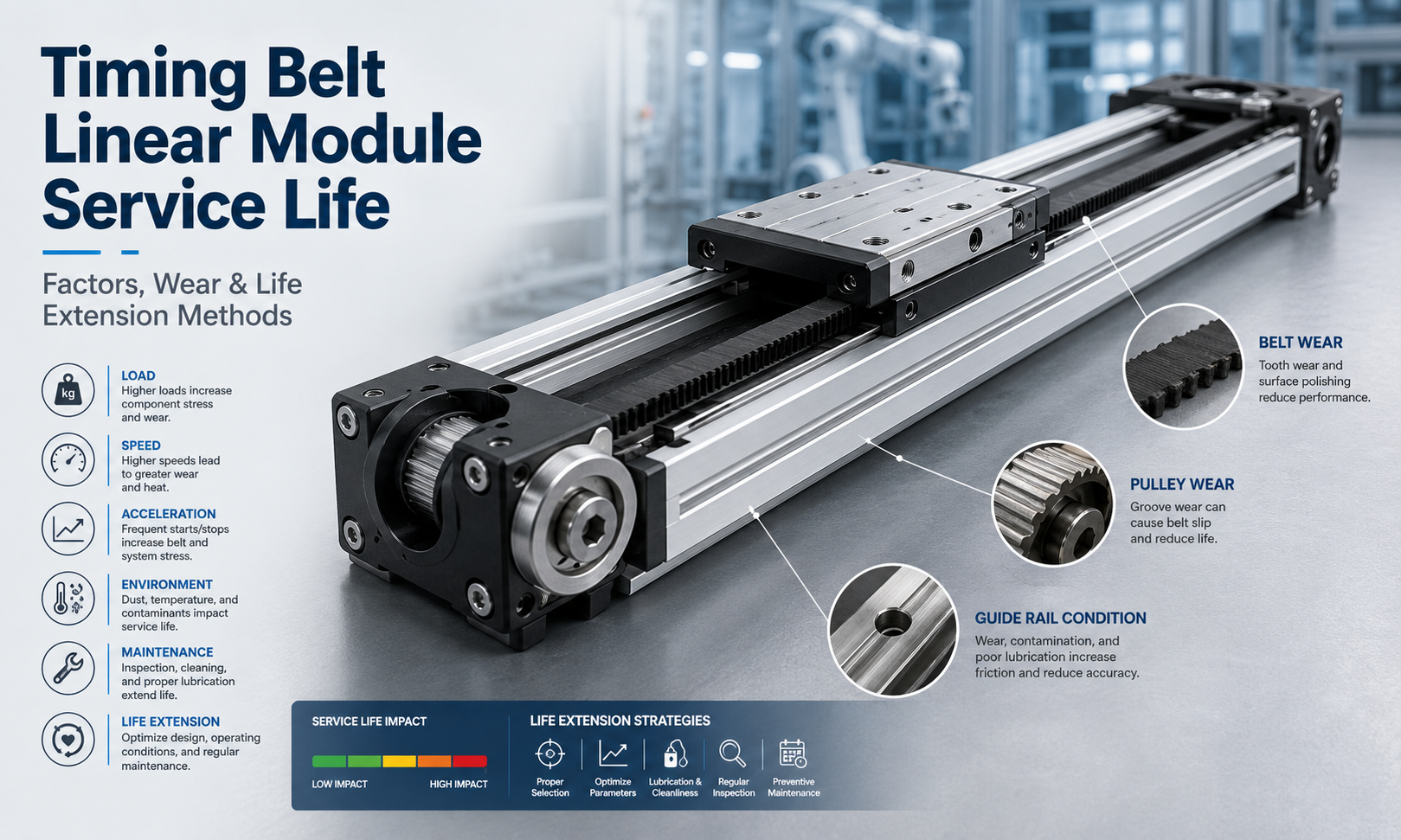
How Long Does a Timing Belt Linear Module Last?
There is no universal service life that applies to every timing belt linear module. Some modules operate reliably for many years in clean, moderate-duty applications, while others may require belt or guide replacement much earlier when exposed to heavy loads, high acceleration, continuous operation, contamination or poor installation.
The service life should therefore be evaluated using several operating indicators:
- Total operating hours
- Total travel distance
- Number of reciprocating cycles
- Average and maximum payload
- Travel speed and acceleration
- Operating frequency and duty cycle
- Installation orientation
- Environmental temperature and contamination level
- Maintenance and lubrication history
For example, a module moving a light payload at moderate speed for several hours per day will normally experience less wear than the same module carrying a high offset load at maximum acceleration in continuous operation.
For this reason, service life should be estimated based on the complete operating profile rather than calendar time alone.
Main Components That Determine Service Life
Timing Belt
The timing belt transfers motor torque from the drive pulley to the moving carriage. During operation, the belt repeatedly bends around the drive and idler pulleys while being subjected to tensile force, tooth engagement, acceleration loads and dynamic vibration.
Over time, this repeated loading may cause:
- Fatigue cracks in the belt body
- Cracking near the tooth roots
- Wear on the tooth surfaces
- Fraying along the belt edges
- Elongation or loss of effective tension
- Separation between belt materials
- Damage to internal tensile cords
Belt life is strongly influenced by belt tension, pulley diameter, transmitted force, acceleration frequency, operating temperature and alignment accuracy.
Linear Guide and Guide Blocks
The linear guide supports the payload and controls the direction of carriage movement. It must withstand vertical loads, lateral loads and moment loads throughout the operating cycle.
Guide rail life may be reduced by:
- Loads exceeding the rated capacity
- Large overhung or offset loads
- Insufficient lubrication
- Dust, metal particles or abrasive contamination
- Corrosion or moisture exposure
- Incorrect mounting surface accuracy
- Impact loads and mechanical collisions
When guide blocks begin to wear, the module may show increased vibration, running resistance, noise, carriage looseness or reduced positioning stability.
Drive Pulley and Idler Pulley
The drive pulley transmits motor torque to the timing belt, while the idler pulley guides the belt and supports the tensioning system. Worn or damaged pulley teeth can affect belt engagement and cause positioning errors.
Common pulley-related problems include:
- Tooth surface wear
- Pulley eccentricity
- Loose shaft connections
- Bearing wear
- Incorrect pulley alignment
- Debris accumulation between pulley teeth
A worn pulley can damage a new belt quickly. Therefore, replacing only the belt without inspecting the pulleys may not fully solve the problem.
Bearings and End Support Components
Bearings inside the drive and idler end assemblies support pulley rotation. Excessive belt tension, contamination, high rotational speed or poor alignment can increase bearing load and shorten bearing life.
Bearing wear may produce abnormal noise, temperature rise, rotational resistance or vibration near the module end blocks.
Carriage and Connection Components
The carriage connects the payload to the timing belt and linear guide. Loose fasteners, an uneven mounting surface or poor load distribution may create additional vibration and moment loads.
Motor couplings, drive shafts, mounting brackets and tensioning components should also be inspected because looseness in these parts may be mistaken for belt wear.
Effect of Load on Timing Belt Module Life
Payload is one of the most important factors affectingbelt driven linear module life. The module must support not only the static weight of the payload but also the dynamic force created during acceleration, deceleration and emergency stopping.
As acceleration increases, the effective force acting on the timing belt and guide system also increases. A payload that appears acceptable under static conditions may generate excessive dynamic load during rapid motion.
Load position is equally important. A load mounted far away from the carriage center creates moment loads on the linear guide. Even when the total payload is below the nominal capacity, excessive overhang may shorten guide block life and reduce movement stability.
To improve service life:
- Keep the payload close to the carriage center whenever possible.
- Avoid exceeding the rated axial force and allowable load moment.
- Use a larger carriage or dual-guide structure for large offset loads.
- Reduce acceleration when moving heavy workpieces.
- Include tooling, cables and fixtures when calculating total moving mass.
- Avoid mechanical impact at the end of travel.
Effect of Travel Speed
High speed is one of the main advantages of timing beltlinear modules, but continuous operation near the maximum rated speed can increase belt bending frequency, pulley rotational speed, bearing temperature and guide wear.
High travel speed may also amplify problems caused by poor belt alignment, incorrect tension or insufficient structural rigidity.
When selecting the operating speed, engineers should distinguish between the module's maximum allowable speed and the recommended continuous working speed. The maximum value may only be appropriate under specific load, stroke and duty-cycle conditions.
A reasonable speed margin can reduce heat generation, vibration and maintenance frequency while improving long-term stability.
Effect of Acceleration and Deceleration
Acceleration and deceleration often have a greater influence on timing belt fatigue than constant-speed movement. Every acceleration cycle changes the tensile force acting on the belt and creates dynamic loads in the carriage, guide blocks, pulleys and motor connection.
Frequent rapid reversing is especially demanding because the drive force changes direction repeatedly.
Excessive acceleration may cause:
- Temporary belt deformation
- Tooth engagement shock
- Carriage vibration
- Motor overload alarms
- Increased guide moment load
- Fastener loosening
- Positioning overshoot
Using smooth acceleration and deceleration curves can reduce mechanical shock. In servo systems, S-curve profiles are often more suitable than abrupt speed changes when cycle time permits.
Influence of Stroke and Operating Frequency
Long-stroke movement increases the total distance traveled during each cycle. Short-stroke, high-frequency movement may concentrate wear within a limited section of the guide rail and timing belt.
Both operating patterns can affect life differently:
- Long strokes increase total belt circulation and travel distance.
- Short repetitive strokes may create localized guide wear.
- Frequent reversing increases dynamic belt loading.
- Continuous operation reduces cooling time for bearings and motors.
Service-life evaluation should therefore include both the number of cycles and the travel distance per cycle.
Influence of Belt Tension
Correct belt tension is essential for positioning accuracy and component life.
If the tension is too low, the module may experience:
- Belt tooth jumping
- Positioning errors
- Vibration during acceleration
- Unstable reversing motion
- Excessive belt movement
- Uneven tooth wear
If the tension is too high, it may cause:
- Increased pulley bearing load
- Higher motor resistance
- Additional belt tensile stress
- Premature bearing wear
- Higher operating temperature
- Reduced belt fatigue life
Belt tension should be adjusted according to the module manufacturer's specified method. Estimating tension only by hand pressure is generally not accurate enough for high-speed or high-precision applications.
Influence of Pulley Alignment
The drive pulley and idler pulley must remain parallel and correctly aligned. Misalignment causes the belt to track toward one side, creating edge wear and uneven tooth engagement.
Typical signs of alignment problems include:
- One-sided belt edge damage
- Belt dust near one side of the profile
- Uneven pulley tooth marks
- Repeated belt tracking adjustment
- Abnormal noise at higher speed
When these symptoms appear, the pulley position, shaft alignment, end-block installation and profile straightness should be inspected before installing a replacement belt.
Environmental Conditions Affecting Service Life
Dust and Particles
Dust, metal chips, abrasive particles and packaging debris may enter the belt channel or linear guide. Contamination can damage belt teeth, increase guide friction and accelerate pulley wear.
Applications involving cutting, grinding, woodworking or powder handling may require protective covers, sealing strips, bellows or regular cleaning.
Temperature
High temperatures may affect belt material properties, lubricant viscosity and bearing performance. Low temperatures may make some belt materials and lubricants less flexible.
The selected timing belt, grease, motor and sensor components must be compatible with the expected operating temperature.
Humidity and Corrosion
High humidity, condensation, water spray or corrosive chemicals may damage guide rails, fasteners, bearings and metal pulley surfaces.
Corrosion-resistant components, protective coatings and suitable sealing may be necessary in wet or chemically aggressive environments.
Oil and Chemical Exposure
Some oils, coolants, solvents and cleaning agents may degrade belt materials. Chemical compatibility should be confirmed before the module is installed in manufacturing environments involving liquid exposure.
Cleanroom Conditions
Cleanroom applications require attention to particle generation, lubricant selection and belt material. A standard opentiming belt modulemay not be suitable for applications with strict cleanliness requirements.
How Maintenance Affects Timing Belt Actuator Lifespan
Proper maintenance can significantly extend the lifespan of a timing belt actuator. Maintenance should not focus only on belt replacement. The guide rail, pulley, bearings, fasteners, sensors, motor connection and cable system should be inspected together.
A preventive maintenance program should include:
- Cleaning the module and surrounding area
- Checking the belt for cracks, fraying and tooth wear
- Inspecting belt tracking and alignment
- Measuring or confirming belt tension
- Lubricating the linear guide as required
- Checking pulley and bearing noise
- Tightening mounting and carriage fasteners
- Inspecting motor couplings and mounting brackets
- Checking sensor and limit-switch positions
- Recording vibration, noise and positioning changes
Inspection frequency should be based on operating intensity. A module operating continuously in a dusty production line requires more frequent inspection than a lightly loaded module used occasionally in a clean laboratory.
Common Signs That the Module Is Wearing
Early wear indicators should be investigated before they develop into complete failure.
| Observed Symptom | Possible Cause |
|---|---|
| Increasing positioning error | Low belt tension, belt wear, loose pulley, coupling looseness or control issue |
| Abnormal repetitive noise | Pulley wear, bearing damage, tooth engagement problem or contamination |
| Carriage vibration | Incorrect tension, guide wear, excessive acceleration or loose load |
| Belt dust inside the profile | Pulley misalignment, belt rubbing or excessive wear |
| Frayed belt edges | Tracking error, pulley misalignment or contact with surrounding components |
| Higher motor current | Excessive tension, guide resistance, bearing wear or mechanical obstruction |
| Reduced repeatability | Belt deformation, loose connections, guide clearance or unstable control settings |
| Temperature rise near end blocks | Excessive bearing load, high belt tension or bearing damage |
Because several faults may produce similar symptoms, the complete drive and guide system should be checked instead of assuming the belt is always the cause.
When Should the Timing Belt Be Replaced?
There is no single timing belt replacement interval suitable for every module. Replacement should be based on the manufacturer's recommendations, operating records and actual belt condition.
The belt should normally be replaced when any of the following conditions are found:
- Visible cracks in the belt body or tooth roots
- Missing, damaged or severely worn teeth
- Exposed or damaged tensile cords
- Severe edge fraying
- Material separation or delamination
- Repeated loss of tension after adjustment
- Abnormal elongation
- Frequent tooth jumping
- Persistent positioning instability caused by belt wear
For production equipment where unexpected downtime is costly, planned replacement may be more economical than waiting for the belt to fail completely.
Maintenance records can help determine an appropriate replacement cycle. Recording operating hours, travel distance, cycle count and inspection results makes it easier to identify the wear trend of a specific application.
How to Estimate Timing Belt Linear Module Service Life
A practical service-life estimation should follow a structured process.
- Determine the total moving mass, including the workpiece, fixture, carriage-mounted equipment and cables.
- Confirm the installation direction and calculate gravity effects.
- Determine the maximum speed, acceleration, deceleration and emergency-stop conditions.
- Calculate the required drive force and check it against the module rating.
- Evaluate radial, axial and moment loads acting on the guide system.
- Confirm the operating stroke, cycle time and daily operating hours.
- Check environmental temperature, dust, moisture and chemical exposure.
- Confirm the required belt tension and guide lubrication interval.
- Compare the application conditions with the manufacturer's load-life data.
- Apply a suitable safety margin for impact, uncertainty and future process changes.
The rated load should not be treated as the recommended continuous operating load. Designing with a reasonable safety margin usually improves reliability and allows for unexpected changes in payload or operating conditions.
Methods to Extend Timing Belt Module Lifespan
Select the Correct Module Size
Choose a module based on dynamic load, allowable moment, acceleration, speed, stroke and duty cycle rather than payload alone. An undersized module may operate temporarily but experience rapid wear.
Reduce Excessive Acceleration
Use only the acceleration required to meet the production cycle. Reducing unnecessary acceleration lowers belt tension variation, guide loads and structural vibration.
Optimize the Motion Profile
Smooth acceleration and deceleration reduce mechanical shock. Avoid sudden reversing, emergency stopping during normal cycles and impact at the travel limits.
Control Belt Tension
Maintain the specified belt tension. Inspect tension after installation, after the initial running period and during scheduled maintenance.
Maintain Pulley Alignment
Check that the drive and idler pulleys remain parallel and secure. Correct the cause of abnormal belt tracking before replacing the belt.
Lubricate the Linear Guide Correctly
Use the specified lubricant and lubrication quantity. Both insufficient lubrication and excessive lubrication may create operating problems.
Protect the Module From Contamination
Use covers, sealing strips, bellows or positive-pressure protection where necessary. Prevent chips and abrasive particles from accumulating inside the module.
Improve Load Distribution
Mount the payload near the carriage center and reduce overhung loads. Use additional support or a multi-axis structure for large or unstable workpieces.
Ensure Accurate Installation
The mounting surface should have sufficient flatness, straightness and rigidity. Forcing the module onto an uneven machine frame may distort the profile and increase guide resistance.
Monitor Changes During Operation
Track motor current, positioning error, noise, vibration and temperature. Gradual changes may indicate developing wear before a visible failure occurs.
Keep Critical Spare Parts
For important production lines, keeping compatible belts, guide blocks, pulleys, bearings and sensors can reduce downtime when maintenance is required.
Recommended Inspection Checklist
| Inspection Item | What to Check |
|---|---|
| Timing belt | Cracks, tooth wear, fraying, contamination, tension and tracking |
| Drive pulley | Tooth wear, looseness, alignment and shaft connection |
| Idler pulley | Rotation, bearing noise, alignment and tensioning condition |
| Linear guide | Lubrication, contamination, abnormal clearance and running resistance |
| Carriage | Fastener tightness, load mounting and vibration |
| Motor connection | Coupling, mounting bolts, shaft alignment and abnormal noise |
| Sensors | Mounting position, cable condition and switching reliability |
| Module profile | Debris, deformation, corrosion and mounting condition |
| Operating data | Motor current, cycle time, positioning error, vibration and temperature |
Frequently Asked Questions
How long does a timing belt linear module normally last?
The lifespan depends on load, speed, acceleration, operating frequency, belt tension, guide lubrication, environment and maintenance. It should be evaluated using operating hours, travel distance, cycle count and component condition rather than a fixed calendar period.
Is the timing belt always the first component to wear out?
No. The guide blocks, pulley bearings, motor coupling or tensioning system may fail earlier if the module is overloaded, contaminated, misaligned or poorly maintained.
Does higher belt tension improve service life?
No. Excessive tension increases bearing load, motor resistance and belt stress. The belt should be adjusted to the specified tension range rather than tightened as much as possible.
Can a worn belt reduce positioning accuracy?
Yes. Belt wear, tooth damage, elongation and insufficient tension may increase reversing error, vibration and positioning instability.
Should the pulley be replaced when replacing the belt?
Not always, but the pulley should be inspected carefully. A worn, damaged or misaligned pulley can quickly damage a new belt.
How often should the module be inspected?
Inspection frequency should be based on operating conditions. High-speed, continuous-duty or contaminated applications require shorter inspection intervals than low-duty applications in clean environments.
Conclusion
Thetiming belt linear module service lifeis determined by the combined condition of the timing belt, linear guide, pulleys, bearings, carriage and installation structure. Load, speed, acceleration, operating frequency, environmental conditions, belt tension and maintenance quality all influence durability.
To extend the lifespan of a timing belt actuator, select the module using dynamic operating conditions, maintain correct belt tension, reduce unnecessary acceleration, control load moments, lubricate the guide properly and protect the drive system from contamination.
Regular inspection and operating-data records make it possible to detect wear before failure occurs. A condition-based preventive maintenance plan can reduce unexpected downtime, improve positioning stability and lower the long-term operating cost of the automation system.