 English

Packaging machinery must complete feeding, sorting, positioning, sealing, labeling and product transfer operations within increasingly short production cycles. These processes require linear motion systems that can move quickly, repeat positions consistently and integrate easily with sensors, grippers and other automation components.
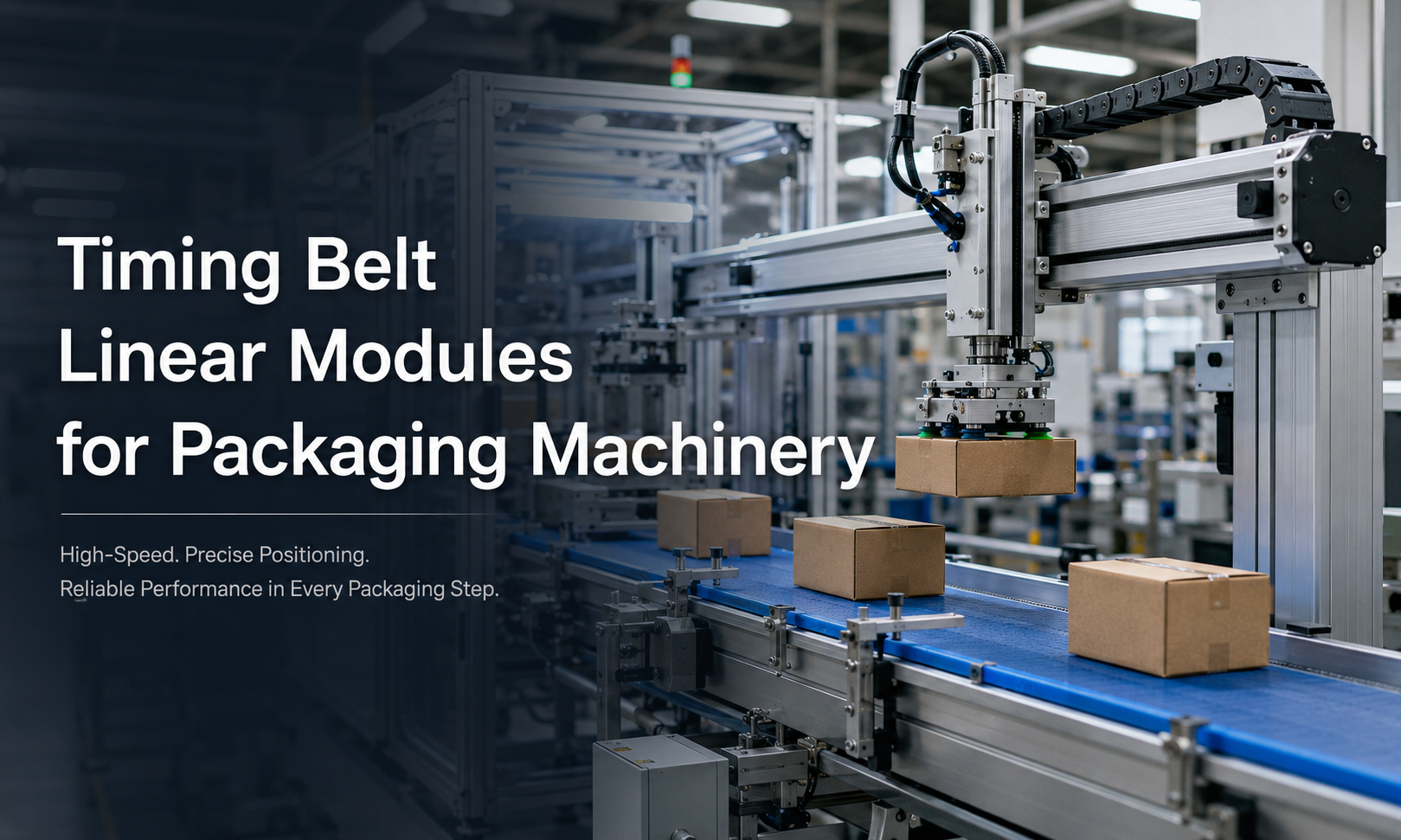
A timing beltlinear moduleis well suited to these requirements because it combines high travel speed, fast acceleration, long stroke capability and flexible multi-axis integration. It can be used as a single positioning axis or combined with other linear modules to build automated feeding, sorting, labeling and packaging systems.
Why Timing Belt Linear Modules Are Used in Packaging Machinery
Packaging equipment often performs repetitive movements continuously over long production periods. The selected motion system must therefore provide both high dynamic performance and reliable operation.
Compared with many screw-driven systems, a belt driven linear module can achieve higher linear speeds over longer strokes without being limited by screw critical speed. Its lightweight moving components also support rapid acceleration and deceleration, helping packaging machines reduce nonproductive motion time.
The main advantages oftiming belt linear modulesin packaging machinery include:
- High-speed reciprocating motion
- Fast acceleration and deceleration
- Long and configurable travel ranges
- Consistent positioning repeatability
- Low moving mass
- Quiet and smooth operation
- Flexible horizontal, vertical and multi-axis installation
- Simple integration with servo motors, sensors and controllers
These characteristics make timing belt modules suitable for packaging lines where speed, production cycle and equipment flexibility are more important than extremely high thrust or micron-level positioning accuracy.
Product Feeding Applications
Product feeding is one of the most common processes in packaging machinery. Products, containers, trays, cartons or packaging materials must be transferred from one workstation to another at a controlled speed and spacing.
A timing belt linear module can drive a pusher, gripper, suction cup or transfer plate to move products into the packaging area. The axis can be programmed to synchronize with conveyors, indexing tables and upstream production equipment.
Typical feeding operations include:
- Loading products into trays or cartons
- Transferring bottles into filling stations
- Feeding pouches into sealing equipment
- Moving cartons toward case packing stations
- Positioning packaging materials before forming
- Loading products into thermoforming machines
Servo-controlled belt axes allow the feeding distance, speed and acceleration profile to be adjusted through the machine controller. This flexibility is especially useful when one packaging machine handles multiple product sizes or package formats.
Automated Sorting Systems
Sorting equipment identifies products according to size, shape, weight, barcode, color or inspection results and then directs them to different output positions. Timing belt linear modules can provide the rapid lateral motion required for this process.
For example, a belt driven axis can move a diverter, pushing mechanism or robotic gripper between several conveyor lanes. Once a vision sensor or barcode reader identifies the product, the controller sends a command to the linear module, which moves the sorting device to the required location.
The module must accelerate quickly, complete the sorting movement and return to its initial position before the next product arrives. High acceleration and low moving mass help reduce sorting time and increase throughput.
Timing belt modules can be used in:
- Food and beverage sorting lines
- Parcel and logistics sorting systems
- Pharmaceutical packaging equipment
- Electronic component classification
- Defective product rejection stations
- Multi-lane conveyor distribution systems
Positioning and Transfer Operations
Accurate positioning is essential before products enter filling, sealing, labeling or inspection stations. If a container or package is not positioned correctly, the process may result in poor seals, misaligned labels or damaged products.
A timing belt linear module can move products to predefined positions using programmable servo motion. Proximity sensors, photoelectric sensors or vision systems can detect the product position and provide feedback to the controller.
Common positioning tasks include:
- Aligning bottles before filling or capping
- Positioning cartons below loading mechanisms
- Moving trays into inspection stations
- Adjusting product spacing on a conveyor
- Transferring packages between parallel production lines
- Positioning sealing heads or cutting mechanisms
The required repeatability depends on the packaging process. General product transfer may tolerate a larger positioning variation, while labeling, vision inspection and precision sealing usually require more stable repeat positioning.
Sealing and Packaging Operations
Sealing equipment may require a tool, sealing head or product fixture to move repeatedly between loading and sealing positions. Timing belt linear modules can perform these rapid reciprocating movements while maintaining a consistent production cycle.
In pouch, tray and carton packaging systems, the module may move a sealing assembly across the package or transfer products underneath a fixed sealing station. It can also adjust the position of side sealing mechanisms when the machine changes between different package widths.
Typical applications include:
- Heat sealing machines
- Pouch packaging systems
- Tray sealing equipment
- Carton closing machines
- Film wrapping systems
- Bag making and cutting equipment
The actual load calculation should include the weight of the sealing head, mounting plate, heater, pneumatic components, cables and any forces generated during the sealing process. A suitable safety factor should also be applied to ensure reliable long-term operation.
Labeling Machine Applications
Labeling equipment requires labels and products to remain synchronized during application. Timing belt linear modules can move labeling heads, printing units, sensors or product fixtures according to the position and speed of the packaging line.
In some machines, the labeling head remains fixed while the module positions the product. In other systems, the linear module moves the labeling head along the product surface to apply long labels or labels with complex shapes.
Timing belt modules can support:
- Top labeling
- Side labeling
- Wraparound labeling
- Carton and box labeling
- Print-and-apply systems
- Variable-position labeling
When connected to an encoder, the servo axis can follow conveyor speed and compensate for changes in product spacing. This electronic synchronization helps maintain label placement consistency at high production speeds.
High-Speed Reciprocating Motion
Many packaging operations require an axis to move forward, stop, complete a process and return within a fraction of a second. The total cycle consists of acceleration time, constant-speed travel, deceleration time, processing time and return travel.
A timing belt module improves cycle performance by allowing high acceleration and high travel speed. However, maximum speed alone does not determine production output. For short strokes, acceleration and deceleration often have a greater effect on cycle time than the rated maximum speed.
When designing a high-speed reciprocating axis, engineers should evaluate:
- Moving payload
- Required stroke
- Acceleration and deceleration
- Maximum operating speed
- Target cycle time
- Motor torque and speed
- Pulley diameter and belt pitch
- Structural vibration
- Settling time after positioning
Excessive acceleration can shorten the theoretical cycle but may also cause vibration, belt tension fluctuation, product instability and premature component wear. Motion profiles should therefore be optimized for both speed and mechanical stability.
Multi-Station Packaging Integration
Modern packaging machines often combine feeding, inspection, filling, sealing, labeling and unloading into one automated production line. Timing belt linear modules can connect these stations or perform coordinated movements between them.
A single long-stroke axis may transport products across several stations. Alternatively, multiple modules can be installed as independent axes, allowing different operations to run simultaneously.
Common configurations include:
- Single-axis product transfer systems
- XY positioning platforms
- XZ pick-and-place units
- XYZ gantry systems
- Dual-axis synchronized transfer mechanisms
- Multi-lane sorting and packaging systems
Multi-axis integration allows one packaging machine to handle several processes while reducing manual transfer and floor space. Servo controllers can coordinate the motion of each axis with conveyors, rotary tables, pneumatic cylinders and packaging tools.
Production Cycle and Throughput
The linear module must be selected according to the required machine output rather than only the maximum speed listed in a product specification. Production cycle analysis should include every stage of the motion sequence.
A complete packaging cycle may include:
- Waiting for the product detection signal
- Accelerating toward the working position
- Moving through the required stroke
- Decelerating and settling
- Completing the feeding, sealing or labeling process
- Returning to the original position
- Preparing for the next product
If the required output is 60 packages per minute, the complete cycle must be finished within approximately one second. The available time for linear motion may be even shorter after sealing, inspection or labeling time is deducted.
Calculating the actual motion profile helps determine whether the selected motor, pulley and belt system can meet the target production rate without operating continuously at its maximum limit.
Payload and Moment Load Considerations
The payload of a packaging axis includes more than the product being moved. Engineers must consider all components mounted on the carriage, including grippers, vacuum generators, sealing heads, labeling units, sensors, brackets and cable carriers.
The installation position also affects the load calculation. A horizontal axis mainly experiences inertia forces during acceleration and deceleration. A vertical axis must continuously support the moving mass against gravity and normally requires a brake or anti-drop mechanism.
Moment loads are created when the payload center of gravity is positioned away from the carriage center. Large overhang distances can increase pitch, yaw and roll moments even when the total payload is relatively low.
For stable operation, the selected module should provide sufficient capacity for:
- Static payload
- Dynamic acceleration force
- External processing force
- Pitch, yaw and roll moments
- Emergency stop loads
- Appropriate safety factors
Hygiene and Environmental Requirements
Packaging machinery is used in industries with very different environmental requirements. Food, beverage, pharmaceutical and medical packaging equipment may require surfaces that are easy to clean and materials that resist corrosion or cleaning chemicals.
Standard timing belt modules are usually designed for general industrial environments. For clean or hygienic applications, additional protective measures may be required, such as:
- Sealed or covered module structures
- Corrosion-resistant fasteners
- Food-compatible lubricants where required
- Protective covers for belts and guide rails
- Dust and liquid splash protection
- Smooth external surfaces that reduce contamination buildup
The module should not be installed where food particles, liquids or packaging debris can directly enter the guide rail or belt mechanism unless the system has suitable protection.
Maintenance of Timing Belt Modules in Packaging Equipment
Packaging machines often operate for multiple shifts, so preventive maintenance is important for maintaining production stability. Regular inspections can identify belt wear, loose fasteners or lubrication problems before they cause unexpected downtime.
Recommended maintenance items include:
- Checking timing belt tension
- Inspecting the belt for wear, cracks or damaged teeth
- Checking pulley alignment
- Lubricating guide rails according to the maintenance schedule
- Inspecting carriage movement for abnormal resistance
- Tightening motor, coupling and mounting fasteners
- Checking sensors and limit switches
- Inspecting cables and cable carriers
- Removing packaging dust and debris
Overtightening the timing belt should be avoided because excessive tension increases bearing loads and may shorten belt and pulley life. Insufficient tension can cause tooth jumping, positioning errors and vibration during rapid acceleration.
How to Select a Timing Belt Linear Module for Packaging Machinery
A suitable module should be selected based on the complete application conditions rather than a single parameter. The main selection factors include:
| Selection Factor | Engineering Consideration |
|---|---|
| Payload | Total mass of the product, fixture, gripper, tool and moving accessories |
| Stroke | Required travel plus deceleration, sensor and mechanical safety margins |
| Speed | Maximum travel speed required to meet the production cycle |
| Acceleration | Required dynamic response without excessive vibration or product movement |
| Repeatability | Position consistency required for feeding, sealing, labeling or inspection |
| Installation | Horizontal, vertical, inclined or multi-axis mounting orientation |
| Environment | Dust, moisture, temperature, cleaning and hygiene requirements |
| Motor | Servo torque, speed, inertia matching and brake requirements |
| Control | Sensor inputs, encoder synchronization and multi-axis communication |
| Maintenance | Lubrication access, belt inspection and component replacement space |
For high-cycle packaging machines, it is advisable to avoid selecting a module that must operate continuously at its maximum rated speed, acceleration or payload. Providing reasonable performance margin improves reliability and service life.
Typical Packaging Machinery Applications
Timing belt linear modules are widely used in:
- Cartoning machines
- Case packing equipment
- Flow wrapping machines
- Pouch filling and sealing systems
- Bottle filling and capping lines
- Labeling machines
- Food sorting and packaging equipment
- Pharmaceutical blister packaging machines
- Parcel sorting systems
- Palletizing and depalletizing units
- Vision inspection stations
- Automatic product loading and unloading systems
Conclusion
Timing belt linear modules provide the speed, stroke and motion flexibility required by modern packaging machinery. They can perform product feeding, sorting, positioning, sealing, labeling and multi-station transfer operations while supporting short production cycles and programmable automation.
Successful application depends on correctly evaluating payload, stroke, acceleration, positioning repeatability, moment load, installation orientation and environmental conditions. The module should also be integrated with suitable motors, sensors, controllers and protective structures.
With proper sizing and regular maintenance, a timing belt linear module can provide reliable high-speed motion for packaging lines ranging from individual labeling stations to fully integrated multi-process automation systems.