 English

Servo motors and stepper motors are both commonly used to drivetiming belt linear modules. Although either motor can move the carriage along the linear axis, they differ significantly in speed performance, torque characteristics, position feedback, control accuracy, cost and system complexity.
The correct choice depends on the payload, travel speed, acceleration, positioning requirements, duty cycle and operating environment of the application. Selecting the motor only by rated power or purchase price may result in insufficient torque, unstable positioning, excessive vibration or unnecessary system cost.
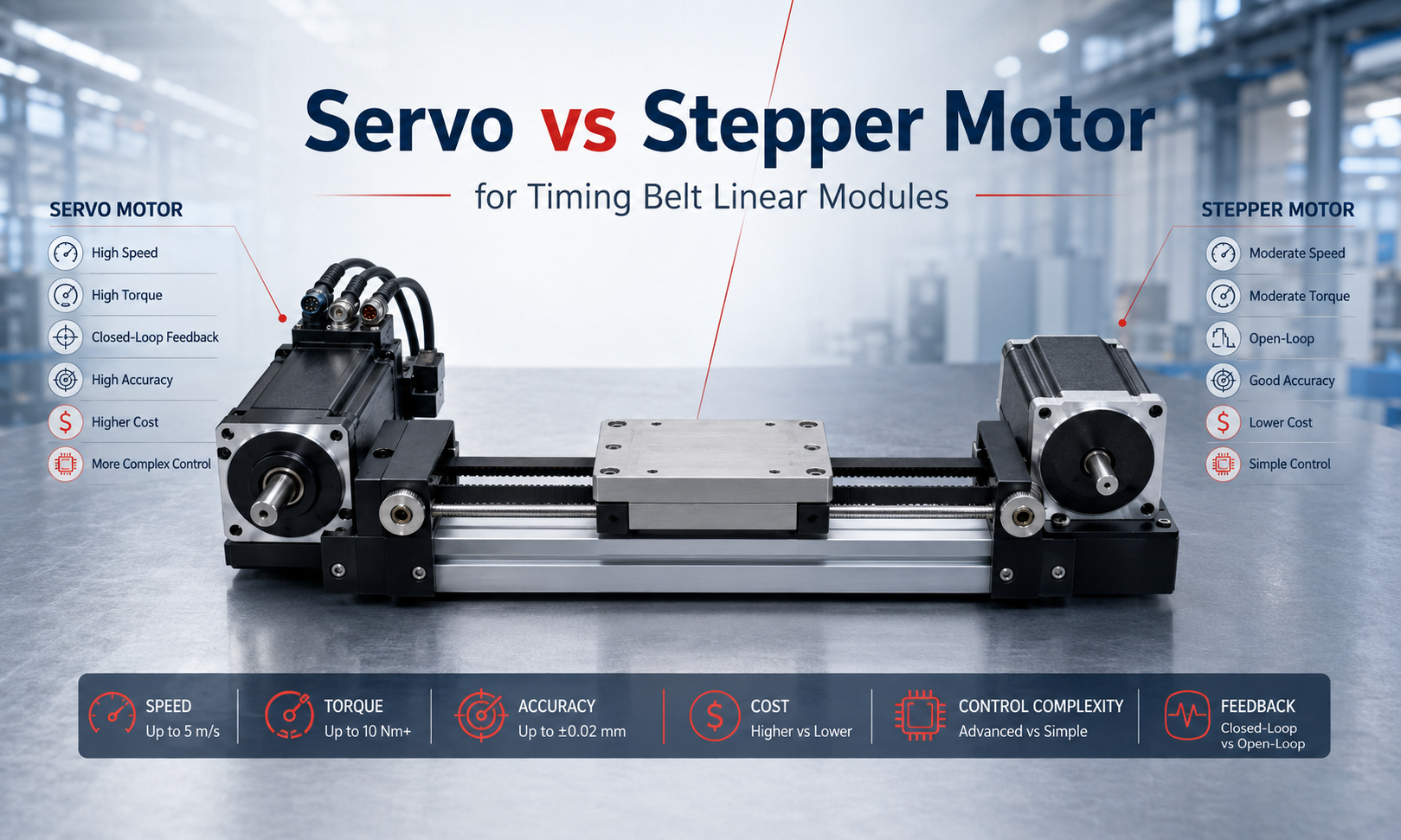
How Motors Drive a Timing Belt Linear Module
In a timing belt linear module, the motor rotates the drive pulley through a direct connection, coupling or reduction mechanism. The pulley drives the timing belt, which moves the carriage along the linear guide.
The motor must provide enough torque to overcome:
- Payload inertia
- Carriage and belt inertia
- Guide rail friction
- Acceleration and deceleration forces
- External resistance
- Gravity loads in vertical installations
The required motor torque can be considered as the combination of acceleration torque, friction torque and external load torque. A suitable safety margin should also be included to handle load variation and long-term operation.
What Is a Stepper Motor?
A stepper motor rotates through a fixed angle for each input pulse. The controller determines the movement distance by sending a specified number of pulses and controls the speed by changing the pulse frequency.
Traditional stepper systems normally operate in an open-loop configuration. The controller sends motion commands without directly confirming whether the motor has reached the commanded position.
Stepper motors are widely used in timing belt modules because they offer simple control, good low-speed torque and relatively low system cost.
Advantages of Stepper Motors
- Lower motor and driver cost
- Simple control architecture
- Good holding torque at standstill
- Strong torque at low operating speeds
- Easy position control through pulse commands
- Suitable for simple point-to-point movement
Limitations of Stepper Motors
- Available torque decreases as motor speed increases
- Open-loop systems cannot directly detect lost steps
- Vibration and resonance may occur at certain speeds
- Motor temperature may remain high while holding position
- Performance margin must be carefully reserved
- Less suitable for high-speed and high-acceleration operation
If the payload, acceleration or external resistance exceeds the available torque, an open-loop stepper motor may fail to follow the command position. This condition is commonly described as losing steps.
What Is a Servo Motor?
A servo motor normally operates as part of a closed-loop control system. An encoder measures the motor position and speed, while the servo drive continuously compares the feedback signal with the commanded motion.
When a position or speed error occurs, the servo drive adjusts motor output to reduce the deviation. This closed-loop control allows the motor to maintain stable operation under changing loads and dynamic motion conditions.
Advantages of Servo Motors
- Closed-loop position and speed feedback
- Strong torque performance across a wider speed range
- Higher maximum operating speed
- Better acceleration and deceleration performance
- Automatic correction of position deviation
- Smoother operation at high speed
- Suitable for high-duty-cycle automation
- Supports alarm monitoring and diagnostic functions
Limitations of Servo Motors
- Higher motor and drive cost
- More complex parameter configuration
- Servo tuning may be required
- Higher requirements for wiring and electrical installation
- Improper gain settings may cause vibration or instability
Servo vs Stepper Motor Comparison
| Comparison Item | Stepper Motor | Servo Motor |
|---|---|---|
| Control Method | Usually open-loop pulse control | Closed-loop control with encoder feedback |
| Low-Speed Torque | Good | Good and more controllable |
| High-Speed Torque | Decreases significantly as speed increases | Maintains stronger torque over a wider speed range |
| Maximum Speed | Better suited to low and medium speeds | Better suited to medium and high speeds |
| Position Feedback | Normally unavailable in open-loop systems | Encoder feedback is normally included |
| Lost-Step Detection | Open-loop systems cannot directly detect lost steps | Position deviation can be monitored and corrected |
| Acceleration | Moderate | Higher acceleration capability |
| Motion Smoothness | May experience vibration or resonance | Smoother across a wider operating range |
| Holding Position | Strong holding torque but may generate heat | Maintains position through closed-loop control |
| Control Complexity | Relatively simple | More complex setup and tuning |
| System Cost | Lower | Higher |
| Typical Application | Simple, low-speed and cost-sensitive equipment | High-speed, dynamic and precision automation systems |
Speed Performance
Speed is one of the most important differences between servo and stepper systems.
A stepper motor can provide strong torque at low speed, but its available torque normally decreases as rotational speed increases. When a timing belt module requires rapid travel over a long stroke, the stepper motor may need to operate near the upper end of its usable speed range. At this point, acceleration capability and torque margin may become limited.
A servo motor usually maintains useful torque over a wider operating speed range. It is therefore more suitable for timing belt modules that require high linear speed, short cycle time or frequent acceleration and deceleration.
Servo motors are generally preferred for:
- Long-stroke rapid positioning
- High-speed pick-and-place systems
- Frequent start-stop cycles
- Applications with short takt time
- Axes requiring smooth high-speed motion
Torque and Load Capacity
Motor torque must be evaluated under actual operating speed rather than only at standstill. A stepper motor may have high holding torque, but holding torque does not represent the torque available during high-speed movement.
For a timing belt axis, the required torque increases when:
- The payload becomes heavier
- The acceleration becomes higher
- The drive pulley diameter increases
- The carriage or tooling inertia increases
- The module is installed vertically
- External process resistance is applied
Servo motors normally provide better overload capability for short acceleration periods. This is useful when the axis must accelerate a heavy fixture or rapidly reverse direction.
Stepper motors can still be suitable for moderate loads when the operating speed is low and sufficient torque margin is maintained.
Position Feedback and Lost-Step Risk
In an open-loop stepper system, the controller assumes that the motor completes every commanded step. If the load suddenly increases or the motor torque becomes insufficient, the actual position may differ from the commanded position without immediate feedback to the controller.
A servo system uses encoder feedback to monitor motor movement. If the following error exceeds the permitted limit, the drive can correct the output or generate an alarm.
This makes servo motors more suitable for applications where an undetected positioning error could damage equipment, interrupt production or create defective products.
However, encoder feedback at the motor does not directly measure the final carriage position. Belt elasticity, pulley installation, mechanical clearance, structural deflection and guide accuracy can still influence the actual positioning performance of the linear module.
Positioning Accuracy
A servo motor does not automatically make a timing belt module highly accurate. The final accuracy of the axis depends on the complete mechanical and control system, including:
- Timing belt pitch accuracy
- Belt tension and stiffness
- Pulley machining and installation accuracy
- Linear guide accuracy
- Carriage rigidity
- Motor encoder resolution
- Controller command resolution
- Acceleration and settling settings
- Payload and moment load
For repeated movement between fixed positions at moderate speed, a correctly selected stepper motor can provide stable positioning performance.
For applications involving changing loads, high acceleration, short settling time or continuous motion, a servo motor normally provides better dynamic positioning performance.
Control Complexity
Stepper systems are generally easier to install and commission. Basic operation may only require pulse, direction and enable signals. This makes them suitable for standalone equipment and machines with simple motion sequences.
Servo systems may require configuration of:
- Electronic gear ratio
- Position gain
- Speed gain
- Acceleration and deceleration parameters
- Inertia system
- Notch filters
- Torque limits
- Alarm outputs
Modern servo drives often include automatic tuning functions, but correct parameter settings are still important. Excessive gain can cause vibration, while insufficient gain can result in slow response and longer settling time.
Cost Comparison
Stepper motors and drivers normally have a lower initial purchase cost. Their simpler wiring and commissioning process may also reduce the cost of basic equipment.
Servo systems usually require a higher initial investment because they include an encoder, servo drive and more advanced control functions. However, purchase price should not be the only consideration.
A servo motor may reduce the total operating cost when the application requires:
- Higher production throughput
- Shorter cycle times
- Automatic fault detection
- Fewer positioning failures
- Stable operation under variable loads
- Continuous high-duty-cycle production
For a simple low-speed axis, using a servo motor may add cost without providing a meaningful production advantage. For a high-speed production axis, selecting a stepper motor only to reduce initial cost may limit machine performance.
Closed-Loop Stepper Motors
A closed-loop stepper motor combines a stepper motor with an encoder. The driver uses position feedback to monitor whether the motor follows the command.
This solution can reduce the risk of undetected lost steps and may provide better performance than a traditional open-loop stepper system. It is often positioned between an open-loop stepper and a servo system in terms of cost and capability.
However, a closed-loop stepper does not completely replace a servo motor. Its high-speed torque characteristics, acceleration capability and control bandwidth are still influenced by the stepper motor structure.
A closed-loop stepper may be suitable when:
- Open-loop reliability is a concern
- Operating speed is moderate
- Cost must remain below a full servo system
- The application requires basic position error monitoring
Which Motor Is Better for Horizontal Timing Belt Modules?
For a horizontal timing belt module, both motor types can be used. The decision should be based on speed, payload and cycle requirements.
A stepper motor is often suitable for:
- Moderate payloads
- Low or medium operating speeds
- Simple indexing movement
- Infrequent start-stop operation
- Cost-sensitive equipment
A servo motor is normally preferred for:
- Heavy moving loads
- High-speed positioning
- High acceleration
- Frequent direction changes
- Short production cycles
- Applications requiring motion alarms
Which Motor Is Better for Vertical Timing Belt Modules?
Vertical installations require additional attention because the motor must support and move the load against gravity.
A servo motor with a holding brake is generally preferred for vertical timing belt modules, especially when the payload is heavy or the axis presents a falling risk during power loss.
The brake is intended to hold the axis when the motor is stopped or power is removed. It should not normally be used as the primary device for repeated dynamic deceleration.
A stepper motor may be used for a light vertical load, but the design must consider:
- Available upward acceleration torque
- Motor heating while holding position
- Power-off falling prevention
- Mechanical brake or counterbalance requirements
- Appropriate safety factor
Application Selection Guide
| Application Requirement | Recommended Motor | Reason |
|---|---|---|
| Low-speed material transfer | Stepper motor | Simple control and good low-speed torque |
| Basic point-to-point positioning | Stepper motor | Cost-effective for predictable loads |
| High-speed pick and place | Servo motor | Better speed, acceleration and dynamic response |
| Long-stroke rapid movement | Servo motor | Stronger high-speed torque performance |
| Variable payload automation | Servo motor | Closed-loop control adapts better to load changes |
| Cost-sensitive inspection fixture | Stepper motor | Suitable when speed and load are moderate |
| Vertical lifting axis | Servo motor with brake | Better dynamic control and power-off holding capability |
| Moderate-speed axis requiring feedback | Closed-loop stepper or servo motor | Selection depends on acceleration and budget |
| Continuous industrial production | Servo motor | Suitable for high duty cycles and fault monitoring |
Questions to Ask Before Selecting the Motor
Before choosing a servo or stepper motor for a timing belt linear module, confirm the following information:
- What is the total moving payload?
- What is the required linear speed?
- What acceleration and deceleration are required?
- What is the effective travel distance?
- How frequently will the axis start and stop?
- Is the module installed horizontally or vertically?
- What positioning accuracy and repeatability are required?
- Will the payload change during operation?
- Is position feedback or fault detection required?
- What safety margin is needed?
- What are the available controller and communication interfaces?
- What is the acceptable total system cost?
Common Motor Selection Mistakes
Selecting a Motor Only by Holding Torque
Stepper motor holding torque is measured at standstill. The available torque during motion may be much lower, especially at higher speeds.
Ignoring Load Inertia
A motor may have sufficient static torque but still accelerate slowly if the moving inertia is too high. Motor inertia, pulley inertia, belt inertia and payload inertia should be considered together.
Using Insufficient Torque Margin
Operating continuously near the motor torque limit can increase the risk of overheating, lost steps or servo alarms.
Assuming the Servo Eliminates Mechanical Error
A servo encoder controls motor rotation, but it cannot completely eliminate belt elasticity, frame deformation, pulley errors or guide inaccuracies.
Ignoring Vertical Axis Safety
Vertical timing belt modules may fall when power is removed. A brake motor, counterbalance or mechanical safety device may be required.
Choosing Only by Initial Purchase Price
The lowest-cost motor may reduce initial investment but may also limit speed, throughput and reliability. Selection should be based on total application requirements.
Conclusion
Stepper motors are suitable for timing belt linear modules with moderate loads, low or medium speeds, predictable motion and limited budgets. They provide simple control, good low-speed torque and economical operation for basic positioning tasks.
Servo motors are better suited to high-speed, high-acceleration and high-duty-cycle applications. Their closed-loop feedback, stronger high-speed torque and fault monitoring capabilities provide greater stability under dynamic or changing load conditions.
Closed-loop stepper motors offer an intermediate option when position monitoring is required but the application does not need the full dynamic performance of a servo system.
The final motor selection should be based on actual payload, speed, acceleration, travel, installation direction, positioning requirements and duty cycle. Evaluating the motor together with the timing belt module, pulley size, controller and mechanical structure helps ensure reliable motion performance and avoids unnecessary system cost.