 English

Lubrication is one of the simplest maintenance tasks on a linear module, but it is also one of the easiest to get wrong. Too little lubricant increases friction and wear. Too much can raise running resistance, trap contamination or leak into areas where it is not wanted. Using an incompatible grease can be even worse than delaying a routine service.
A goodlinear module lubricationplan therefore starts with three questions: which components actually need lubrication, which lubricant is compatible with them, and how operating conditions change the relubrication interval.
This guide explains how to make those decisions for ball screw, timing belt, rack-and-pinion and other industrial linear motion systems, with practical maintenance steps for engineers and technicians.
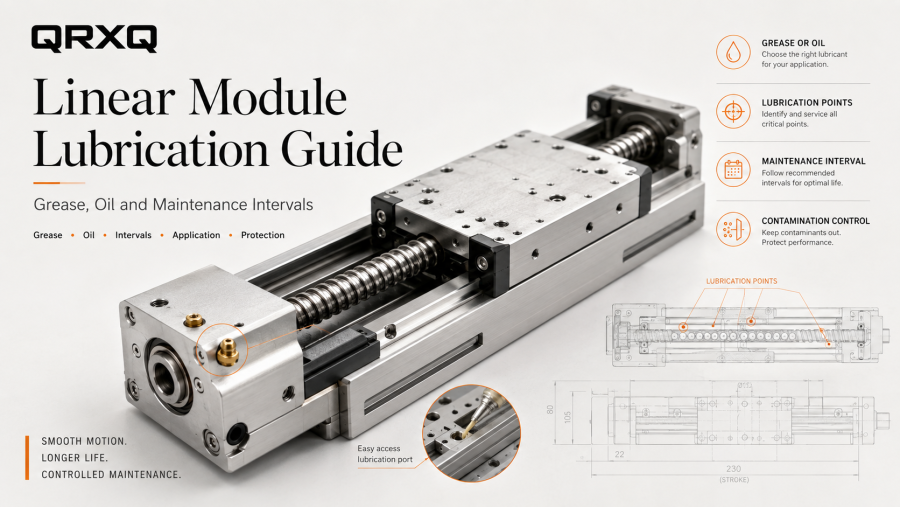
What Lubrication Does Inside a Linear Module
A linear module may contain several moving interfaces: linear guide blocks, a ball screw and nut, support bearings, rack-and-pinion gears, pulleys or other transmission components. These parts do not all use the same lubrication method.
Where rolling elements are used, the lubricant forms a film that reduces direct metal-to-metal contact, lowers friction, helps limit wear and protects surfaces from corrosion. In recirculating guides and ball screws, correct lubrication also supports smooth ball circulation and more stable operating torque.
Lubrication is not a substitute for correct alignment. If a module is twisted during installation, overloaded or contaminated with abrasive particles, adding more grease will not correct the underlying problem.
Maintenance principle:lubrication should preserve a correctly installed motion system. It should not be used to hide abnormal noise, binding, excessive motor current or damaged components.
Which Parts of a Linear Module Need Lubrication?
The answer depends on the module design. Before servicing an axis, identify the guide type and drive mechanism rather than applying one lubricant to every visible moving part.
| Component | Typical Lubrication Need | Important Note |
|---|---|---|
| Recirculating linear guide | Grease or, in some systems, oil | Use the lubricant and inlet method specified for the guide block |
| Ball screw and nut | Usually grease or oil depending on design and operating conditions | The screw raceway and nut circulation system must receive lubricant |
| Rack and pinion | Grease or oil applied to the tooth contact | Open gearing requires strong contamination control |
| Timing belt | Normally no grease or oil on the belt teeth | Lubricant on the belt can attract dirt or damage some belt materials |
| Support bearings | Often pre-lubricated or sealed | Do not assume they require routine external greasing |
| Motor and gearbox | Depends on the motor or gearbox design | Follow the component manufacturer's maintenance instructions |
On an enclosed module, lubrication ports may provide access to internal guides or screw nuts without removing the cover. On other designs, the carriage must be moved to a service position before the nipple or lubrication hole becomes accessible.
Grease or Oil: Which Is Better for Linear Motion?
Neither is universally better.Greaseis the more common choice for many industriallinear modulesbecause it stays in place, simplifies manual maintenance and can provide some additional protection against moisture and contamination.Oilcan be useful when low viscous resistance, frequent automatic supply, heat removal or high-speed operation is more important.
| Selection Factor | Grease | Oil |
|---|---|---|
| Retention | Stays in the lubrication zone relatively well | Flows easily and may require a controlled supply system |
| Manual maintenance | Convenient for grease guns and centralized grease ports | Less convenient unless the axis is designed for oil lubrication |
| Cooling | Limited heat-removal capability | Circulating oil can help remove heat |
| High-speed operation | Suitable when the correct consistency and quantity are used | Can reduce viscous drag in applications designed for oil |
| Contamination control | Can help seal surfaces but can also hold trapped particles | Can carry contaminants away in circulating systems, but requires filtration and control |
| Leakage risk | Generally lower | Higher if seals and collection are not designed correctly |
When grease is usually the practical choice
Grease is often suitable for standard factory automation, intermittent or continuous positioning axes, enclosed linear modules and equipment that is maintained manually. It is easy to meter through a grease nipple and does not require a separate circulation system.
When oil lubrication may make more sense
Oil may be selected for high-speed systems, centralized automatic lubrication, special low-friction requirements or applications where the lubricant is intentionally circulated. The module must be designed for oil supply and drainage; simply replacing grease with oil in a grease-lubricated system is not a safe assumption.
How to Choose Linear Module Grease
“Use grease” is not enough information. The base oil, thickener, consistency, additives, temperature range and material compatibility all affect how a grease behaves in a linear motion system.
Start with the module manufacturer's specified lubricant
The safest first choice is the lubricant specified for the actual guide, screw or module. If a supplier lists an approved grease, use that reference or an explicitly compatible alternative.
This matters because a grease that works well in a general bearing may not provide the same starting torque, low-temperature behavior, cleanroom performance or compatibility with seals and plastics required by a particular module.
Do not mix greases unless compatibility is confirmed
Different greases can use different thickeners and additive packages. Mixing them may change consistency, cause oil separation or reduce lubrication performance.
If the previous grease type is unknown and a change is necessary, the preferred procedure is to identify the original lubricant, consult the supplier and, where the product design allows, remove or purge old grease before introducing the new one.
Match the grease to the environment
Special applications may need properties that are not required in ordinary factory automation:
- Low-temperature equipment may need a grease with suitable low-temperature starting behavior.
- High-temperature axes require a lubricant with adequate thermal stability.
- Clean manufacturing may require low-particle or low-volatility lubrication.
- Food and pharmaceutical machinery may require a lubricant approved for the applicable hygiene requirements.
- Wet or corrosive environments may need stronger water resistance and corrosion protection.
- High-load or oscillating motion can require a lubricant formulated for heavier contact conditions.
Do not select grease by color.Two greases that look similar can have completely different base oils, thickeners and additives.
How Often Should a Linear Module Be Lubricated?
There is no single lubrication interval that is correct for every linear module.
Manufacturers may express relubrication recommendations in travel distance, operating hours or calendar time. Those values should be treated as a starting point for the specific product and then adjusted to the real machine conditions.
Conditions that usually shorten the interval
- High travel speed or frequent acceleration and deceleration
- High load or large moment load
- Short-stroke reciprocating motion
- High duty cycle or 24-hour production
- Elevated temperature
- Dust, chips, fibers or abrasive contamination
- Water, coolant or washdown exposure
- Vertical or unusual mounting orientations where lubricant distribution is less uniform
- Small lubrication reservoirs or compact guide blocks
Why short-stroke motion deserves special attention
A module that travels only a few millimeters back and forth may not redistribute lubricant across the full raceway as effectively as an axis making longer strokes. The same region of the guide or screw repeatedly carries the load.
For this type of application, lubrication quantity, grease distribution and inspection frequency should be reviewed with the component supplier instead of relying only on total travel distance.
Use condition-based evidence, not only the calendar
A useful maintenance program records when lubricant was added and watches for changes in noise, motor current, temperature, vibration and positioning behavior. If the machine repeatedly shows signs of lubricant starvation before the planned interval, the schedule should be shortened after ruling out other mechanical causes.
Conversely, do not automatically increase the quantity because an axis operates frequently. More grease is not always better.
How to Lubricate a Linear Module Correctly
The exact procedure varies by product, but the following sequence is a practical framework for manual servicing.
- Identify the lubrication points.Confirm whether the axis has separate ports for the linear guides, ball screw or other components. Do not assume one grease nipple supplies the entire module.
- Verify the lubricant.Check the specified grease or oil and make sure the container and application tool are clean and correctly labeled.
- Make the machine safe.Isolate power and prevent unexpected motion according to the machine's maintenance and lockout procedures before accessing moving components.
- Clean around the port.Remove dust, chips and old contaminated grease from the fitting area before connecting a grease gun or oil supply.
- Apply the specified amount gradually.Avoid forcing a large volume into a small guide block. If the manufacturer gives a quantity, use it rather than judging only by visible grease.
- Distribute the lubricant.When the maintenance procedure permits, move the carriage slowly through its usable stroke so fresh lubricant can spread through the raceways and circulation paths.
- Remove excess lubricant.Wipe away grease that has been pushed outside seals or onto surfaces where it can collect contamination.
- Inspect during the first operating cycles.Check for abnormal drag, noise, leakage or grease discharge before returning the axis to normal production speed.
- Record the service.Note the date, machine operating hours or travel count, lubricant type and any abnormal observations.
How Much Grease Should You Add?
This is one of the most important questions and one of the hardest to answer generically.
The correct quantity depends on internal free space, block size, seal arrangement, grease consistency and the manufacturer's filling method. A small guide block can be overfilled easily if a high-volume grease gun is used without control.
Over-lubrication can cause:
- Higher running resistance
- Temporary motor-current or torque increase
- Heat generation from churning
- Grease leakage past seals
- Contamination around the carriage
- Pressure on seals or internal return paths
Under-lubrication can cause:
- Dry or rough running
- Rising friction and temperature
- Accelerated wear
- Noise
- Surface damage and shortened service life
Best practice:use a metered grease gun or automatic lubrication unit when consistent quantity matters. “Pump until grease comes out” is not a universal procedure for precision linear components.
Lubrication by Linear Module Drive Type
Ball screw linear modules
Aball screw moduleusually contains at least two lubrication-critical systems: the linear guide and the ball screw nut. Depending on the module, they may have separate ports or a centralized lubrication path.
The screw shaft should remain clean because grease on an exposed screw can hold dust or chips. Covers, seals and wipers are therefore part of the lubrication strategy, not just cosmetic accessories.
Timing belt linear modules
The timing belt itself is normally operated without grease or oil. Routine maintenance focuses more on the linear guide bearings, belt condition, pulley alignment and belt tension.
A common maintenance mistake is allowing grease from a guide port to spread onto the belt or pulley surfaces. Keep the lubrication zone controlled and wipe away excess material.
Rack-and-pinion linear modules
Rack-and-pinion systems have sliding and rolling contact at the gear teeth and may require regular grease or oil supply depending on the design. Open racks are especially exposed to dust and debris, so applying fresh lubricant onto a dirty tooth surface can create an abrasive paste.
Cleanliness and lubricant delivery should therefore be considered together.
Linear motor modules
A direct-drive linear motor has no screw, belt or rack transmission to lubricate, but the axis still normally uses linear guides or air-bearing technology. Recirculating guide blocks still require the lubrication specified for those guides.
Removing a mechanical transmission reduces the number of lubrication points; it does not automatically make the complete axis maintenance-free.
Contamination Prevention Is Part of Lubrication
Fresh grease cannot protect a guide indefinitely if abrasive particles are continually entering the raceway. Hard contamination can indent rolling surfaces and accelerate fatigue, while fibers and sticky process residue can damage seals and wipers.
For this reason, a good linear motion maintenance plan also checks:
- Guide and screw covers
- Wipers and end seals
- Bellows or protective strips
- Positive-pressure systems where used
- Nearby machining chips or grinding dust
- Coolant, washdown liquid and process chemicals
- Cable carriers that may drag contamination into the axis
Should old grease be wiped away?
Grease that has been pushed outside the seal and is collecting dust should normally be removed from accessible external surfaces. Do not disassemble a sealed guide block or ball nut simply to clean internal grease unless the component's service procedure specifically allows it.
Can compressed air be used to clean a linear module?
Use caution. A strong air jet can drive chips and dust past seals and deeper into guides or screw assemblies. Vacuum extraction, controlled wiping or the cleaning method specified by the manufacturer is often safer around precision rolling components.
What Abnormal Signs Can Point to Lubrication Problems?
Lubrication problems do not always start with visible damage. Early symptoms may include:
- A gradual increase in motor current or servo torque
- New scraping, clicking or rough-running noise
- Higher carriage or bearing temperature
- Uneven resistance through the stroke
- Grease leaking heavily from seals
- Dark, dry or contaminated grease around exposed areas
- Changes in repeatability or motion smoothness
These symptoms are not proof of a lubrication fault. Misalignment, preload, damaged bearings, a loose coupling, belt problems, cable drag or overloading can create similar behavior.
Before adding extra grease, inspect the axis systematically.
Should You Use Automatic Lubrication?
Automatic lubrication can be valuable when a machine operates continuously, has many lubrication points, is difficult to access or needs very consistent lubricant quantities.
A centralized system can reduce missed maintenance, but it introduces its own design requirements: line sizing, metering, pump pressure, lubricant compatibility and confirmation that every point actually receives lubricant.
Automatic lubrication should therefore be treated as an engineered system, not as a guarantee that lubrication can be ignored.
Build a Maintenance Interval Around the Actual Machine
A useful lubrication schedule is based on the application rather than copied from a generic calendar. Start with the module manufacturer's recommendation, then document actual operating conditions.
| Condition to Record | Why It Matters |
|---|---|
| Daily operating hours | Separates intermittent equipment from continuous production axes |
| Travel distance or cycle count | Shows how much rolling contact the guide and screw actually experience |
| Load and moment | Higher contact load can increase lubrication demand |
| Speed and acceleration | Affect heat, lubricant distribution and dynamic loading |
| Temperature | Changes lubricant viscosity, consistency and service life |
| Dust or liquid exposure | May require shorter inspection intervals and better sealing |
| Lubricant type and quantity | Prevents accidental mixing and makes maintenance repeatable |
A Practical Linear Module Lubrication Checklist
Before closing a maintenance job, confirm the following:
- The correct lubrication points were identified.
- The lubricant matches the module or component specification.
- Different grease types were not mixed without compatibility confirmation.
- Ports and tools were clean before lubricant was introduced.
- The correct amount was applied rather than an uncontrolled excess.
- The carriage was moved as required to distribute lubricant.
- Excess grease and external contamination were removed.
- Belts, sensors, brakes and electrical parts were kept free of lubricant.
- The axis was checked for abnormal resistance, noise and leakage.
- The maintenance date, lubricant and observations were recorded.
Need a lubrication recommendation for a QRXQ linear module?Provide the module model, drive type, installation orientation, operating speed, daily cycle or travel distance, load and working environment. Lubrication intervals and grease selection should be matched to the actual axis and service conditions rather than chosen from a universal schedule.