 English

Gear racklinear modulesare widely used in industrial automation systems that require long travel, high load capacity and fast linear motion. Unlike ball screw systems, which rely on a rotating screw shaft, a gear rack linear module converts motor rotation into linear movement through the engagement of a pinion gear and a straight rack.
The mainadvantages of gear rack linear modulesinclude scalable stroke, high load capacity, high speed, strong structural rigidity and convenient multi-axis integration. These characteristics make rack-and-pinion linear axes particularly suitable forgantry robots, automated production lines, large CNC equipment, material handling systems and other long-stroke applications.
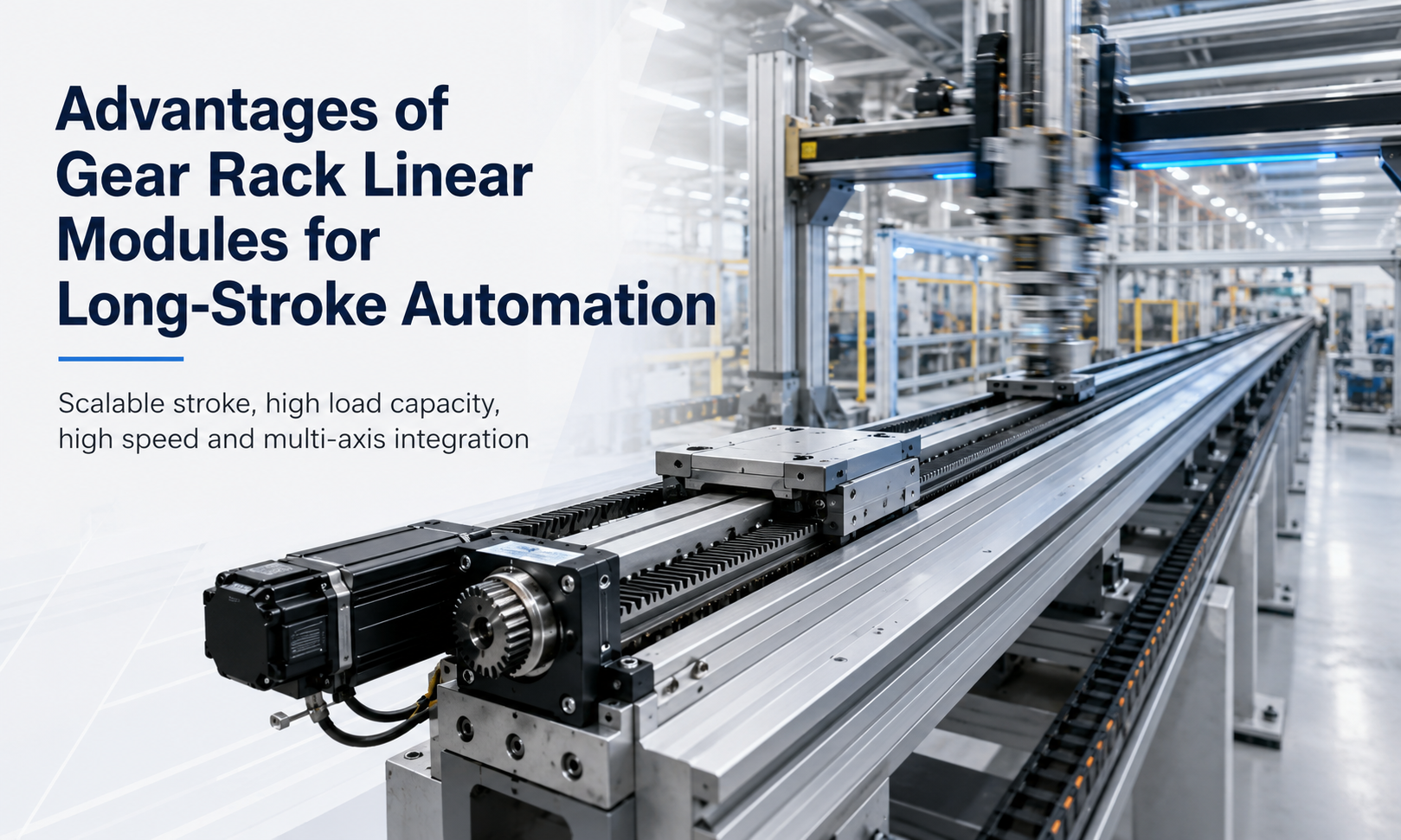
How Does a Gear Rack Linear Module Work?
A typical gear rack linear module consists of a rigid base, linear guide rails, guide blocks, a carriage, a precision rack, a pinion gear, a gearbox and a servo motor. The rack is installed along the length of the module, while the pinion is connected to the motor through a reducer or transmission mechanism.
When the motor rotates, the pinion moves along the fixed rack and drives the carriage in a straight line. Because the drive element is distributed along the travel length, the system does not require a long rotating screw shaft.
This transmission principle provides several important benefits for long-travel industrial automation.
1. Scalable Stroke for Long-Travel Applications
One of the most important gear rack linear module advantages is its scalable travel length. Rack sections can be installed in segments and connected along the machine frame, allowing the linear axis to be extended according to the application requirements.
In practical engineering, the stroke is not literally unlimited. It is limited by factors such as machine structure, guide rail installation accuracy, cable routing, rack alignment and control system configuration. However, compared with conventional screw-driven modules, rack-and-pinion systems can achieve much longer travel without requiring a single extremely long transmission shaft.
This makes them suitable for applications such as:
- Long-span gantry robots
- Large automated loading and unloading systems
- Warehouse transfer equipment
- Industrial cutting and welding machines
- Large-format inspection platforms
- Multi-station production lines
2. High Load Capacity
Gear rack linear modules can be designed for heavy-duty motion by combining a strong rack-and-pinion drive with large linear guide rails, reinforced carriages and rigid structural profiles.
The pinion transfers torque directly to the rack, while the linear guides support radial loads, lateral loads and moment loads. The load capacity can be increased by selecting a larger module rack, a wider pinion, a higher-torque gearbox and additional guide blocks.
This makes a heavy-duty rack actuator suitable for transporting large workpieces, robotic arms, welding equipment, machine tools and production fixtures.
Actual payload capacity depends on more than motor power. The complete selection process should also consider:
- Moving mass
- Acceleration and deceleration
- Mounting direction
- External cutting or processing forces
- Overhung load
- Pitch, yaw and roll moments
- Required service life
- Dynamic safety factor
3. High-Speed Linear Motion
A rack-and-pinion actuator is well suited to high-speed motion over long distances. Because the system does not rotate a long screw shaft, it avoids many of the speed restrictions associated with long ball screws.
The maximum operating speed is mainly influenced by the servo motor speed, gearbox ratio, pinion pitch diameter, rack precision, lubrication condition and rigidity of the mechanical structure.
For applications requiring rapid movement between distant stations, a gear rack drive can reduce non-processing travel time and improve the overall production cycle.
Typical high-speed applications include:
- High-speed gantry transfer systems
- Automated pallet handling
- Large-area laser processing
- Robotic loading systems
- Packaging and sorting equipment
- Long-travel pick-and-place systems
4. High Acceleration Capability
Gear rack linear modules can provide high acceleration when the motor, reducer, rack, pinion and machine structure are correctly matched.
High acceleration is especially valuable in automation systems with short cycle times. The axis can quickly reach the commanded speed, complete the required travel and decelerate before arriving at the target position.
However, acceleration should not be selected independently. Excessive acceleration increases:
- Motor torque demand
- Gear tooth contact force
- Guide block load
- Structural vibration
- Positioning overshoot
- Wear on transmission components
The acceleration profile should therefore be optimized according to the payload, stroke, positioning requirements and rigidity of the complete machine.
5. Reduced Ball Screw Critical Speed Limitations
Long ball screws can experience critical speed limitations. As screw length increases, the rotating shaft becomes more susceptible to vibration, bending and unstable operation at high rotational speeds.
A rack-and-pinion system does not require the entire transmission element to rotate. The rack remains fixed, and only the pinion rotates. Therefore, extending the travel does not create the same rotating-shaft critical speed problem found in long screw-driven systems.
This is one of the main reasons why gear rack linear modules are frequently selected for long-stroke, high-speed equipment.
The system still has practical speed limits. Gear meshing quality, lubrication, noise, guide alignment, gearbox performance and frame rigidity must all be evaluated. Nevertheless, the drive principle provides greater flexibility for combining long travel with high speed.
6. High Structural Rigidity
Industrial rack-driven linear axes are often built with reinforced aluminum profiles, welded steel frames or machined steel bases. When combined with large linear guides and multiple guide blocks, the system can achieve high structural rigidity.
High rigidity helps the module resist deformation under heavy payloads, acceleration forces and external processing loads. It also improves motion stability and helps maintain the correct engagement between the rack and pinion.
A rigid system provides several practical benefits:
- Reduced vibration during acceleration
- More stable motion under changing loads
- Improved resistance to moment loads
- Better gear meshing consistency
- Higher reliability in continuous operation
- Improved positioning repeatability
For very long axes, the supporting machine frame is as important as the module itself. The mounting surface must provide adequate flatness, straightness and support along the full travel length.
7. Easy Multi-Axis Integration
Gear rack linear modules can be integrated into XY, XZ, XYZ and gantry motion systems. Their long-stroke capability makes them especially suitable for the main horizontal axis of a multi-axis machine.
Common configurations include:
- XY system:Used for large-area positioning, cutting, inspection and dispensing.
- XZ system:Used for loading, unloading, lifting and transfer operations.
- XYZ system:Used for three-dimensional handling, assembly and machining.
- Single-drive gantry:Used when the crossbeam width and load are moderate.
- Dual-drive gantry:Uses two synchronized drive systems for wide spans, heavy loads or high dynamic performance.
In a dual-drive gantry system, electronic synchronization, mechanical alignment and homing procedures are critical. The two sides must move consistently to prevent the crossbeam from twisting or binding.
8. Modular and Scalable Machine Design
Rack-driven systems support modular machine construction. Manufacturers can use standardized rack sections, guide rails, carriages, motor mounts and support structures to build linear axes with different travel lengths and load ratings.
This scalable design simplifies the development of product families. A machine builder can retain the same basic drive concept while changing:
- Stroke length
- Rack size
- Pinion diameter
- Gearbox ratio
- Motor power
- Guide rail size
- Number of guide blocks
- Base structure
Modularity can reduce engineering time, simplify spare-parts management and make future equipment expansion easier.
9. Reliable Performance in Industrial Environments
Gear rack drives are used in demanding industrial environments because they have a robust mechanical structure and can withstand frequent acceleration, long operating cycles and heavy loads.
With correct lubrication, alignment and protection, a gear rack linear module can provide reliable performance in applications involving dust, metal particles, production debris or continuous operation.
Protective covers, bellows, wipers or enclosed housings may be required when the axis operates in contaminated environments. Lubrication intervals should be determined according to the operating speed, load, duty cycle and environmental conditions.
Routine maintenance usually includes:
- Checking rack and pinion lubrication
- Inspecting gear tooth wear
- Checking pinion preload or backlash
- Inspecting guide rail lubrication
- Checking mounting bolts
- Verifying rack joint alignment
- Monitoring gearbox noise and temperature
- Checking positioning repeatability
10. Flexible Precision and Backlash Control
Although gear rack systems are primarily known for long travel and heavy loads, they can also provide good positioning performance when precision racks, quality gearboxes and suitable preload mechanisms are used.
Backlash can be reduced through several methods:
- Precision-ground racks
- Low-backlash planetary reducers
- Preloaded dual-pinion systems
- Spring-loaded pinion mechanisms
- Electronic compensation
- Accurate rack alignment
A dual-pinion preload system applies torque in opposite directions to reduce the clearance between the gear teeth. This solution is often used when a long-stroke axis requires improved positioning accuracy and direction-change consistency.
Gear Rack, Ball Screw and Timing Belt Comparison
| Comparison Item | Gear Rack Module | Ball Screw Module | Timing Belt Module |
|---|---|---|---|
| Suitable Stroke | Very long and scalable | Short to medium | Medium to long |
| Load Capacity | High to very high | Medium to high | Low to medium |
| Maximum Speed | High | Limited on long strokes | High |
| Acceleration | High with correct sizing | Medium to high | High |
| Positioning Accuracy | Medium to high | High | Medium |
| Structural Rigidity | High | High | Medium |
| Stroke Extension | Easy through rack sections | Difficult | Possible but belt length is a limitation |
| Typical Application | Heavy-duty long-travel automation | Precision positioning | Lightweight high-speed transfer |
When Should You Choose a Gear Rack Linear Module?
A gear rack linear module is generally a strong choice when an application has one or more of the following requirements:
- The required travel is too long for a practical ball screw design.
- The payload or external force is relatively high.
- The machine requires both long stroke and high speed.
- The axis must support frequent acceleration and deceleration.
- The equipment may need to be extended in the future.
- A large gantry or multi-axis system is required.
- The application operates continuously in an industrial environment.
- The machine frame can provide adequate structural support.
A different drive method may be more suitable when the stroke is short and very high positioning accuracy is the main priority.Ball screw modulesare often preferred for precision positioning, whiletiming belt modulesmay be more economical for lightweight, high-speed transfer.
Important Selection Factors
To fully benefit from a rack-and-pinion actuator, the complete motion system must be selected rather than evaluating only the motor or rack size.
Key selection parameters include:
- Required effective stroke
- Maximum payload
- Load center and moment load
- Maximum speed
- Required acceleration
- Positioning accuracy
- Repeatability
- Duty cycle
- Mounting orientation
- Rack precision grade
- Gearbox backlash
- Pinion pitch diameter
- Guide rail size
- Lubrication method
- Environmental protection
- Servo synchronization requirements
The motor torque should be calculated using the moving mass, acceleration force, friction, external load, transmission efficiency and safety factor. For high-dynamic applications, motor inertia matching and gearbox capacity must also be checked.
Frequently Asked Questions
Can a gear rack linear module provide unlimited stroke?
The stroke is scalable rather than physically unlimited. Multiple rack sections can be connected to create a very long axis, but the final travel is still limited by the machine frame, guide installation, cable management and control system.
Is a gear rack module suitable for precision positioning?
Yes. Precision racks, low-backlash gearboxes, preloaded pinions and servo compensation can provide good positioning accuracy. However, a ball screw may remain more suitable for short-stroke applications requiring extremely high precision.
Why is a gear rack drive suitable for long travel?
The rack remains stationary while the pinion rotates. The system therefore avoids the rotating-shaft critical speed limitations associated with very long ball screws.
Can gear rack modules be used in vertical applications?
Yes, but the motor torque, gearbox, brake, holding force, falling prevention and safety factor must be evaluated carefully. A brake motor or additional mechanical protection is usually required for vertical axes.
How can backlash be reduced?
Backlash can be reduced through precision racks, low-backlash reducers, accurate installation, dual-pinion preload systems and electronic compensation.
Conclusion
The primary advantages of gear rack linear modules are scalable stroke, high load capacity, high speed, high acceleration, structural rigidity and convenient multi-axis integration. Because the rack does not rotate, the system can support long travel without being constrained by the same critical speed problems as a long ball screw.
These characteristics make gear rack linear modules an effective solution for gantry robots, large machine tools, automated loading systems, warehouse equipment and other heavy-duty long-stroke applications.
To achieve reliable performance, the rack, pinion, gearbox, servo motor, linear guides and supporting frame must be selected as a complete system. QRXQ can configure gear rack linear axes according to the required stroke, payload, speed, accuracy, installation direction and operating environment.