 English

Correct lubrication is essential for maintaining the accuracy, load capacity and service life of a gear racklinear module. During operation, the rack teeth and pinion repeatedly slide and roll against each other under load. Without a stable lubricating film, friction increases rapidly, resulting in tooth wear, abnormal noise, temperature rise, corrosion and positioning errors.
This guide explains how to lubricate a gear rack linear module correctly, including rack tooth lubrication, pinion lubrication, grease selection, automatic lubrication systems, lubrication quantity, service intervals, contamination control and the risks of over-lubrication.
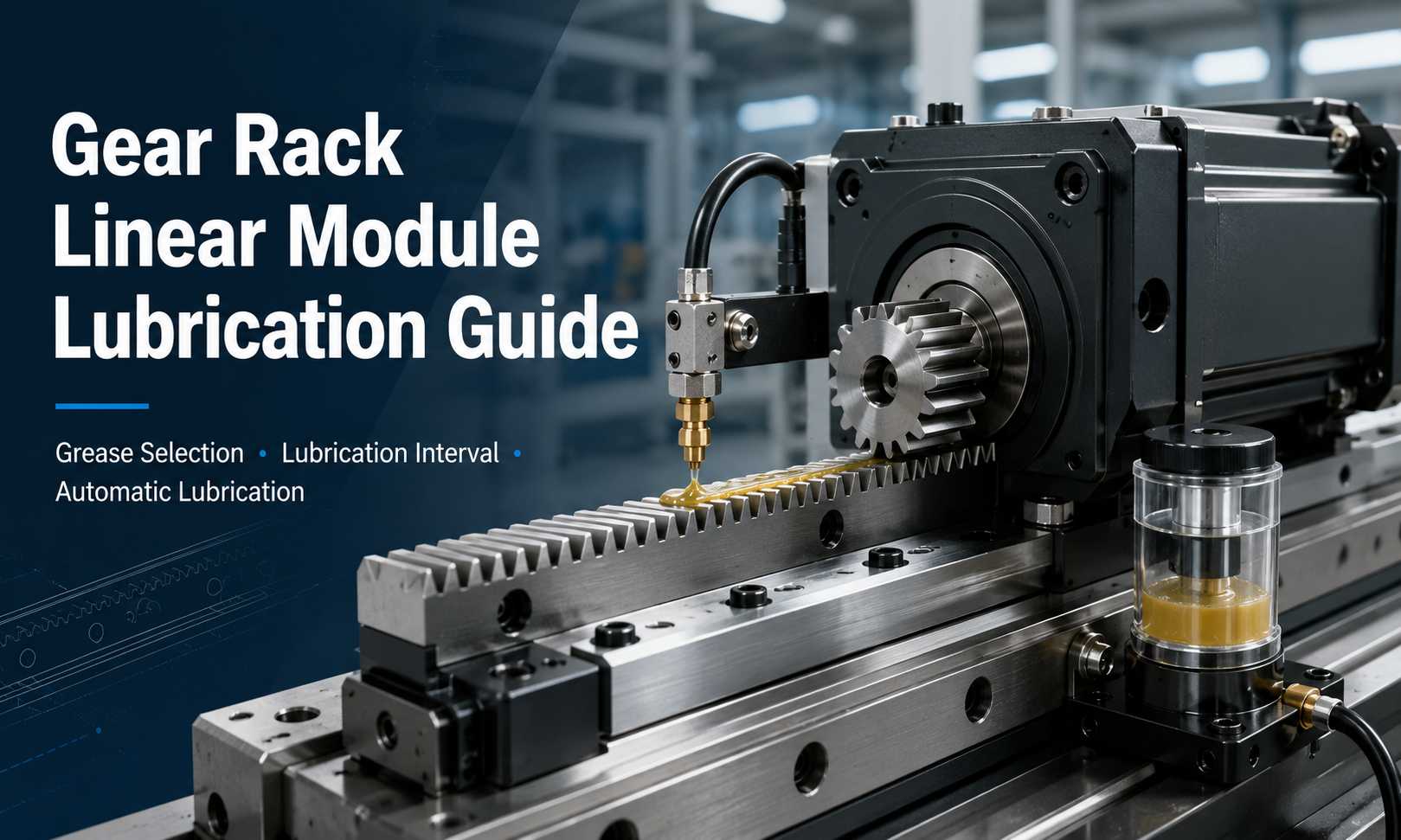
Why Gear Rack Linear Modules Require Lubrication
A gear rack linear module converts rotary motor motion into linear movement through the engagement of a pinion and a straight rack. Because the tooth surfaces transmit force continuously, they are exposed to contact pressure, sliding friction and impact loads during acceleration, deceleration and direction changes.
Proper lubrication provides several important benefits:
- Reduces friction between the rack teeth and pinion.
- Limits tooth surface wear and pitting.
- Reduces operating noise and vibration.
- Helps prevent rust and corrosion.
- Improves transmission efficiency.
- Maintains stable backlash and positioning performance.
- Extends the service life of the rack, pinion, bearings and gearbox.
Lubrication does not correct mechanical misalignment, excessive backlash or damaged gear teeth. If unusual wear continues after lubrication, the rack alignment, pinion engagement, gearbox condition and guide system should also be inspected.
Rack Tooth Lubrication
The rack tooth surface is the main lubrication point of a gear rack drive. Grease should form a thin and continuous film across the working tooth flanks without accumulating in large deposits.
Before applying new lubricant, inspect the rack for dust, metal particles, hardened grease and other contamination. Wipe the tooth surface with a clean, lint-free cloth. Use a compatible cleaning agent only when old grease cannot be removed mechanically. The rack should be dry before fresh lubricant is applied.
Apply grease evenly along the effective travel length of the rack. A brush, grease applicator, lubrication pinion or automatic dispensing unit may be used. After application, move the carriage slowly through the complete stroke several times so that the grease is distributed across the rack and pinion contact area.
Pay particular attention to the following positions:
- Rack joints on long-stroke systems.
- Areas with frequent acceleration and deceleration.
- Sections exposed to dust, cutting chips or moisture.
- Locations where the carriage frequently stops or reverses.
- Vertical axes where lubricant may migrate downward.
The lubricant layer should remain visible but thin. Excess grease trapped between the teeth may increase resistance and collect contaminants.
Pinion Lubrication
The pinion normally receives lubricant through direct contact with the lubricated rack. However, the pinion should still be inspected independently because its teeth complete more engagement cycles than an individual section of the rack.
Check the pinion for polished tooth flanks, scratches, pitting, chipped edges, corrosion and uneven wear. Uneven contact patterns may indicate incorrect gear alignment, improper backlash or excessive shaft deflection.
When applying grease directly to the pinion, rotate it slowly and coat each working tooth surface with a small quantity of lubricant. Avoid forcing excessive grease into the gearbox, motor coupling, seals or sensor area.
If the drive uses a gearbox, the gearbox lubricant is normally separate from the external rack-and-pinion grease. Gearbox oil or grease should be maintained according to the gearbox manufacturer's requirements. Do not assume that lubricating the rack also lubricates the internal gearbox gears.
How to Select Grease for a Rack-and-Pinion Drive
The best grease for a gear rack linear module depends on the applied load, operating speed, temperature, environment, installation orientation and lubrication method. The equipment manufacturer's recommended lubricant should always take priority.
| Operating Condition | Recommended Lubricant Characteristics |
|---|---|
| General industrial automation | Multipurpose lithium-based or lithium-complex grease with good mechanical stability and anti-wear performance |
| Heavy load or shock load | Extreme-pressure grease with strong load-carrying and anti-pitting properties |
| High-speed movement | Lower-viscosity grease with low internal resistance and good distribution performance |
| High-temperature environment | High-temperature grease with strong oxidation resistance and suitable base-oil viscosity |
| Wet or humid environment | Water-resistant grease with reliable corrosion protection |
| Dusty environment | Adhesive grease that remains on the tooth surface, combined with covers or regular cleaning |
| Low-temperature environment | Low-temperature grease with low starting resistance |
Grease with an NLGI consistency of approximately 1 or 2 is commonly used in industrial rack drives, but the correct grade depends on the lubrication system and operating conditions. Automatic lubrication systems may require a softer grease or fluid grease that can move reliably through small pipes and metering units.
Before changing lubricant types, confirm that the new and existing greases are compatible. Mixing incompatible thickeners or base oils can cause separation, hardening, softening or loss of lubricating performance. When compatibility is uncertain, remove the old grease completely before applying the new product.
Manual Lubrication Procedure
A typical manual lubrication process can be completed as follows:
- Stop the machine and isolate the drive power.
- Move the carriage to a safe maintenance position.
- Inspect the rack, pinion, covers and surrounding area.
- Remove dust, debris and degraded grease from the tooth surfaces.
- Check the rack teeth and pinion for abnormal wear or damage.
- Apply a thin, even layer of approved grease to the rack teeth.
- Apply a small quantity to the pinion when required.
- Move the module slowly through its full stroke.
- Inspect the grease distribution and remove excess deposits.
- Record the lubrication date, lubricant type and inspection findings.
Do not place hands near the rack, pinion or carriage while the axis is powered. Maintenance personnel should follow the machine's lockout and safety procedures before accessing the transmission system.
Automatic Lubrication Systems
An automatic lubrication system supplies a controlled amount of lubricant to the rack at defined intervals. It is especially useful for long-stroke axes, high-duty-cycle systems, inaccessible installations and production lines that operate continuously.
A typical automatic rack lubrication system may include:
- Grease or oil reservoir.
- Electric, pneumatic or mechanical pump.
- Timer or controller.
- Metering valve or progressive distributor.
- Lubrication pipes and fittings.
- Lubrication pinion, brush or felt applicator.
- Low-level or pressure monitoring device.
A lubrication pinion is commonly installed so that it rotates against the rack and distributes lubricant across the tooth surface. The lubrication pinion is not the drive pinion and should not transmit the axis load.
Automatic lubrication reduces dependence on manual maintenance, but it still requires regular inspection. Pipes may become blocked, applicators may wear, grease reservoirs may empty and metering units may deliver an incorrect quantity. The presence of an automatic system does not eliminate the need to inspect the rack and pinion.
Correct Lubrication Quantity
The correct lubrication quantity is enough to maintain a continuous protective film without filling the tooth spaces with grease. More grease does not necessarily provide better protection.
The required amount depends on:
- Rack module and tooth size.
- Effective travel length.
- Applied load and drive torque.
- Operating speed and acceleration.
- Duty cycle.
- Installation orientation.
- Ambient temperature.
- Exposure to dust, water or process contamination.
- Manual or automatic lubrication method.
After lubrication, observe the drive during several slow movements. The grease should spread evenly over the active tooth flanks. Large lumps pushed ahead of the pinion, grease splashing from the rack or heavy accumulation around the end stops normally indicates excessive application.
Recommended Lubrication Intervals
There is no universal lubrication interval for every gear rack linear module. The correct schedule should be established according to operating hours, travel distance, load, speed and environmental conditions.
| Operating Environment | Inspection and Lubrication Approach |
|---|---|
| Clean, light-duty operation | Inspect regularly and lubricate according to the standard preventive maintenance schedule |
| High-duty-cycle production | Use shorter intervals or an automatic lubrication system |
| Heavy load or frequent acceleration | Inspect the tooth film and wear condition more frequently |
| Dust, chips or abrasive particles | Clean and relubricate more frequently; use protective covers where possible |
| Wet, humid or corrosive environment | Use corrosion-resistant lubricant and inspect for rust frequently |
| Long periods of inactivity | Inspect and renew the protective grease film before restarting |
For a new module, the rack and pinion should be inspected more frequently during the initial running period. This helps confirm that the lubricant is distributed correctly and that the gear contact pattern is normal.
Lubrication should also be performed when the grease film becomes dry, contaminated, discolored or uneven, even if the planned service interval has not yet been reached.
Contamination Prevention
Grease naturally attracts dust, chips and other particles. When these contaminants enter the gear contact area, they may act as abrasives and accelerate tooth wear.
Contamination can be reduced through the following measures:
- Install bellows, covers, brushes or protective guards.
- Keep cutting chips and welding spatter away from the rack.
- Clean the rack before applying fresh lubricant.
- Use clean brushes, grease guns and dispensing equipment.
- Keep lubricant containers sealed when not in use.
- Do not use grease that contains visible particles or moisture.
- Inspect rack joints and end areas where debris may accumulate.
- Avoid using compressed air that may push contaminants deeper into the gear engagement area.
In environments with severe contamination, open rack-and-pinion drives may require additional shielding or a redesigned lubrication arrangement. Simply increasing the grease quantity is not an effective substitute for contamination control.
Risks of Over-Lubrication
Over-lubrication can create several problems:
- Increased movement resistance and motor load.
- Higher operating temperature.
- Grease splashing onto sensors, cables or workpieces.
- Accumulation of dust and abrasive particles.
- Blocked tooth spaces and uneven gear engagement.
- Damage to seals or covers.
- False impression that mechanical wear has been corrected.
If excessive grease has been applied, stop the module and remove the surplus with a clean, lint-free cloth or suitable tool. Do not use sharp objects that could scratch the tooth surfaces.
Lubrication of Linear Guides and Bearings
Many gear rack linear modules also contain profile linear guides, guide blocks, support bearings and a gearbox. These components may require different lubricants and service intervals.
The rack grease should not automatically be used for every component. Lubricate the guide blocks through their designated grease ports and maintain the gearbox and bearings according to their respective specifications. Mixing lubrication circuits without confirming compatibility may cause seal damage or lubrication failure.
Signs That Lubrication Requires Attention
Inspect the lubrication condition when any of the following symptoms appear:
- Increasing gear noise.
- Dry or polished tooth surfaces.
- Discolored, hardened or contaminated grease.
- Higher motor current or drive resistance.
- Abnormal temperature rise.
- Visible rust or corrosion.
- Uneven wear on the rack or pinion.
- Reduced positioning repeatability.
- Increasing backlash.
These symptoms may also result from poor alignment, incorrect preload, damaged bearings, gearbox wear or improper backlash. Lubrication should therefore be combined with a complete mechanical inspection.
Preventive Lubrication Checklist
- Confirm that the lubricant matches the module specification.
- Check the grease level in manual or automatic systems.
- Inspect the rack teeth and pinion contact pattern.
- Remove contaminated or degraded grease.
- Apply only the required quantity.
- Verify that automatic lubrication pipes are not blocked.
- Check brushes, felt pads and lubrication pinions for wear.
- Inspect covers and guards for damage.
- Run the axis slowly and confirm smooth movement.
- Record the maintenance date and operating condition.
Frequently Asked Questions
What grease should be used for a gear rack linear module?
A high-quality industrial grease with good anti-wear, load-carrying and adhesion properties is commonly used. The correct thickener, base-oil viscosity and consistency should be selected according to load, speed, temperature, environment and the module manufacturer's requirements.
Can oil be used instead of grease?
Oil lubrication may be suitable for certain high-speed systems or centralized lubrication arrangements. However, oil drains more easily from an open rack and may require continuous or frequent delivery. The rack system must be designed for oil lubrication before it is used.
How often should a gear rack be lubricated?
The interval depends on operating hours, travel distance, load, speed and contamination. Inspect the rack regularly and shorten the interval for heavy-duty, high-speed, dusty, wet or continuously operating applications.
Should the entire rack be covered with grease?
The active tooth surfaces along the operating stroke should have a thin, continuous film. Large grease deposits are unnecessary and may increase resistance or collect contaminants.
Does an automatic lubrication system eliminate manual inspection?
No. The reservoir, pump, pipes, metering units and applicators must still be checked. The rack and pinion should also be inspected for proper grease distribution, contamination and abnormal wear.
Conclusion
Reliable gear rack linear module lubrication depends on more than periodically adding grease. The rack must be cleaned, the correct lubricant must be selected, the application quantity must be controlled and the service interval must reflect the actual operating environment.
A thin and continuous lubricating film, combined with regular rack, pinion, guide and gearbox inspections, helps maintain smooth movement, stable positioning accuracy and long transmission life. For demanding long-stroke or continuous-duty applications, a correctly designed automatic lubrication system can improve consistency and reduce maintenance risk.