 English

Gear rack linear modules are widely used in industrial automation systems that require long travel, high speed, heavy load capacity and reliable continuous operation. Unlike ball screw systems, which may face critical speed and length limitations over extended strokes, a rack and pinion actuator transmits motion through a rotating pinion engaged with a fixed linear rack.
This transmission method makes the gear racklinear moduleespecially suitable forgantry robots, machine tending, material handling, welding automation, laser processing, large-format cutting, palletizing, warehouse automation and other long-distance transfer applications.
Why Gear Rack Linear Modules Are Used in Industrial Automation
Many industrial machines require linear axes that can move heavy equipment over several meters while maintaining stable speed and structural rigidity. In these applications, stroke length, payload, acceleration, installation environment and maintenance requirements are often more important than ultra-high positioning accuracy.
A rack driven automation system offers several practical advantages:
- Long and extendable travel through connected rack sections
- High load capacity for heavy carriages, tools and workpieces
- High operating speed without ball screw critical speed limitations
- Strong structural rigidity for demanding industrial environments
- Flexible integration into single-axis and multi-axis systems
- Reliable operation in horizontal, vertical and gantry configurations
These characteristics allow a heavy duty linear module to operate effectively in large machines where conventional short-stroke actuators may not be suitable.
1. Gantry Robots
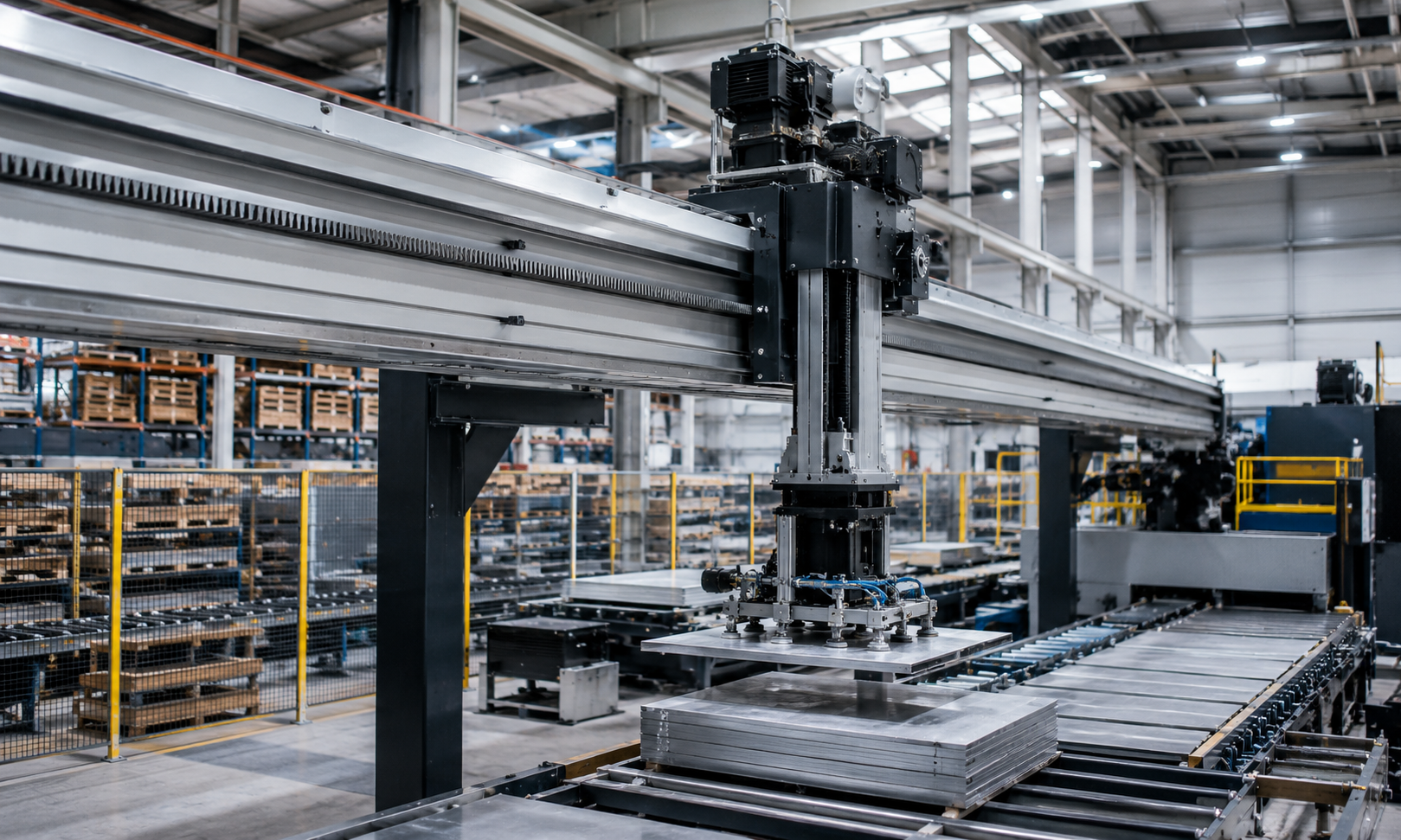
Gantry robots are one of the most common gear rack linear module applications. A typical gantry robot consists of two supporting columns, one or more horizontal beams and multiple linear axes arranged in X, Y and Z directions.
The main horizontal axis may need to travel across an entire production line or machine bed. Arack and pinion modulefor gantry robots can provide the long stroke, high speed and heavy load capacity required to move crossbeams, lifting mechanisms, grippers or processing tools.
In large dual-drive gantry systems, gear rack modules can be installed on both sides of the structure. Two servo motors are electronically synchronized to prevent skewing and maintain stable movement of the crossbeam.
Typical gantry robot operations include:
- Loading and unloading large workpieces
- Moving parts between production stations
- Handling steel plates, aluminum profiles and structural components
- Transferring molds, pallets and containers
- Performing automated assembly or processing operations
2. Machine Tending
Automated machine tending systems use linear motion equipment to load raw materials into CNC machines and remove finished parts after machining. When several machines are installed in a row, the handling axis may need to travel over a long distance.
A gear rack linear module can carry a robotic arm, gripper or lifting unit along the front of multiple CNC machines. Its scalable stroke allows a single handling system to serve several machining centers, lathes or inspection stations.
Compared with using an individual robot for every machine, a long-stroke linear axis can reduce equipment duplication and simplify material flow across the production cell.
3. Material Handling
Material handling equipment often requires heavy loads to be transported quickly and repeatedly between workstations. A heavy load linear axis for material handling may carry fixtures, mechanical grippers, vacuum lifting devices, trays, containers or large components.
Gear rack linear modules are suitable for these tasks because the drive system can be configured for both long travel and high drive force. The rack can be mounted along an aluminum profile, steel beam or machine frame, depending on the required payload and rigidity.
Common material handling applications include:
- Transferring components between assembly stations
- Moving batteries, motors and automotive parts
- Handling metal sheets and profiles
- Transporting cartons, crates and industrial containers
- Feeding production and packaging equipment
4. Welding Automation
Automated welding systems require stable motion, controlled speed and sufficient rigidity to carry welding torches, positioners, extraction equipment or workpiece fixtures. Gear rack modules can be used to move the welding head along long seams or reposition heavy components during the welding process.
In robotic welding cells, the linear module may function as an external axis that extends the working range of the robot. This allows one robot to process longer workpieces or access multiple welding stations without requiring a larger robotic arm.
Protective covers, lubrication systems and suitable sealing structures should be considered because welding environments may contain metal dust, sparks and heat.
5. Laser Processing
Laser processing machines often require high-speed movement over long working areas. A long stroke actuator for laser cutting can move the cutting head, crossbeam or material platform across large metal sheets and profiles.
Gear rack linear modules are commonly used in laser cutting systems because they can maintain high linear speed over several meters of travel. Compared with long ball screws, the rack and pinion transmission is less affected by shaft whip and critical rotational speed.
Precision-ground or accurately machined racks, suitable gearboxes and servo control systems can help improve positioning performance for laser cutting, laser welding and laser marking equipment.
6. Large-Format Cutting
Large-format cutting machines process materials such as sheet metal, wood, plastic panels, composite boards, stone and insulation materials. These machines may have working widths and lengths of several meters.
A rack driven linear axis can move the cutting gantry along the machine bed while maintaining stable travel over the entire processing area. The modular rack design also makes it easier to manufacture machines with different working lengths using a standardized mechanical platform.
Typical large-format cutting equipment includes:
- Plasma cutting machines
- Flame cutting machines
- Waterjet cutting systems
- CNC routers
- Wood and panel cutting machines
- Composite material cutting systems
7. Palletizing Systems
Palletizing systems move cartons, bags, containers or finished products from conveyors to pallets. In facilities with multiple pallet positions, a long-stroke linear axis allows one palletizing robot or lifting mechanism to serve several stacking locations.
A gear rack linear module can be installed as a horizontal travel axis underneath or above the palletizing equipment. High load capacity is important because the moving assembly may include a robot, frame, gripper, cables and the product being handled.
Rack and pinion drives also support high acceleration and repeated cycles, making them suitable for continuous packaging and logistics operations.
8. Warehouse Automation
Automated warehouses use long-distance linear motion in storage, retrieval, sorting and transfer systems. Gear rack modules can move shuttles, lifting mechanisms, transfer carts and robotic handling units along storage aisles or between conveyor lines.
In warehouse automation, stroke length may extend across dozens of storage positions. Modular rack sections make it possible to build long travel systems without relying on a single rotating screw or shaft.
Applications include:
- Automated storage and retrieval systems
- Stacker crane travel axes
- Shuttle handling systems
- Sorting and distribution equipment
- Pallet transfer systems
- Multi-station picking systems
9. Heavy Equipment and Large Machinery
Heavy industrial machinery may require linear axes to move large tools, inspection devices, lifting assemblies or machine components. In these systems, structural strength and allowable moment load are critical.
A heavy duty gear rack linear module can be built with steel beams, reinforced carriages, large linear guideways and high-torque servo gearboxes. The module can then support demanding applications such as steel processing, shipbuilding, railway manufacturing, construction machinery production and large component assembly.
The final design should consider not only payload but also radial load, axial force, overturning moment, acceleration force and emergency stopping load.
10. Long-Distance Transfer Systems
Long-distance transfer is a core application of rack and pinion linear modules. The travel length can be increased by joining multiple rack sections and extending the supporting beam or guide system.
This design is suitable for production lines where components must move between distant processing stations. The moving carriage may carry a product, fixture, robot, sensor, inspection unit or lifting mechanism.
Typical long-distance transfer applications include:
- Automotive production lines
- Battery and energy storage assembly lines
- Large component manufacturing
- Packaging and distribution systems
- Multi-station inspection equipment
- Factory logistics and workpiece circulation
Application Requirements and Module Configuration
| Application | Main Requirements | Typical Configuration |
|---|---|---|
| Gantry robots | Long stroke, high load, synchronized motion | Dual-drive X axis with Y and Z axes |
| Machine tending | Multi-station access, repeatability, reliability | Long horizontal axis carrying a robot or gripper |
| Material handling | Heavy payload, high acceleration, strong rigidity | Reinforced carriage and servo gearbox |
| Welding automation | Stable speed, environmental protection, rigidity | Protected rack axis with external robot control |
| Laser processing | High speed, long travel, controlled backlash | Precision rack with servo motor and gearbox |
| Large-format cutting | Scalable machine length, consistent movement | Rack-driven gantry on parallel guideways |
| Palletizing | Repeated cycles, high load, multi-position travel | Horizontal robot travel axis |
| Warehouse automation | Long-distance travel, continuous operation | Extended rack with shuttle or lifting carriage |
How to Select a Gear Rack Linear Module for an Application
Selecting the correct module requires more than checking the nominal payload. The complete operating conditions should be evaluated before determining the rack size, pinion diameter, gearbox ratio, guideway size and motor power.
Travel Length
Determine the effective stroke, total module length and required clearance at both ends. Long systems may require segmented racks, intermediate supports and careful alignment during installation.
Payload and Moment Load
Calculate the total moving mass, including the workpiece, carriage, tooling, motor, cable carrier and auxiliary equipment. The center of gravity should also be considered because offset loads generate pitch, yaw and roll moments.
Speed and Acceleration
The selected motor, gearbox, pinion and rack must provide sufficient torque for the required speed and acceleration. High acceleration increases inertial force and may require a larger drive system even when the static payload is moderate.
Positioning Accuracy
Positioning accuracy depends on rack precision, gear quality, backlash, gearbox performance, guideway installation and servo tuning. Applications requiring tighter accuracy may use precision-ground racks, preloaded pinions or closed-loop position feedback.
Installation Environment
Dust, metal chips, moisture, welding sparks and temperature variations can affect service life. Protective bellows, covers, automatic lubrication and corrosion-resistant components may be required for harsh operating conditions.
Duty Cycle
Continuous production systems should be evaluated for operating hours, cycle frequency, acceleration rate and lubrication intervals. Motors and gearboxes must be sized for both peak torque and continuous thermal load.
Single-Drive and Dual-Drive Systems
A single-drive gear rack module uses one motor and pinion to move the carriage along the rack. It is commonly used for standard horizontal axes and machines with moderate width.
A dual-drive system uses two synchronized drive units, usually installed on opposite sides of a wide gantry. This configuration improves force distribution and reduces the risk of crossbeam twisting. Electronic synchronization and alignment control are essential to prevent racking between the two sides.
Maintenance Considerations
Regular maintenance helps maintain reliable operation and reduce transmission wear. Typical maintenance tasks include:
- Inspecting rack and pinion tooth contact
- Checking gearbox and motor mounting bolts
- Lubricating the rack, pinion and linear guideways
- Monitoring backlash and abnormal noise
- Cleaning dust, chips and process contaminants
- Checking cable carriers, sensors and limit switches
- Verifying alignment in long or dual-drive systems
Lubrication type and maintenance intervals should be determined according to operating speed, load, environment and manufacturer recommendations.
Conclusion
Gear rack linear modules are an effective solution for industrial machines that require long travel, heavy load capacity, high speed and scalable mechanical design. Their ability to extend stroke through modular rack sections makes them particularly suitable for gantry robots, machine tending, material handling, welding automation, laser processing, large-format cutting, palletizing, warehouse automation and long-distance transfer systems.
For reliable system performance, the module should be selected according to travel length, payload, moment load, speed, acceleration, accuracy, duty cycle and environmental conditions. A properly configured rack and pinion actuator can provide stable and efficient linear motion across a wide range of heavy-duty automation applications.
Frequently Asked Questions
What applications are gear rack linear modules best suited for?
They are best suited for long-stroke, high-speed and heavy-load applications such as gantry robots, material handling systems, laser cutting machines, palletizing equipment and warehouse automation.
Can a gear rack linear module be used for very long travel?
Yes. Multiple rack sections can be joined to create an extended travel axis. The supporting structure and linear guideways must also be designed and aligned for the total stroke.
Are gear rack modules suitable for precision applications?
Yes, but the achievable accuracy depends on rack grade, pinion quality, backlash control, gearbox precision, guideway installation and feedback system. Precision racks and preloaded drive arrangements can improve positioning performance.
Why are gear rack drives used in gantry robots?
They provide long travel, high speed, heavy load capacity and flexible dual-drive configurations, making them suitable for moving wide gantry beams and large robotic assemblies.
Can gear rack linear modules operate vertically?
Yes. Vertical applications require sufficient motor torque, a suitable gearbox ratio and a braking or holding mechanism to prevent the load from falling during power loss.