 English

Atiming belt linear moduleand a servoelectric cylindercan both create programmable linear motion, but they are designed around different mechanical priorities. A belt-driven stage is usually optimized for long travel, high speed and repeated positioning, while an electric cylinder is usually optimized for compact thrust generation, pushing, pressing, lifting or replacing pneumatic and hydraulic cylinders.
This means the right choice is rarely “which actuator is better?” The more useful question is whether the application is dominated by travel and speed, or by thrust and axial stiffness.
This guide compares atiming belt module vs electric cylinderacross speed, stroke, load, thrust, accuracy, rigidity, installation, maintenance, lifecycle and cost, then provides practical selection guidance for common automation tasks.
Quick Answer: When Should You Choose Each?
| Application Priority | Timing Belt Linear Module | Servo Electric Cylinder |
|---|---|---|
| Long travel | Usually stronger | Often less economical as stroke increases |
| High linear speed | Usually stronger | Depends on screw lead and motor speed |
| High axial thrust | Moderate | Usually stronger |
| High axial stiffness | Lower because of belt elasticity | Usually higher with screw drive |
| Pressing / pushing | Not usually the first choice | Often well suited |
| Pick and place | Often well suited | Possible for shorter strokes |
| Long-axis gantry motion | Well suited | Usually less practical |
| Replace pneumatic cylinder | Possible but often unnecessarily complex | Very common use case |
Rule of thumb:choose the timing belt module when the axis mainly needs to move something quickly over distance. Choose the electric cylinder when the axis mainly needs to generate controlled axial force over a shorter stroke.
What Is a Timing Belt Linear Module?
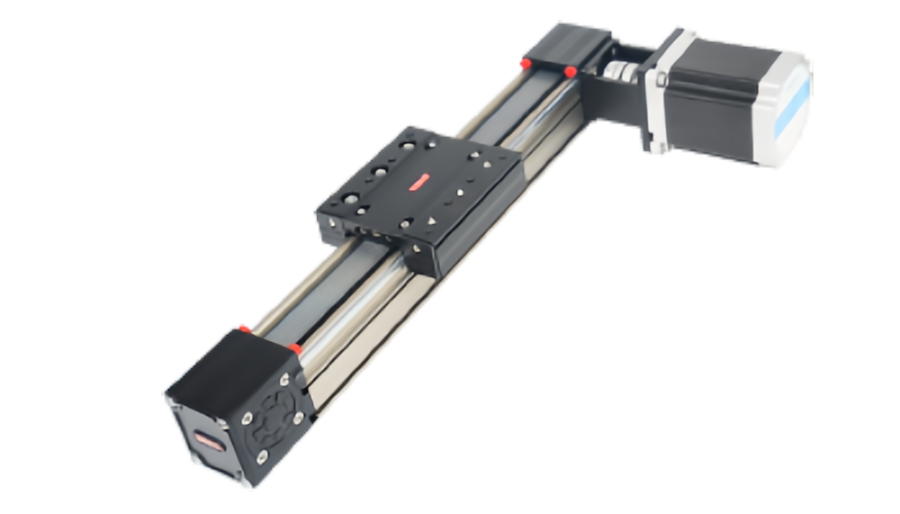
A timing belt linear module uses a toothed belt and pulleys to convert rotary motor motion into carriage travel along a linear guide.
Its key characteristics usually include:
- Long travel capability
- High linear speed
- Low moving inertia
- Fast reversing
- Easy XY, XZ and XYZ integration
- Good repeatability for automation
The belt provides drive force while the linear guide carries the payload and controls straight-line motion.
What Is a Servo Electric Cylinder?
A servo electric cylinder usually combines a servo motor, screw mechanism, bearings and rod or guided output structure to produce controlled linear extension and retraction.
It is often used where a machine needs programmable stroke, force and speed in a compact cylinder-like form.
Typical applications include:
- Pressing
- Clamping
- Lifting
- Pushing
- Insertion
- Position-controlled replacement of pneumatic cylinders
The Mechanical Difference Explains Most of the Performance Difference
The timing belt module transmits motion through a flexible belt. The electric cylinder usually transmits motion through a screw and nut.
This creates a fundamental trade-off:
- Belt drive:favors speed, long stroke and low moving mass.
- Screw-driven cylinder:favors thrust, axial stiffness and controlled force.
Many of the later differences in accuracy, lifecycle and cost come from this basic mechanical architecture.
Speed Comparison
Timing belt modules are generally strong in high-speed transfer because the belt can circulate around pulleys without requiring a long screw shaft to rotate at high rpm.
This makes them attractive for:
- Pick and place
- Tray transfer
- Packaging
- Long-axis material handling
- Fast gantry motion
Electric cylinder speed is often more constrained by screw lead, screw critical speed, nut limits and motor rpm.
Short stroke changes the comparison
On a very short stroke, the cylinder may still achieve excellent cycle time because it does not need to reach the extreme speeds associated with long transfer axes.
Therefore, maximum speed should be compared together with actual move distance and acceleration.
Acceleration and Cycle Time
A light belt carriage can accelerate quickly, which is valuable for repeated indexing and pick-and-place cycles.
Electric cylinders can also accelerate rapidly, but the moving screw, nut, rod and motor inertia may become more important depending on architecture.
For short cycles, compare:
- Acceleration time
- Constant-speed time
- Deceleration time
- Settling time
- Process dwell time
Cycle-time rule:do not compare only catalog maximum speed. The faster actuator is the one that completes the entire move-and-process cycle sooner.
Stroke Comparison
Timing belt modules are usually easier to scale to long travel.
This is one of their main advantages because:
- The belt itself can span long distances.
- The system does not rely on a long rotating screw.
- Long gantry structures are relatively straightforward.
Electric cylinders are generally more compact in shorter strokes, but very long screw strokes can become heavier and more difficult to package.
Thrust Comparison
Electric cylinders are often the stronger choice when the process requires substantial axial force.
Screw transmission can convert motor torque into high linear thrust efficiently, making it suitable for:
- Press fitting
- Clamping
- Forming or compression
- Heavy pushing
- Controlled lifting
Timing belt modules can also produce useful thrust, but belt tooth capacity, belt tensile load, pulley size and belt stiffness become limiting factors sooner in many high-force applications.
Payload Is Not the Same as Thrust
A timing belt module can support a substantial payload because its linear guide carries the load, while the belt only provides motion.
An electric cylinder may generate high thrust but still require external guidance if the load produces large side or moment forces.
This means:
- Timing belt module payload depends strongly on guide capacity and moments.
- Electric cylinder thrust depends strongly on screw and motor capacity.
- Side loading must be checked separately for both.
Accuracy and Repeatability
Both actuator types can be used for precise positioning, but their error mechanisms differ.
Timing belt module
Accuracy is influenced by:
- Belt elasticity
- Belt pitch variation
- Pulley pitch diameter
- Tension
- Load variation
- Feedback location
Electric cylinder
Accuracy is influenced by:
- Screw lead error
- Backlash or preload
- Bearing support
- Thermal growth
- Encoder and control resolution
For high absolute positioning under changing load, a screw-driven cylinder often has a stiffness advantage. For high-speed taught-position automation, a belt stage may provide excellent practical repeatability.
Which Has Better Repeatability?
There is no universal winner because repeatability depends on the actual product design.
A properly tensioned belt module with stable load can repeat very well. A preloaded screw cylinder can also provide excellent repeatability.
The correct comparison should use actual manufacturer data under comparable conditions, including:
- Stroke
- Payload
- Approach direction
- Temperature
- Feedback system
Rigidity and Compliance
Electric cylinders generally provide higher axial stiffness because the force path is through a screw and mechanical structure rather than a long elastic belt.
This matters in:
- Pressing
- Insertion
- Clamping
- Machining support
- Force-sensitive assembly
Timing belt modules have more transmission compliance, especially on long strokes.
That does not make them unsuitable for automation; it simply means they are better matched to motion tasks than high-stiffness force tasks.
Force Control
Servo electric cylinders are often used in applications where the controller must regulate or monitor thrust.
Motor torque can be used as an indirect force estimate, and some systems include dedicated load cells for more accurate force control.
Timing belt modules can also apply force, but belt elasticity and long force paths make them less natural for high-precision pressing or force-control applications.
Vertical Axis Performance
Both actuator types can operate vertically, but the design considerations differ.
Timing belt vertical axis
Check:
- Continuous belt load
- Motor torque against gravity
- Brake requirements
- Belt tension
- Anti-fall strategy
Electric cylinder vertical axis
Check:
- Screw backdrivability
- Motor brake
- Static holding requirement
- Vertical duty cycle
- Safety against uncontrolled descent
Neither system should rely on motor torque alone where load drop creates a safety hazard.
Installation Space
Electric cylinders are often very compact in cross-section and can fit naturally where a pneumatic cylinder would normally be installed.
Timing belt modules generally require a guide beam along the complete travel length, plus carriage and pulley space.
This makes:
- Electric cylinder:strong for compact push-pull motion.
- Belt module:strong for guided travel across a machine frame.
Rod-Type vs Guided Motion
Many electric cylinders use a rod output and are primarily designed to carry axial load.
If the application has large side forces or moments, external linear guides may be required.
A timing belt linear module already includes linear guidance in the carriage structure, which makes it convenient for moving plates, tools and fixtures directly.
This difference can affect total system cost.
Multi-Axis Integration
Timing belt modules are especially convenient for XY, XZ, XYZ and gantry systems.
Examples include:
- Pick-and-place robots
- Cartesian automation
- Large transfer gantries
- Vision positioning systems
Electric cylinders are more commonly used as individual push, lift or clamp axes inside a larger machine.
They can be combined into multi-axis systems, but their cylinder-style architecture is usually less natural for long Cartesian travel.
Noise and Vibration
Timing belt modules can run quietly when correctly tensioned and aligned, but belt vibration and pulley noise may increase at high acceleration.
Electric cylinders can generate screw and ball recirculation noise, particularly at high speed.
Actual noise depends heavily on:
- Speed
- Preload
- Lubrication
- Structure resonance
- Motor control
Neither technology should be assumed quieter without comparing actual operating conditions.
Maintenance Comparison
| Maintenance Area | Timing Belt Module | Electric Cylinder |
|---|---|---|
| Primary transmission | Belt condition and tension | Screw lubrication and wear |
| Guide lubrication | Usually required | Depends on cylinder and external guide design |
| Alignment checks | Belt/pulley and guide alignment | Screw, rod and load alignment |
| Typical wear item | Timing belt | Screw/nut, seals, support bearings depending on design |
Lifecycle Comparison
Neither technology has one universal service life.
Timing belt module life can be limited by:
- Belt fatigue
- Tooth wear
- Guide wear
- Pulley bearing life
- Contamination
Electric cylinder life can be limited by:
- Ball screw or lead screw fatigue
- Nut wear
- Support bearings
- Rod seals or guides
- Lubrication condition
The correct lifecycle comparison should use actual load spectrum, speed, stroke, duty cycle and maintenance conditions.
Cost Comparison
Initial price depends on size, stroke, motor, controller, feedback and accessories.
In general:
- Timing belt modules can be cost-effective for long travel and multi-axis structures.
- Electric cylinders can be cost-effective when replacing pneumatic cylinders or delivering high force in a compact space.
But purchase price is only one part of cost.
Total Cost of Ownership
Compare:
- Actuator price
- Motor and drive
- External guides if needed
- Machine frame requirements
- Installation labor
- Energy use
- Maintenance
- Spare parts
- Downtime
An electric cylinder may look more expensive than a belt axis until the belt axis requires additional mechanics for pushing or holding. A belt module may look more expensive than a cylinder until a long external guide structure is added to the cylinder.
Energy Efficiency
Both technologies can be more energy-efficient than continuously supplied pneumatic systems because electric motors consume most power when producing motion or holding load.
Actual efficiency depends on:
- Motor efficiency
- Gearbox if used
- Belt or screw transmission efficiency
- Duty cycle
- Vertical holding strategy
Do not compare energy use from actuator type alone.
Safety and Holding
Electric cylinders can sometimes hold position through screw friction or motor brake, depending on screw design, but this should never be assumed without checking the actual mechanism.
Timing belt axes are generally backdrivable and require an appropriate brake or mechanical holding strategy when gravity or external force can move the axis.
For safety-critical holding, both systems need machine-level risk assessment.
Environmental Considerations
Timing belt module
Dust, oil, chips and chemicals can affect the belt, guide and pulleys. Enclosed versions can improve protection.
Electric cylinder
Rod seals, screw protection and enclosure design influence resistance to contamination.
For harsh environments, compare actual sealing and material specifications rather than assuming one actuator type is automatically better.
Which Is Better for Pick and Place?
For long-stroke, high-speed pick and place, the timing belt module is usually the more natural choice.
Reasons include:
- High travel speed
- Long stroke
- Low moving inertia
- Easy XY and XYZ integration
Electric cylinders can still be excellent for the Z pressing, lifting or insertion axis within the same machine.
Mixed-drive systems are often best.A machine can use timing belt axes for X/Y travel and an electric cylinder for Z pressing or clamping.
Which Is Better for Pressing?
For controlled pressing, insertion and clamping, the electric cylinder usually has the advantage because:
- Axial stiffness is higher.
- High thrust is easier to achieve.
- Force-control integration is more natural.
- Compact push-pull geometry fits the process.
A timing belt stage can move a press head into position, but it is not usually the first choice for generating the press force itself.
Which Is Better for Long Travel?
Timing belt modules usually win when stroke becomes long.
The belt can span long distances without the critical-speed limitations of a long screw, which is especially useful for:
- Long machine rails
- Packaging
- Warehouse automation
- Gantry systems
- Large-format handling
Which Is Better for Precision?
The answer depends on the definition of precision.
For high repeatability in taught-position handling, a timing belt stage can perform very well.
For high axial stiffness and tighter absolute position under changing force, a preloaded screw-driven electric cylinder often has an advantage.
For very high precision, direct linear feedback may be needed regardless of actuator type.
Selection Matrix
| Requirement | Usually Favor |
|---|---|
| Long stroke + high speed | Timing belt module |
| High thrust + short stroke | Electric cylinder |
| XY / XYZ Cartesian motion | Timing belt module |
| Pressing / insertion | Electric cylinder |
| High-speed transfer | Timing belt module |
| Pneumatic-cylinder replacement | Electric cylinder |
| Large guided fixture movement | Timing belt module |
| Compact force axis | Electric cylinder |
A Practical Selection Process
- Define the job.Is the axis mainly moving, positioning, pressing, lifting or clamping?
- Define stroke.
- Define maximum speed and acceleration.
- Calculate required thrust.
- Calculate payload and moment loads.
- Define repeatability and absolute accuracy separately.
- Check required axial stiffness.
- Check available installation space.
- Determine whether external guidance is needed.
- Review vertical holding and safety.
- Compare maintenance and lifecycle.
- Compare total system cost, not actuator price only.
What QRXQ Needs to Recommend Between the Two
- Required stroke
- Moving mass
- Required thrust
- Maximum speed
- Acceleration
- Horizontal or vertical installation
- Repeatability and accuracy requirements
- Pressing or force-control requirements
- Available installation space
- Single-axis or multi-axis structure
- Daily cycle count
- Working environment
The selection comes down to the dominant job of the axis.If the machine needs fast guided travel, timing belt modules are usually the stronger starting point. If it needs compact, controlled axial force, servo electric cylinders are usually the stronger starting point.
QRXQ evaluates both technologies from the complete machine requirement and may recommend a mixed architecture when different axes have different jobs—for example, timing belt X/Y travel combined with an electric-cylinder Z press axis.