 English

Linear modulesand linear motors are both widely used to create controlled linear motion in industrial automation systems. They can be found in assembly equipment, semiconductor machinery, packaging lines, inspection systems, laser processing machines, material handling equipment and multi-axis positioning platforms.
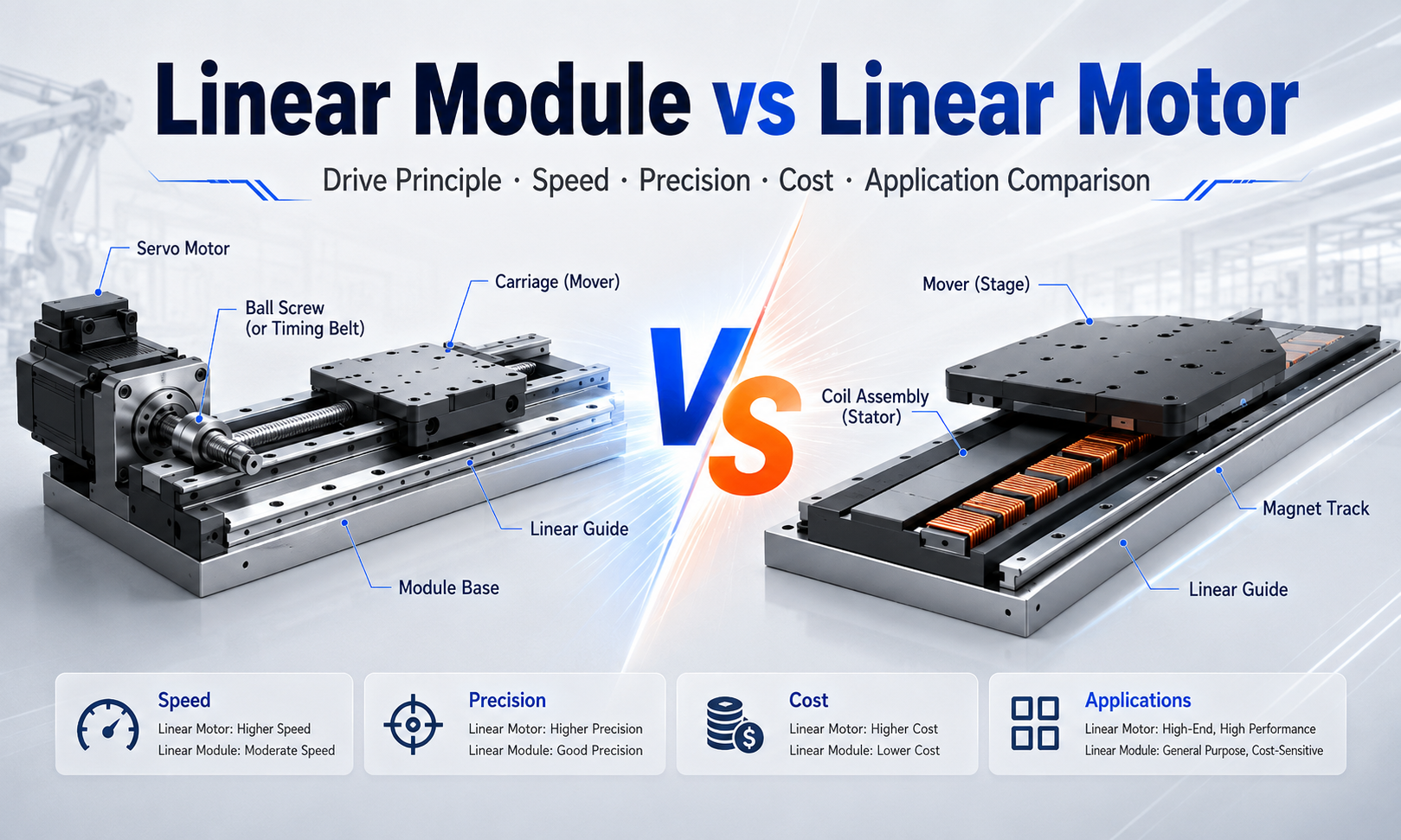
Although the two technologies can perform similar motion tasks, their internal drive principles, speed limits, positioning performance, maintenance requirements and overall costs are significantly different. A conventionallinear modulenormally uses a rotary motor combined with a ball screw, timing belt or rack-and-pinion transmission. Alinear motor, by contrast, generates linear force directly through electromagnetic interaction without requiring a mechanical transmission mechanism.
It is important to note that a linear motor can also be integrated into a complete linear motor module. In this article, the term “linear module” mainly refers to conventional mechanically driven modules, while “linear motor” refers to a direct-drive linear motion system.
This guide compareslinear modules vs linear motorsin terms of working principle, speed, acceleration, precision, stroke, load capacity, maintenance, energy consumption, cost and suitable industrial applications.
What Is a Conventional Linear Module?
A conventional linear module is an integrated motion unit that converts the rotary motion of a servo motor or stepper motor into controlled linear movement. The module usually includes a base profile, linear guide rails, guide blocks, a moving carriage, drive components, bearings, sensors and a motor mounting structure.
Depending on the transmission method, conventional linear modules can be divided into several main types:
- Ball screw linear modules:Use a rotating ball screw and ball nut to generate precise linear movement.
- Timing belt linear modules:Use a toothed timing belt and pulley system for high-speed, long-stroke motion.
- Rack-and-pinion linear modules:Use gear meshing to support long travel distances and heavy-duty applications.
- Lead screw linear modules:Use sliding screw transmission for economical, lower-speed positioning tasks.
In these systems, the motor does not directly move the carriage in a straight line. Instead, the motor first produces rotational motion, which is then converted into linear motion by the mechanical transmission.
What Is a Linear Motor?
A linear motor is an electromagnetic actuator that produces linear motion directly. It can be understood as a conventional rotary motor that has been opened and laid flat. Instead of generating torque around a rotating shaft, it produces thrust along a straight travel path.
A typical linear motor system includes:
- A primary electromagnetic coil assembly
- A secondary magnet track or reaction plate
- High-precision linear guide rails
- A linear encoder or position feedback system
- A servo drive andmotion controller
- A machine base or structural support
When current passes through the coils, the electromagnetic field interacts with the permanent magnet track and generates linear thrust. Because the force is applied directly to the moving component, no ball screw, timing belt, pulley, gearbox or rack-and-pinion mechanism is required.
This direct-drive structure reduces mechanical transmission errors and allows the system to achieve very high speed, acceleration and motion responsiveness.
Linear Module vs Linear Motor: Main Difference
The fundamental difference between a conventional linear module and a linear motor is how driving force is transferred to the moving carriage.
A conventional linear module follows this motion chain:
Rotary motor → coupling or pulley → screw, belt or rack transmission → moving carriage
A linear motor follows a much shorter motion chain:
Electromagnetic force → moving carriage
The mechanical transmission used in a conventional module can provide force multiplication, structural simplicity and relatively low cost. However, it may also introduce backlash, elasticity, friction, wear and speed limitations.
A direct-drive linear motor eliminates most transmission-related limitations, but it requires more advanced feedback control, better cooling, stronger machine construction and a larger initial investment.
Linear Module vs Linear Motor Comparison
| Comparison Factor | Conventional Linear Module | Linear Motor System |
|---|---|---|
| Drive principle | Rotary motor with screw, belt or rack transmission | Direct electromagnetic linear drive |
| Mechanical transmission | Required | Not required |
| Maximum speed | Moderate to high depending on transmission | Very high |
| Acceleration | Limited by rotating and transmission components | Extremely high |
| Positioning accuracy | Good to high, especially with ball screws | Very high with precision encoder feedback |
| Repeatability | Good, but affected by backlash and wear | Excellent |
| Backlash | Possible depending on transmission | No mechanical transmission backlash |
| Stroke capability | Short to very long depending on module type | Can be extended through magnet track sections |
| Load capability | Suitable for light to heavy loads | Depends on motor thrust and guide structure |
| Maintenance | Requires inspection and lubrication of transmission parts | Low transmission maintenance |
| Cooling requirement | Usually limited | May require air or liquid cooling |
| Control complexity | Relatively straightforward | More demanding servo tuning and feedback control |
| Initial cost | Low to moderate | High |
| Typical applications | General automation and cost-sensitive equipment | High-speed, high-dynamic and ultra-precision systems |
Difference in Drive Principle
Mechanical Transmission in Linear Modules
Conventional linear modules depend on a mechanical transmission component to convert motor rotation into linear movement.
In aball screw module, the motor rotates the screw shaft. The ball nut moves along the screw and carries the worktable. The circulating balls reduce friction and allow accurate positioning.
In atiming belt module, the motor turns a drive pulley. The timing belt circulates between the drive pulley and idler pulley, pulling the carriage along the guide rail.
In a rack-and-pinion module, the motor rotates a pinion gear that meshes with a fixed or moving gear rack. The gear engagement generates long-stroke linear movement.
Each mechanical transmission has different characteristics. Ball screws provide precision and thrust, timing belts provide speed and long travel, while rack-and-pinion systems provide long stroke and heavy-load capability.
Direct Drive in Linear Motors
A linear motor produces thrust directly between the coil assembly and magnet track. There is no intermediate transmission mechanism between the electromagnetic force and the moving carriage.
This direct-drive arrangement provides several important advantages:
- No screw lead error
- No belt stretching
- No gear backlash
- No coupling torsional deformation
- No transmission friction reversal
- Faster response to control commands
However, the motor does not provide mechanical reduction. The linear motor must generate the required thrust directly, which can increase motor size, current demand, heat generation and system cost.
Speed and Acceleration Comparison
Speed of Conventional Linear Modules
The achievable speed of a conventional linear module depends heavily on the transmission type.
Ball screw modules are limited by screw rotational speed, critical speed, shaft diameter, screw lead and stroke length. As the travel length increases, the risk of screw vibration and whipping also increases. High-lead ball screws can provide faster movement, but they may reduce mechanical resolution and available thrust.
Timing belt modules are generally faster than ball screw modules and are well suited to long-stroke movement. They do not have the same critical-speed limitation as long rotating screws. However, belt elasticity, pulley speed, belt strength and carriage stability still limit maximum performance.
Rack-and-pinion modules can support high speed over very long travel distances, but gear meshing quality, gearbox performance, lubrication and structural vibration must be carefully controlled.
Speed of Linear Motors
Linear motors are especially suitable for applications requiring very high travel speed and acceleration. Because there are no rotating screws, belts, pulleys or gearboxes, the system has less transmission inertia and can respond more quickly to servo commands.
The actual maximum speed is usually limited by factors such as:
- Linear encoder reading frequency
- Servo drive capacity
- Available travel length
- Cable management
- Guide rail performance
- Machine vibration
- Heat generation
- Required settling time
A high maximum speed alone does not guarantee higher machine productivity. The system must also accelerate, decelerate and settle accurately within the available travel distance. Linear motors are particularly valuable in short-cycle machines where rapid acceleration and fast settling directly reduce cycle time.
Precision and Repeatability Comparison
Accuracy of Conventional Linear Modules
The positioning accuracy of a conventional linear module is affected by several mechanical factors:
- Ball screw lead accuracy
- Transmission backlash
- Belt elasticity
- Gear meshing error
- Coupling deformation
- Bearing clearance
- Guide rail straightness
- Thermal expansion
- Assembly alignment
Preloaded ball screw modules can achieve high positioning accuracy and repeatability. For many industrial automation applications, their performance is more than sufficient.
However, repeated acceleration, load changes, lubrication conditions and long-term wear can gradually influence transmission accuracy. Error compensation can improve positioning performance, but the mechanical transmission remains part of the motion chain.
Accuracy of Linear Motors
A linear motor does not rely on screw pitch or belt movement to determine position. The actual carriage position is measured directly by a linear encoder, and the servo system continuously corrects the motion based on encoder feedback.
This closed-loop direct measurement allows linear motor systems to achieve excellent positioning accuracy, repeatability and contouring performance.
Nevertheless, overall accuracy still depends on more than the motor itself. Important factors include:
- Encoder resolution and accuracy
- Guide rail precision
- Machine base flatness
- Thermal stability
- Servo tuning
- Cable force
- External vibration
- Environmental temperature
A linear motor installed on an unstable or thermally distorted machine structure will not automatically provide ultra-high accuracy. Mechanical design, feedback performance and environmental control must work together.
Backlash and Mechanical Compliance
Backlash is the lost motion that can occur when the direction of movement changes. It is especially important in applications involving frequent forward and reverse positioning.
Conventional mechanical transmissions may experience different forms of lost motion:
- Clearance between screw and nut
- Elastic deformation of a timing belt
- Gear tooth backlash
- Coupling torsional deformation
- Bearing and support clearance
Preloading can significantly reduce backlash in ball screws and gear systems, but it may increase friction, heat and component stress.
A linear motor does not have transmission backlash because no mechanical conversion mechanism is used. Direction changes can therefore be faster and more consistent. However, the machine structure and guide system can still deform under load, so the entire axis should not be considered perfectly rigid.
Load and Thrust Capability
Thrust of Conventional Linear Modules
Ball screw modules are highly effective when large axial thrust is required at moderate speeds. The screw lead acts as a mechanical transmission ratio, allowing motor torque to be converted into substantial linear force.
Rack-and-pinion systems are also suitable for heavy loads and long travel, especially when combined with a planetary gearbox.
Timing belt modules are typically selected for light to medium loads, although larger belt widths and reinforced structures can support higher payloads.
Thrust of Linear Motors
A linear motor must generate thrust directly. It does not benefit from screw lead or gearbox reduction. Therefore, continuous thrust, peak thrust, duty cycle and heat dissipation must be carefully calculated.
Linear motors can provide high peak force for rapid acceleration, but continuous force may be limited by coil temperature. Applications with heavy loads, vertical movement or long holding periods may require a larger motor, cooling system, brake or counterbalance mechanism.
For vertical axes, a conventional ball screw can sometimes be more practical because the screw transmission helps support the load. A linear motor vertical axis may need an additional brake, pneumatic balance cylinder or counterweight to prevent uncontrolled movement when power is removed.
Stroke Length and Long-Travel Performance
Conventional linear modules and linear motors can both be designed for long travel, but they achieve it in different ways.
Ball screw modules become more difficult to operate at high speed as the screw length increases. Long screws require larger diameters, additional support or rotating-nut designs to control vibration.
Timing belt modules are commonly used for long travel because the belt can span a large distance without the critical-speed limitations of a rotating screw.
Rack-and-pinion modules are especially suitable for very long axes because rack sections can be connected along the machine frame.
Linear motor travel can also be extended by installing multiple magnet track sections. However, longer travel increases the cost of the magnet track, encoder scale, cable system, machine base and protective structure.
For extremely long, cost-sensitive travel, a timing belt or rack-and-pinion module may be more economical. For long travel combined with very high speed and dynamic performance, a linear motor may justify the higher investment.
Maintenance Requirements
Maintenance of Conventional Linear Modules
Conventional linear modules contain transmission components that require periodic inspection and maintenance. Depending on the module type, maintenance tasks may include:
- Lubricating the ball screw and linear guide
- Checking timing belt tension
- Inspecting belt tooth wear
- Checking pulley alignment
- Lubricating rack-and-pinion engagement
- Inspecting gearbox backlash
- Checking couplings and bearings
- Cleaning protective covers
- Verifying sensor positions
Over time, screws, nuts, belts, gears, bearings and couplings may wear and require adjustment or replacement.
Maintenance of Linear Motors
A linear motor has fewer transmission components, which reduces mechanical maintenance. There is no ball screw to lubricate, no belt to tension and no gear pair to adjust.
However, the complete linear motor axis still requires maintenance. Engineers must inspect:
- Linear guide lubrication
- Encoder cleanliness and alignment
- Cooling system condition
- Cable carrier wear
- Protective cover integrity
- Magnet track contamination
- Fastener tightness
- Servo alarms and temperature records
Linear motor magnet tracks can attract ferromagnetic particles. In machining, grinding or metal-processing environments, effective sealing and protective covers are especially important.
Heat Generation and Cooling
Heat management is one of the most important design considerations for linear motors.
Because the electromagnetic coils generate thrust directly, electrical losses create heat close to the moving axis and machine structure. If heat is not controlled, it can cause thermal expansion, encoder drift, structural deformation and reduced positioning accuracy.
High-performance linear motor systems may use forced-air cooling or liquid cooling to maintain stable coil temperature.
Conventional linear modules also generate heat through the motor, bearings, screw friction, nut preload, gearbox and guide system. However, the heat source can often be positioned farther from the precision working area, and the cooling requirements are usually less demanding.
In precision equipment, thermal behavior should be evaluated for both technologies rather than considering only nominal positioning specifications.
Energy Consumption and Efficiency
The energy efficiency comparison depends strongly on the operating cycle.
A direct-drive linear motor eliminates energy losses from screws, belts, gears and couplings. During high-speed reciprocating motion, this can provide excellent dynamic efficiency.
However, a linear motor may consume continuous current to hold a load in position, especially on a vertical axis. Cooling equipment can also increase total energy consumption.
A ball screw can convert motor torque into high linear thrust efficiently. In some holding or low-speed applications, it may require less continuous motor current. Mechanical transmission can also make it easier to maintain position under load.
Therefore, energy consumption should be evaluated using the complete duty cycle, including acceleration, constant-speed travel, deceleration, holding time, load direction and cooling requirements.
Control System and Servo Tuning
Conventional linear modules are generally easier to integrate and tune because their mechanical transmission can reduce the effect of load disturbances. Standard servo motors, stepper motors and motion controllers can be used in many applications.
Linear motors require high-performance closed-loop control. Because there is no mechanical reduction between the motor and load, force disturbances act directly on the moving carriage.
Successful linear motor control may require:
- High-resolution linear encoder feedback
- High-bandwidth servo drives
- Accurate commutation
- Careful gain tuning
- Feedforward control
- Notch filters for structural resonance
- Vibration suppression
- Thermal compensation
The machine frame must also be sufficiently rigid. Poor structural stiffness can cause resonance and make it difficult to use the full acceleration capability of the motor.
Installation and Machine Design Requirements
Conventional linear modules are usually supplied as integrated units. The guide rail, transmission, carriage and end supports are assembled and aligned by the manufacturer. This makes installation relatively straightforward.
Linear motor systems can also be supplied as complete modules, but custom-built systems require greater attention to machine design. Engineers must control:
- Magnet track straightness
- Coil-to-magnet air gap
- Guide rail parallelism
- Encoder alignment
- Machine base flatness
- Cable routing
- Cooling connections
- Magnetic attraction forces
The strong magnetic field can create handling risks during assembly. Special tools, spacers and installation procedures may be required to prevent injury or damage.
Noise and Vibration
Mechanical transmissions can generate noise from ball circulation, belt engagement, pulley rotation, gear meshing, bearings and gearbox operation.
A well-designed linear motor can operate quietly because it does not contain a screw, belt or gear transmission. However, electromagnetic force ripple, servo tuning errors, guide rail vibration and structural resonance can still generate noise.
At very high acceleration, the reaction force transmitted into the machine base can be substantial. The frame must be designed to prevent excessive vibration from affecting neighboring axes, sensors or precision processes.
Cost Comparison
Initial Equipment Cost
Conventional linear modules generally have a lower initial purchase cost. Standard ball screw and timing belt modules are produced in large quantities and can be configured using common motors, sensors and controllers.
Linear motor systems normally require:
- Linear motor coils
- Permanent magnet tracks
- High-resolution encoders
- Advanced servo drives
- Precision machine bases
- Cooling components
- Protective covers
- More complex commissioning
As a result, the initial system price is usually higher.
Total Cost of Ownership
Initial price should not be the only decision factor. In high-throughput equipment, a linear motor may reduce cycle time, increase production capacity and lower transmission maintenance. These benefits can offset the higher purchase cost.
On the other hand, using a linear motor in an application that does not require high speed or extreme precision can create unnecessary cost without improving production results.
Total cost of ownership should include:
- Initial hardware cost
- Engineering and commissioning time
- Energy consumption
- Cooling requirements
- Replacement component cost
- Preventive maintenance
- Production cycle time
- Machine downtime
- Expected service life
Advantages of Conventional Linear Modules
- Lower initial investment
- Wide range of standard sizes and configurations
- Simple integration with common motors and controllers
- High thrust capability with ball screw transmission
- Economical long-stroke solutions using belts or racks
- Easier maintenance by general mechanical technicians
- Suitable for horizontal, vertical and multi-axis systems
- Proven reliability in general industrial automation
Limitations of Conventional Linear Modules
- Mechanical transmission wear
- Possible backlash and elastic deformation
- Speed limitations for long ball screws
- Periodic lubrication or belt tension adjustment
- More transmission inertia
- Reduced response during rapid direction changes
- Accuracy can change as components wear
Advantages of Linear Motors
- Direct electromagnetic drive
- Very high travel speed
- Extremely high acceleration
- No mechanical transmission backlash
- Excellent repeatability
- Fast directional reversal
- Low transmission maintenance
- Suitable for high-throughput and precision equipment
- Flexible travel extension using multiple magnet tracks
Limitations of Linear Motors
- Higher initial cost
- Greater control and commissioning complexity
- Heat generation near the motion axis
- Possible need for liquid or air cooling
- High-resolution encoder required
- Strong machine structure required
- Magnet track can attract metal particles
- Additional safety measures needed during assembly
- Vertical axes may require a brake or counterbalance
Suitable Applications for Conventional Linear Modules
Conventional linear modules are generally the better choice for applications where standard industrial positioning performance, cost control and ease of maintenance are more important than maximum dynamic performance.
Typical applications include:
- Packaging and labeling machines
- Pick-and-place equipment
- Material loading and unloading
- General assembly automation
- Dispensing and screwdriving systems
- Warehouse transfer equipment
- Palletizing systems
- Inspection fixtures
- Welding and cutting equipment
- Cartesian robots
- Gantry handling systems
- Cost-sensitive multi-axis platforms
Suitable Applications for Linear Motors
Linear motors are most valuable when machine productivity or process quality depends on exceptional speed, acceleration, repeatability and response.
Typical applications include:
- Semiconductor wafer handling
- Electronic component placement
- High-speed optical inspection
- Precision laser processing
- PCB manufacturing equipment
- High-speed sorting systems
- Precision measurement machines
- Advanced machine tools
- High-dynamic scanning platforms
- Automated testing equipment
- Flat-panel display manufacturing
- High-throughput medical automation
How to Choose Between a Linear Module and a Linear Motor
The correct choice should be based on the actual motion requirements rather than selecting the technology with the highest specification.
Choose a Conventional Linear Module When:
- The application has a limited equipment budget.
- Moderate speed and acceleration are sufficient.
- The required positioning accuracy can be achieved by a ball screw or belt system.
- High thrust is required at moderate speed.
- The machine needs a simple and standardized axis.
- Maintenance must be performed by general technicians.
- The travel is very long and cost sensitivity is important.
- The application includes vertical lifting or static load holding.
Choose a Linear Motor When:
- Cycle time is a critical production requirement.
- Very high acceleration and rapid direction changes are required.
- Mechanical backlash cannot be accepted.
- High repeatability must be maintained over many cycles.
- The process requires smooth, high-bandwidth contouring.
- Transmission wear would create unacceptable downtime.
- The machine structure can support high dynamic reaction forces.
- The productivity improvement justifies the higher investment.
Key Selection Parameters
Before selecting either system, engineers should define the following parameters:
- Effective payload
- Required stroke
- Maximum travel speed
- Acceleration and deceleration
- Cycle time
- Positioning accuracy
- Repeatability
- Settling time
- Continuous and peak thrust
- Installation orientation
- Allowable moment load
- Duty cycle
- Environmental temperature
- Cleanroom or dust protection requirements
- Expected service life
- Maintenance capability
- Equipment budget
It is also necessary to evaluate the complete motion profile rather than considering only maximum speed or rated payload. A system may have enough nominal thrust but still fail to meet cycle time because of insufficient acceleration, excessive settling time or thermal limitations.
Can a Linear Motor Replace Every Linear Module?
No. A linear motor is not automatically the best solution for every linear motion application.
For high-speed, high-precision and high-throughput machines, direct drive can provide major performance advantages. However, for ordinary material handling, packaging, lifting, dispensing and general positioning, a conventional linear module may provide the required performance at a much lower cost.
Mechanical transmission can also be beneficial. Ball screws and gearboxes can multiply force, timing belts can provide economical long travel, and rack-and-pinion systems can support heavy loads over large working areas.
The best technology is the one that meets the required motion performance, reliability and service life without creating unnecessary complexity.
Frequently Asked Questions
Is a linear motor more accurate than a ball screw linear module?
A linear motor can achieve higher positioning accuracy and repeatability because it uses direct encoder feedback and has no mechanical transmission backlash. However, a precision ball screw module can still provide sufficient accuracy for most industrial automation applications. Actual performance depends on the encoder, guide rails, machine structure, temperature and control system.
Is a linear motor faster than a timing belt module?
Linear motors generally provide higher acceleration, faster response and better directional reversal. Timing belt modules can also achieve high travel speed and long stroke, but belt elasticity and pulley dynamics limit their ultimate performance.
Which system is better for heavy loads?
For heavy loads moving at moderate speed, a ball screw or rack-and-pinion module is often more economical because mechanical transmission can multiply force. A linear motor can move heavy loads, but the motor, drive and cooling system must be sized for the required continuous and peak thrust.
Does a linear motor require maintenance?
Yes. Although it does not require screw, belt or gear maintenance, the linear guides, encoder, cooling system, cables and protective covers still require inspection and maintenance.
Which system is better for vertical movement?
Ball screw modules are commonly used for vertical movement because they provide high thrust and can support the load efficiently. Linear motor vertical axes usually require a brake, counterbalance or safety mechanism to prevent the load from falling during power loss.
Are linear motors suitable for dusty environments?
They can be used in dusty environments when properly protected. However, permanent magnet tracks can attract metal particles, so effective sealing, covers and cleaning procedures are particularly important.
Which solution has a lower total cost?
For general automation, conventional linear modules usually have a lower total cost. For high-volume production where faster cycles significantly increase output, a linear motor may provide a better long-term return despite its higher initial price.
Conclusion
The main difference between alinear module and a linear motorlies in the transmission method. Conventional linear modules use ball screws, timing belts or rack-and-pinion mechanisms to convert rotary motor motion into linear movement. Linear motors generate linear thrust directly through electromagnetic force.
Conventional linear modules offer lower cost, high thrust, mature technology and easier integration. They are suitable for most packaging, handling, assembly, lifting and general positioning applications.
Linear motors offer higher speed, acceleration, repeatability and responsiveness with no mechanical transmission backlash. They are better suited to semiconductor equipment, precision inspection, high-speed electronics manufacturing, laser processing and other high-performance automation systems.
Neither technology is universally superior. The correct solution depends on payload, stroke, speed, acceleration, accuracy, duty cycle, environment, maintenance capability and total project budget. A careful analysis of the complete motion cycle is the most reliable way to select the appropriate industrial linear motion technology.